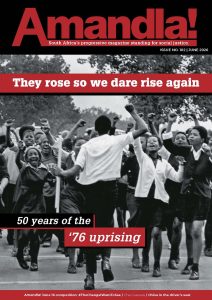

Reaching a 100th issue is no small feat in today’s fractured and financially ravaged media landscape. For a magazine rooted in critical analysis, movement-building, and the difficult work of imagining alternatives, it is even more remarkable.
The front cover of the first pilot issue of Amandla, from 2007. Amandla is rooted in critical analysis, movement-building, and the difficult work of imagining alternatives. To celebrate 100 issues is to honour that legacy. It is also to recognise the continued need for independent spaces of Left thought.
Amandla! was founded in 2007, in a moment of deep turbulence both within South Africa and globally. At home, the centralisation of power around Thabo Mbeki’s presidency had produced a technocratic, insulated ruling elite presiding over widening inequality and the entrenchment of neoliberalism. The ANC Alliance was convulsing under the weight of the arms deal scandal, while Jacob Zuma opportunistically positioned himself as a champion of the Left. This positioning masked deeper currents of factionalism and political opportunism, rather than any meaningful ideological break with the neoliberal core of the state.
It was in this context that Amandla! first appeared. Its task was ambitious: to draw together a diverse range of voices from across the South African Left—both inside and outside the Alliance—to re-open a strategic dialogue that had largely stalled. This was reflected in the composition of the Editorial Collective and Advisory Board, which brought together significant members of the different forces of the Left, including the independent and Alliance Left. The hope was that such a dialogue might give birth to something broader: a united front capable of resisting the tightening hold of neoliberal policy, as well as the narrowing of democratic space that came with the consolidation of power in Mbeki’s centralised presidency.
Globally, these were also years when the contradictions of globalised capitalism were coming to the fore; its stability was cracking. The 2007–2008 financial crisis exposed the deep structural contradictions of neoliberal capitalism. Across the world, people were beginning to question the legitimacy of the economic order that had dominated since the fall of the Soviet Union. Amandla! was able, in those early days, to offer important commentary on this crisis and its implications, not only for the global economy, but also for struggles at home. In South Africa, the effects were quickly felt in rising unemployment, service delivery failures, and the intensification of inequality.
To celebrate 100 issues is to honour that legacy of critical analysis, dialogue, and rootedness in struggle. It is also to recognise the continued need for independent spaces of Left thought and debate in South Africa today, at a moment when the crisis risks tearing the country apart, and when the political and ideological terrain is shifting in dangerous ways.
The right is on the rise
The global feature in this milestone issue reflects a stark reality: the right is on the march across continents. From the Americas to Europe to South Asia, we see the rise of reactionary forces—some traditional, some newly configured—that blend authoritarianism, xenophobia, militarism, and neoliberal economics.
South Africa is far from insulated from these global winds. Here, too, the right is surging. And though the forms it takes are varied, the cumulative threat is serious.
The old white right has never disappeared and remains a persistent danger, resurfacing in moments of crisis and drawing strength from wealth, property and global networks of capital. At its forefront today is AfriForum, with the trade union Solidarity in support. AfriForum has built strong links with the extreme right in the United States and Europe. It uses these alliances to amplify the false narrative of a “white genocide” and to pressure the South African state, while undermining transformative policies such as land reform.
Yet the influence of this white right is not confined to its overt formations. Its agenda increasingly influences the liberal bourgeois centre-right, particularly the Democratic Alliance. Although clothed in the language of constitutionalism and good governance, the DA’s economic and foreign policy positions remain not just neoliberal but outright reactionary.
Its agenda aligns with a section of South African business that sees the current crisis not as a warning about inequality and exclusion, but as an opportunity to accelerate market reforms, deregulation, and austerity. This is a right that speaks the language of efficiency, while ignoring the structural violence of hunger, unemployment, and collapsing public services.
The new right
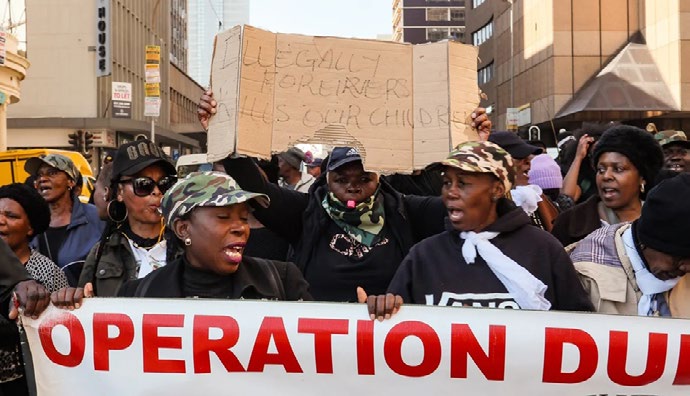
Right-wing populism presents the most immediate political threat in South Africa today. It is volatile, demagogic, and able to mobilise real despair into reactionary energy. It speaks directly to the lived misery of impoverished communities.
Alongside it, however, another, potentially more explosive, right-wing formation is rapidly maturing. It is one that thrives on the social despair, anger, and alienation generated by South Africa’s deepening crises.
In a society battered by unemployment approaching 50%, decaying infrastructure, the collapse of local government, rising costs of living, and, for many years, persistent load shedding, the ground is fertile for dangerous political currents. Populist, ethno-nationalist, and openly xenophobic groups and parties now draw significant support by exploiting precisely these conditions.
These forces scapegoat migrants for the structural failures of the state and capital. They fuse anti-immigrant rhetoric with racial and tribal narratives that fracture working-class unity and redirect anger towards the most vulnerable. And they do so with growing organisational sophistication, buoyed, in part, by flows of money and ideological support from sections of the global right, who see South Africa as another frontline in a worldwide culture war.
This right-wing populism presents the most immediate political threat in South Africa today. It is volatile, demagogic, and able to mobilise real despair into reactionary energy. It speaks directly to the lived misery of impoverished communities, but channels that suffering away from the actual sources of crisis—neoliberal austerity, corporate power, elite corruption, and the ANC’s historic failure to transform the economy—and towards migrants, minorities, and invented enemies.
In doing so, it has driven a wedge between the Left and the very communities whose interests it seeks to champion.
Weakness of the Left
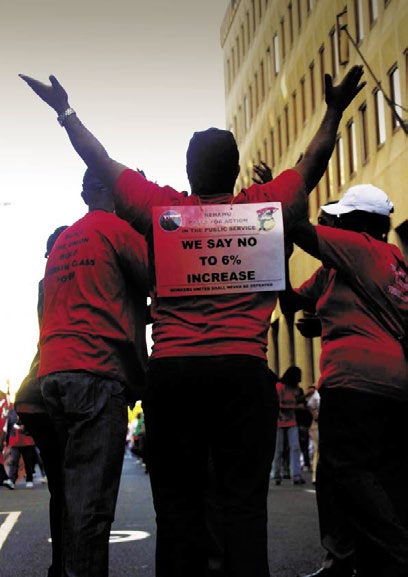
The tragedy is that the South African Left is entering this dangerous period weakened and fragmented. Years of organisational erosion, ideological drift, and strategic confusion have taken a toll. Trade unions remain crucial but are divided. Social movements that once led powerful local struggles have, in many places, lost organisational capacity or dissolved under pressure. Emerging formations have struggled to gain traction or build durable structures.
Meanwhile, the cost-of-living crisis, unemployment, and the collapse of basic services have created a vacuum. And it is one that the right has been far quicker and more adept at filling than the Left.
This makes the challenge before us both urgent and immense: how to rebuild the confidence of the people in Left politics; how to re-establish rootedness in working-class communities; and how to articulate a programme that speaks directly to people’s immediate needs, while pointing towards a transformative horizon.
Organise or starve
The starting point must be to go back to the basics of political organising. The Left must campaign on the issues that matter most to people:
- the soaring cost of food, transport, and electricity;
- unemployment, especially among youth;
- access to water, sanitation, housing, and healthcare;
- safety, dignity, and the right to live free from fear;
- a functioning state capable of delivering basic services.
These struggles cannot remain rhetorical or confined to intellectual spaces. They must be anchored in daily life, in street committees, in neighbourhood assemblies, in community organisations, in democratic trade unions, and in campaigns that are tangible and winnable.
Rebuilding the Left means rebuilding local organisation—block by block, ward by ward, municipality by municipality.
It also means rekindling a culture of unity. While ideological differences are inevitable and sometimes productive, fragmentation has become a luxury the Left can no longer afford. We need local united fronts capable of coordinating struggles, sharing resources, and amplifying the demands of the poor and working class. And at the national level, we need renewed efforts to build broad coalitions that can counter both the liberal centre-right and the dangerous ethno-nationalist right.
The next 100 issues
If the first 100 issues of Amandla! played a role in creating spaces of critical dialogue, strategic debate, and solidarity across the Left, the next 100 will be even more essential. As the right grows stronger and more organised, the Left will need platforms that can analyse conditions honestly, expose reactionary forces, elevate grassroots struggles, and help clarify political strategy.
Amandla! has always been more than a magazine. It is part of an ecosystem of movements, thinkers, activists, workers, feminists, youth organisers, and internationalists committed to building a just, democratic, and egalitarian society. That ecosystem must now become more vibrant, more rooted, and more capable of challenging the right on every front: ideological, organisational, and material.
Reaching a hundred issues is an achievement worth celebrating. But it is also a reminder of how much work lies ahead. In a time of despair, the task of the Left is to rebuild hope—not the shallow hope of empty promises, but the grounded hope born of collective action, solidarity, and struggle.