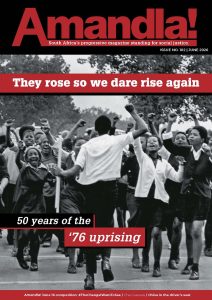

The 50th anniversary of June 16 demanded a response. So the bulk of this issue is devoted to a special feature. It both provides an analysis of the significance of June 16 and assesses how far we have to go 50 years later, as well as ways in which we have regressed.
The editorial explains how June 16 triggered the upsurge of struggle from the repression of the 1960s into the mass struggle of the 1980s. It then bemoans the state of education in 2026 – the unmanageable class sizes of the 1970s, which were a feature of Bantu Education, are still with us 50 years later.
The feature: we were fortunate to have the opportunity to piggyback on a major conference on June 16, which allowed us to commission articles from many of its contributors. In this collection, we have covered an overview of the enduring significance of June 16 (Salim Vally) and an explanation of the roots of the new, young militant generation (Noor Nieftagodien). Koni Benson describes how Upbeat magazine captured the energy of the 76 generation. Sadia Agsous-Bienstein looks at language as a weapon of settler colonialism in South Africa and Palestine. Terri Maggott takes us forward from 1976 into the people’s education movement of the 1980s. Sibusisiwe Nxongo explains the contradictions in the BC movement’s approach to gender, and Anne Heffernan explains the impact of the uprising of school students on students at Black universities. Happy Vena (Galeshewe), Tshepo Moloi (Tembisa), Lopang Victor Molokwe (Huhudi), and Precious Mashaba (Temba, Hammanskraal) demonstrate that the uprising was not limited to Soweto or even to urban areas.
Bringing us up to date, Itumeleng Mothlabane from Equal Education describes some of the dire conditions faced by students in 2026 and the efforts to improve them. Zolani Balekwa writes an appeal to 2026 students — move left as the government moves right. And Noncedo Madubedube describes the creative dialectic of intergenerational engagement in a description of the first episode of her new podcast.
And finally, we present the results of our social media photo and writing competition on #TheChangeIWantToSee. Young people of 2026 rising to the challenge of the 1976 generation.
On the economy, Moegsien Ismail from the Back to Work Campaign describes the devastating impact that unemployment has on people’s lives and health. In the field of labour, the campaign to scrap the labour bills gives a rundown on the largely negative effects of the Labour Relations Amendment Bill for workers. And, in an interview, Vuyo Lufele, one of those dismissed from Numsa for asking awkward questions, describes the successes and struggles of building a new union.
On community issues, Rea Mmethi says it’s time to stop trading insults about the NHI and examine it rationally. And Amandla interviewed Henriette Abrahams about the impact (largely negative) of the president’s initiative to put the army into the townships. In the political space, Zolani Balekwa describes how he became acquainted with Che Guevara. On Afrophobia, Rea Mmethi pens a powerful poem, and Faisal Garba makes a trenchant analysis of what lies underneath the current wave. On land, Nokwanda Sihlali explains how the Ingonyama Trust, headed by the Zulu king, is being less than transparent in repaying unlawfully levied rent from traditional landholders.
The International section starts with a powerful article from Usuf Chikte, which reminds us that, despite slipping from our newsfeeds, the Zionist state continues its onslaught on Gaza and the West Bank. Alexander Korolev analyses how China has indeed arrived in the driving seat of the global powers. Madoda Cuphe gives us hope in a description of an antifascist conference in Brazil. And Fabrizio Burattini bemoans the fact that as a Left we are so weak that we feel obliged to celebrate the victory of a conservative nationalist over Victor Orban in Hungary.
And finally, in the Reluctant President, Cyril Ramaphosa can’t shake off recurring bad dreams which feature flying sofas and dollars floating everywhere.
Download the latest issue here: