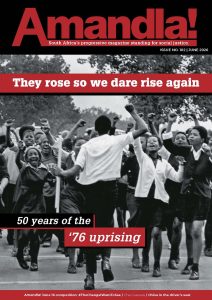

Over time, June 16 1976, has come to be celebrated primarily as a moment of resistance against the forced imposition of Afrikaans in schools in Soweto. That injustice was undoubtedly one catalyst for the uprising. Yet to reduce this watershed moment to a single cause is to miss its deeper meaning, its true contributions to the liberation struggle, and its lasting relevance for our own time. No event of historical importance can be understood apart from its wider context.
In this brief reflection, I merely point to several key and yet neglected dimensions of the uprising: its internationalism; its engagement with the national question; its reinforcement of worker struggles; its embrace of collective leadership and rejection of personality cults; its nonsectarian character; and its emphasis on praxis.
A globally conscious youth
The Black Consciousness organisations and the youth of 1976 were deeply influenced by other liberation struggles. They drew inspiration from the independence struggles in Zimbabwe, Namibia, Angola and Mozambique, as well as from popular resistance against US imperialism in South America and Asia. Frantz Fanon’s The Wretched of the Earth and Paulo Freire’s Pedagogy of the Oppressed were widely circulated and read in the townships. Students were also keenly aware of the struggles of African Americans and other oppressed peoples around the world.
This internationalist consciousness found explicit expression in protests against the 1976 visit of US Secretary of State Henry Kissinger. On September 18, 1976, the New York Times reported that students in Soweto had demonstrated against Kissinger’s three-day visit, during which he held talks with Prime Minister John Vorster. The newspaper noted that many young protesters were killed: “The shooting began after students carrying placards denouncing Mr Kissinger gathered in schoolyards in the black township, singing black protest songs.” One placard called Kissinger “a murderer”; another read: “Kissinger, get out of Azania—don’t bring your disguised American oppression into Azania”.
Unity beyond apartheid’s racial categories
The apartheid regime sought to divide the oppressed majority through the Bantustan policy, the Group Areas Act, and even the spatial segregation of townships such as Soweto into so-called ‘Zulu’ and ‘Sotho’ sections. Yet the students of 1976 mounted a determined challenge to these divisions. The slogan “One Azania, One Nation”—baptised in blood—resonated as a revolutionary cry. Consider the names of the young people and the places where they fell: not only Soweto, but also Manenberg, Elsies River, Montagu, Mamelodi, Alexandra, Gugulethu, Mossel Bay and Athlone. Unlike the crass racial and tribalistic identity politics of today, the youth of 1976 refused to see themselves through apartheid’s imposed categories. They were not ‘minorities’, nor ‘Zulu’, ‘Coloured’, ‘Indian’ or ‘Xhosa’. They were simply the oppressed united in struggle.
Moreover, though many township residents had arrived from neighbouring countries and lived ‘illegally’ in South Africa, they were accepted and respected by their communities. For instance, Sibongile Mkhabela (née Mthembu), one of eleven young people accused of leading the uprising, was the daughter of a Mozambican father who was a pillar of strength in the community; as were many others from Lesotho, Swaziland, Malawi and elsewhere.
Strengthening worker struggles
The 1976 uprising followed closely on the heels of massive urban worker strikes that had begun in Durban in 1973 and spread across the country; similar strikes had even taken place in Namibia before that. By 1979, the apartheid regime was forced to amend labour legislation to grant Black workers the legal right to form and register trade unions. Crucially, many of the key shop stewards who built that union movement had been active participants in the 1976 uprising.
The students who confronted the apartheid state, together with the workers of 1973, ushered in an unprecedented wave of struggle against racial capitalism. They demonstrated that the system was not impregnable and could be challenged. They showed that resistance could be conducted in a non-sectarian way. They proved that even schoolgoing youth could join the fight, and that the struggle was never confined to Soweto alone, despite what some accounts of June 16 suggest.
The events of 1976 laid the foundations for a far broader challenge to the racial capitalist state; it reached even greater heights in the 1980s as workers and community organisations joined forces.
Collective leadership and the defeat of fear
The students of 1976 broke the climate of fear that had subdued older generations after the violent persecutions of the 1960s. They succeeded in bringing organisations together, especially through collaboration with their families and the worker organisations to which those families belonged. They cultivated a new corps of radical organic intellectuals rooted in grassroots organisations, and they placed a premium on collective learning and shared leadership.
We remember those who made the ultimate sacrifice. The most fitting memorial is neither statues nor empty rhetoric, but the urgent work of building a better country than the one we inhabit today. For many young people, 32 years into democracy has become a nightmare.
Post-apartheid capitalism has failed to deliver on its promises—and, by its very nature, it cannot. Too often, young people are blamed for being undisciplined, lazy or lacking in the ‘right skills’ or entrepreneurial spirit. We seldom blame the system itself: the structural unemployment that forecloses any prospect of gainful employment for so many; the billboards, television screens and print media that bombard the youth with the seductive elixir of consumer goods; a social order in which human relations mean nothing unless they are commodified. All in a climate where corruption has embraced those once lionised by the makers of official history, and where struggle ‘icons’ have become affluent overnight.
A polycrisis born of racial capitalism
Who can deny that the country is in the grip of a polycrisis engendered by racial capitalism? The evidence is everywhere: levels of inequality, unemployment, poverty, food insecurity, ecological degradation, poor quality education, inadequate healthcare, soaring energy, transport and food costs, and the crushing burden of debt that most people must endure daily, through no fault of their own. Even the middle classes are not spared. Who can argue that narrow, elitist, and corporate interests and their corruption do not rule the day? Who can ignore the utter desperation that fuels the psychosocial trauma, gender-based violence and other forms of social dysfunction we witness daily?
Lessons for today: xenophobia and internationalism
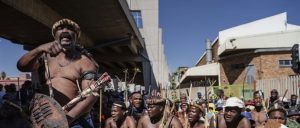
March and March protest in Joburg, April 30 2026. The lessons of June 1976 are also vital for the struggle against contemporary xenophobia. Opportunistic politicians exploit the current crises to blame, scapegoat and attack ‘foreigners’, rather than confronting the real causes of inequality, poverty and unemployment. (Photo: Ihsaan Haffejee/GroundUp)
The lessons of June 1976 are also vital for the struggle against contemporary xenophobia. Opportunistic politicians exploit the current crises to blame, scapegoat and attack ‘foreigners’, rather than confronting the real causes of inequality, poverty and unemployment.
The uprising reminds us of the importance of internationalism and the linking of struggles. The same crude oil extracted from the Niger Delta, the minerals of the Congo and the coal of South Africa fuel the machinery of Israeli occupation and genocide. This connects the dispossession of Palestinian lives and land directly to the exploitation of African resources by big corporations, African elites and warlords.
The logic and violence of racial capitalism, colonialism and extraction are not confined to any single place or time. They operate across borders, binding Africa, Palestine and other sites of struggle into a shared history of resistance.
Palestine stands today as a global front against colonialism, imperialism, fossil-fuel capitalism and white supremacy. It is incumbent upon all of us—solidarity activists, climate justice advocates, anti-racist and anti-imperialist organisations, and faith-based groups—to actively support the Palestinian liberation struggle and their right to resist. The genocide in Gaza is a harbinger of worse to come if we do not organise and fight back vigorously, including through the boycott, divestment and sanctions campaign against apartheid Israel. The empire and its global ruling classes are willing to sacrifice millions of Black and Brown bodies, and working-class people everywhere, so that they can continue accumulating capital, amassing wealth and maintaining their domination.
Colombian President Gustavo Petro recently observed:
“Genocide and barbaric acts unleashed against the Palestinian people is what awaits those in the Global South. What we see in Gaza is the rehearsal of the future”.
The youth of 1976 understood that freedom is indivisible. They risked everything, not for statues or hollow commemorations, but for a world in which human beings are no longer reduced to commodities, ethnic labels or disposable labour. Their legacy demands nothing less from us today: to see our struggles as linked, to reject the divisions that power imposes, and to build a genuine liberation for all.
That is the true significance of 1976—and the unfinished business before us now. Steve Biko understood this when he argued:
The great powers of the world may have done wonders in giving the world an industrial and military look, but the great gift still has to come from Africa, giving the world a more human face.
Salim Vally is the NRF Chair in Community, Adult and Workers’ Education and a professor in the Education Faculty at the University of Johannesburg. He was a member of the South African Students’ Movement in 1976 until its banning in 1977.
*Featured image by Denisbin