

2024 has shown us flames, literally in some parts of the world. It is turning out to be the hottest year on record, and we have already reached more than 1.5 degrees of global warming above pre-industrial levels. As we prepare to say farewell to 2024, we must pause to reflect on the state of our planet’s climate emergency and our responses to it.
As we hurtle towards 3 degrees by the end of the century, we must recognise that Africa will be hardest hit. It is the continent that is heating up faster than any other. Africa has seen some of the worst droughts, flooding, cyclones, and sea level rises, and this is bound to worsen as the climate deteriorates. Some estimates put displacement and migration as a result of climate change at 86 million by 2100.
Thousands are already living in a state of perpetual crisis after being bombarded with disasters, and this will surely go up to millions in a matter of years. Weak and poor governance exacerbates the problem, along with a massive debt burden and other intersecting crises such as poverty and social and political instability. Tragically, we also know that Africa has done the least to cause the climate crisis yet faces the worst consequences. Given this grim prospect in Africa alone, what are the responses to the crisis?
We immediately turn to the climate negotiations or COPs. As the official space where governments of the world come together to collectively develop solutions to climate change, this is theoretically where a unified response is developed. The science of climate change should also direct the actions taken, and given what scientists are saying, there is a need to act not just with seriousness but also with urgency. But after 29 years of COPs—with the last one concluding in Baku, Azerbaijan a couple of days ago—the agreements are severely lacking. In fact, it seems as though they are getting weaker. There appears to be less motivation than ever to rise to the challenge and deliver outcomes that are commensurate with the scale and intensity of the problem.
Let’s break this down.
Too little too late: defining key principles and the birth of carbon trading
Firstly, the COPs started too late. Fossil fuel companies knew about climate change in the 1950s and 1960s but suppressed the information. Governments under the United Nations eventually came together in 1992 to form the United Nations Framework Convention on Climate Change (UNFCCC), and the first COP was held in 1995. Since then, emission reductions have been pegged at 1992 levels instead of when emissions first started escalating, from the time of the Industrial Revolution in the 1800s. But the important thing to mention here is that at least there was an acknowledgement of climate change and some sort of collective will to deal with it.
The UNFCCC also led, at the time of its formation, with some founding principles. These were important guides on justice and equity, with a significant one to distinguish between developed and developing countries in their responsibilities for action.
These were, however, quickly undermined at the COP talks in Kyoto a few years later. There, targets for emission reductions were set, but the loophole of carbon trading was pushed through by the US. Described as a ‘win-win’ by developed countries and their corporations, carbon trading is a scheme where polluters can continue to pollute, provided that they ‘offset’ their emissions by developing ‘green’ projects in the developing world. In truth, carbon trading is the biggest racket out there. Dubious projects are often developed with no green credentials to speak of; people in the developing world have to shoulder the fallout, including getting their lands and resources grabbed for these projects; and polluters get to happily go on with business as usual.
Seeing the faulty logic and bad practice, there have been many efforts, mostly by civil society, to stymie the carbon markets from going full throttle. But years later, and at the Baku COP this year, carbon trading has been given fresh life when new rules were put in place for it to continue. This will no doubt unleash more carbon trading and its worst ills, sabotaging effective responses to the crisis.
The dim glow is snuffed out of climate reparations and securing a climate finance goal
The UNFCCC’s guiding principles, referred to above, reflect a genuine acknowledgement that some countries (that is, those in the developed world) have caused the climate crisis and are most responsible for fixing the mess. They also indicate that, in effect, climate reparations would need to be made (and paid) to developing countries for bearing the burden of the crisis. The ‘payment’ or financial assistance is generally referred to as climate finance, and it is to take the form of transfers to the developing countries to adapt and mitigate climate change.
In all these years, there appear to have been some efforts towards providing this climate finance by way of a variety of different funds that have been created. These include, most recently, the Green Climate Fund and the Loss and Damage Fund. But developed countries are simply not coughing up the money to go into these funds. They are also pushing through dodgy governance mechanisms, like getting the World Bank and the private sector to run these funds. And they are giving money as loans, which create debt, instead of as grants.
At this year’s COP, dubbed the “Climate Finance COP” (which was actually anything but that), a paltry $300 billion per year was agreed by developed countries as the goal. This was in response to the $1.3 trillion asked for by developing countries. This has left many developing countries and groups like the African Group of Negotiators and the Small Island Nation States gutted by the outcome. They feel as though this was a missed opportunity to deliver real relief to their people.
The fossil fuel elephant in the room and its dark shadow over the COP
Scientists have been clear that to bring emissions down to levels which would support human existence, we must end the long era of fossil fuels. That means immediately stopping new projects from going ahead and then a managed decline of existing infrastructure over the next few years. But despite this, the fossil fuel industry remains a major influence over the climate talks. Fossil fuel companies have historically been ‘controlling’ the information on climate change, then outright denying their culpability, and now taking over the COP space and influencing the text of the agreements. Every year sees a record number of fossil fuel lobbyists taking part in the talks, and the negotiations have been held in petrostates for the last two years. This year, the COP President gave a ‘stellar’ performance, denying that there is any science that backs up climate change, and language around fossil fuels was left out of the agreement. This happens at the same time as the presence of civil society and communities are reduced and their voices subdued.
Sneaky side deals on the just transition meet injustice in Africa with the pursuit of green energy
Despite the march of the fossil fuel industry, there has been a growing global recognition that a just transition, particularly from fossil fuels, is necessary for humanity to survive the climate crisis. But the just transition has become a dimmer prospect in successive COPs. This year’s COP doesn’t even mention it.
What is happening, however, is that there are numerous side deals that are being brokered, called the JET-Ps or Just Energy Transition Partnerships. These are agreements between developed and developing countries which will secure resources from developed countries to support transitions in developing ones. At COP26, South Africa secured one of these deals with Germany (and, more broadly, the EU), part of which was to produce green hydrogen which can be transported—via state-developed and -backed infrastructure—to Europe. This is but one such deal in a whole host of them, in which ‘green’ minerals and metals, hydrogen and gas, are being brokered. It is what has been called the new scramble for Africa.
In truth, this just mirrors the extractivism that has always been happening in Africa, but now with a distinctly greener tint. The green hydrogen projects, as with other green extractivism projects, will see people’s land and resources siphoned away to make way for this new era of colonialism.
And still, the transition is barely happening in the developed world. Most of the renewable energy being added to the grid is an ‘add-on’ rather than a switch from fossil fuels to renewable energy.
Enter an African feminist response that denounces the COPs and builds the climate justice movement
In the midst of the failure of the COPs to serve as a just, real and equitable way to deal with the climate crisis, a counter-movement is emerging in Africa that denounces the COP and seeks to build the climate justice movement. The Africa Climate Justice Collective has been building for the past four years and has held four ‘Counter COPs’ and birthed a Women’s Climate Assembly, which is into its third year this year.
At the recent Women’s Climate Assembly women had this to say:
“Through our march and this assembly, we have left our fingerprints, and it is clear what we want for our environment, our climate, our ecosystem, our livelihoods. During the COPs, we have seen how the agendas of the donor countries dominate. You cannot come and steal African resources and, at the same time, help us to get climate justice. Once we see this, we can talk about false solutions. Where do false solutions come from? These are false projects put in place by countries with money from the Global North as yet another way to extract our resources to feed their companies and banks in Europe. We have the Right to say NO! The Right to say NO is in the hands of women!” Khady, Senegal
“This is my third time attending the Women’s Assembly and [at the same time] listening to what is happening at the UN Conference of Parties. The COP has failed and does not alleviate the crisis of climate change for us women in Africa. The COP MUST BE BOYCOTTED! THE COP MUST DIE!” Woman from Liberia
“Women did not cause the climate crisis, and so the issues of the COP should be with the West. We are African women, and we can address our issues at the local level. We can hold our African COP.” Woman from Senegal
In these processes women are demanding that their voices are heard and are calling for action on a range of fronts. These are the voices of the people who are harmed by the climate crisis yet who are silenced in the corridors of power and the official spaces. They also refuse to continue to face the brunt of so-called ‘climate actions’ like carbon trading and the JET-Ps, which only bring them more misery and strife. They are developing real solutions from the ground up. And maybe, just maybe, this kind of action sparks a glimmer of hope that saves us all.
Trusha Reddy is the Programme Manager at WoMin African Alliance. She has over 20 years of experience in the fight for climate justice in Africa and the Global South.
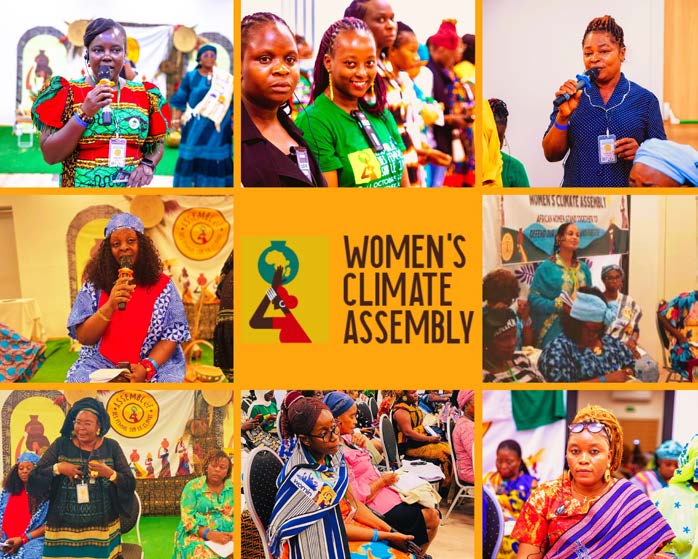
The Africa Climate Justice Collective has been building for the past four years and has held four ‘Counter COPs’ and birthed a Women’s Climate Assembly, which is into its third year this year. PHOTO: womin.africa