




There is a dangerous misconception in South Africa that crime exists in isolation, that it is simply the result of individuals making bad choices.
While individuals must always be held accountable for their actions, this explanation alone ignores the conditions that produce the environments in which organised crime flourishes. Crime does not emerge from a vacuum; it grows where poverty is entrenched, where unemployment is normalised, where public institutions lose the trust of communities, and where desperation becomes easier to organise than opportunity.
Protection fees
Nowhere is this contradiction more visible than in the growing crisis of protection-fee extortion across parts of Cape Town, especially the Cape Flats. Over the past few years, criminal gangs have demanded so-called ‘protection fees’ from immigrant-owned businesses, and particularly spaza shops. Many South Africans watched this happen, and some even defended it in the mistaken belief that immigrants were responsible for unemployment, poverty and economic hardship. The language of xenophobia created the illusion that once foreign-owned businesses were intimidated, displaced or forced to pay, local communities would somehow become economically secure.
That illusion has collapsed; immigrant-owned businesses did not all disappear. Many remain and continue to operate despite intimidation and violence. What has changed is something even more disturbing: criminal gangs have expanded their operations. The pursuit of profit has grown beyond one group of victims. Today, local South Africans are increasingly finding themselves subjected to the very same extortion.
That alone should force us to rethink everything we have been told about who the enemy really is.
Recently, I spent time interviewing mothers in Site C, Khayelitsha, who sell amagwinya and other food from small informal businesses. These were not interviews filled with political slogans or ideological debates. They were conversations about survival.
These women wake while most of the city is still asleep. Long before dawn, they prepare dough, heat cooking oil, organise ingredients and set up their tables. Their businesses are not side hustles; they are the foundations upon which entire households survive. Every gwinya sold contributes towards school uniforms, electricity, transport money, rent and food. Every customer represents another day their families can keep going. Yet instead of being able to concentrate on their work, they spend every day wondering whether someone will arrive demanding money they cannot afford to give.
Extorted by their children
The stories they shared were heartbreaking. What affected me most was not simply that they were being extorted, but who was extorting them. Several mothers explained that the people demanding these payments are the very same boys they watched grow up in the neighbourhood, children they once greeted, young people they watched play football in the streets. Some had bought amagwinya from these same women after school, and they were once known by name, but today they arrive representing criminal gangs. The transformation is almost impossible to comprehend. A child who once depended on the community now returns to prey on that very community.
One mother paused during our conversation before saying something that has remained with me ever since: “Some of them used to go buy flour for me, or some would come peel the potatoes.” There was no anger in her voice but only disappointment, grief and the painful recognition that somewhere along the way an entire generation had been abandoned.
This is perhaps the greatest tragedy of all. These women are not simply losing money; they are watching children they once knew become instruments of fear. The trauma extends beyond the business owners themselves. Several mothers told me their own children are now frightened whenever unfamiliar groups approach their stalls. A simple customer walking towards the table can trigger anxiety because they no longer know whether the next person is arriving to buy food or to demand money.
Children are learning that work does not necessarily bring safety but that their mothers can be threatened while simply trying to earn an honest living. They are learning that violence can interrupt ordinary life at any moment. No child should grow up believing that this is normal.
One testimony in particular revealed just how deeply these criminal networks attempt to control people’s lives. One woman explained that she had reached a point where she wanted to close her business altogether. The emotional strain had become too much. She thought walking away would protect her family; instead, she was threatened; she was warned that if she closed her business, she had better move far away because they would come looking for her.
Think about what that means: she was no longer being told where she could trade; she was being told where she could live.
This is no longer merely extortion; it is the attempted control of entire communities through fear. Protection fees are often discussed as though they are simply another criminal offence, but they are far more than that. They represent an informal taxation system imposed through violence. People who already struggle to survive are forced to surrender part of their income to criminal organisations, simply to continue existing. It is a parallel economy built upon intimidation. But this raises another question.
Why has this criminal economy become so powerful?
The answer cannot simply be that people are evil. South Africa continues to experience some of the highest levels of inequality and youth unemployment in the world. Entire generations have grown up in communities where opportunities remain painfully limited. Organised criminal groups often exploit these conditions by offering money, identity, belonging and power to young people who feel excluded from the formal economy.
None of this excuses criminal behaviour, but it helps explain why these networks continue to recruit and expand, as the underlying social and economic conditions remain unchanged. This is precisely why xenophobia has failed as a response to economic hardship: the argument was always that immigrants were the problem; but if that were true, why are local South Africans now increasingly becoming victims too?
The answer is simple. Criminal gangs were never driven by nationality; they were driven by profit. As long as there is money to be extracted, the identity of the victim becomes secondary. Foreign nationals were targeted, now local traders are targeted, and tomorrow it may be someone else.
Organised crime follows opportunity, not nationality.
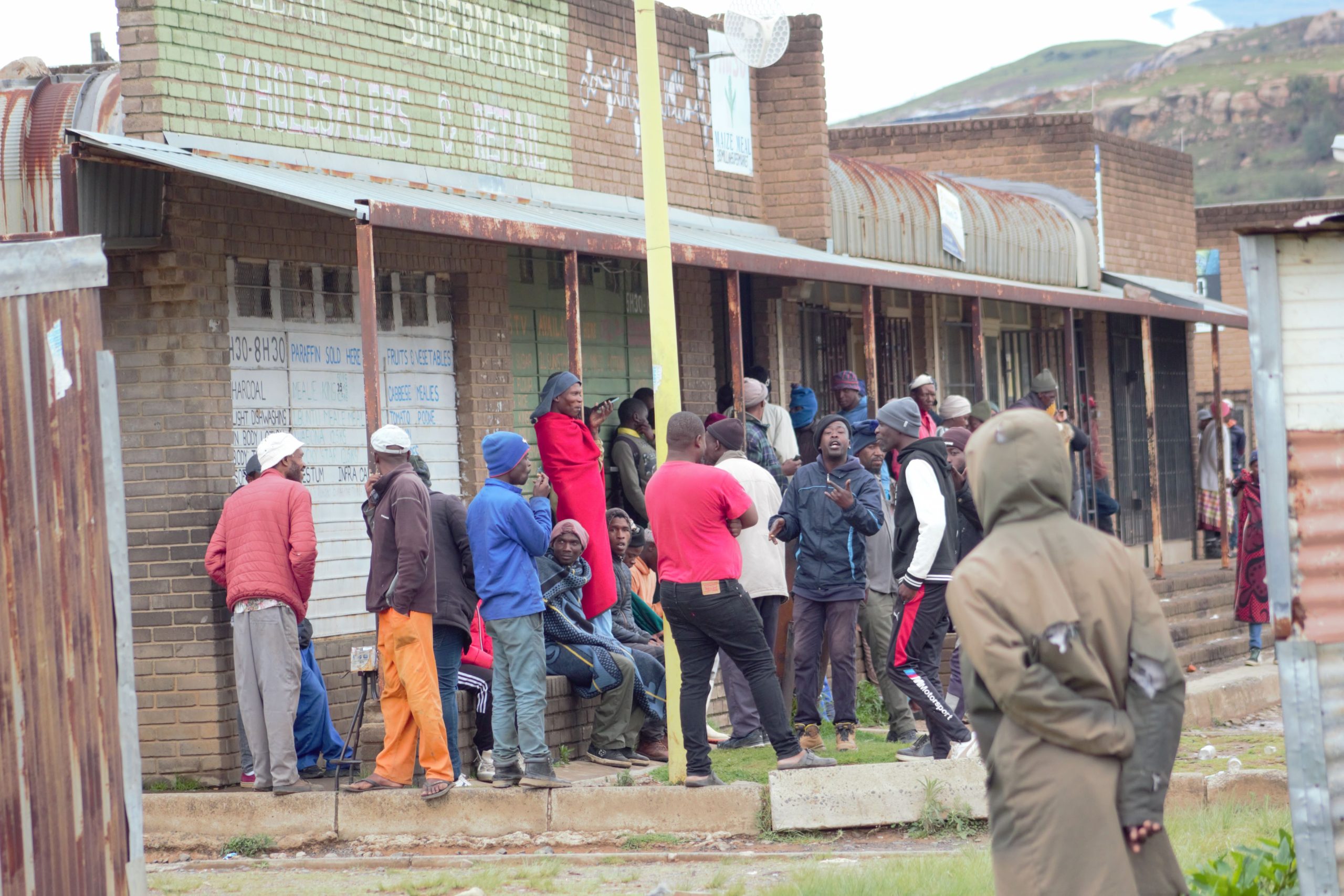
People gathered at the Tsheseng shopping complex in Phuthaditjhaba, Free State, in 2024, wanting to shut down immigrant-owned shops. Over the past few years, criminal gangs have demanded so-called ‘protection fees’ from immigrant-owned businesses, particularly spaza shops. (Photo: Tladi Moloi/GroundUp)
This is why xenophobia can never solve poverty, and it can never solve unemployment or organised crime; it merely redirects public frustration away from structural failures and towards vulnerable people who are themselves trying to survive. Meanwhile, the real crisis continues to grow, communities lose businesses, families lose income, children inherit trauma, young people are recruited into gangs, trust disappears, fear replaces solidarity, and the cycle repeats itself.
The mothers I interviewed are not asking for sympathy; they are not asking to become rich; they are not asking for special treatment; they simply want to wake up before sunrise, prepare amagwinya, serve their customers and return home safely to their children. That should not require courage; it should be guaranteed.
If we continue treating protection-fee extortion as merely a policing problem, we will forever be responding to symptoms while ignoring the disease. Strong law enforcement is essential, and those responsible for threatening communities must be brought to justice. But policing alone cannot replace jobs, functioning schools, youth programmes, mental health support, accountable local government, or an economy that gives young people a genuine stake in society.
The women of Khayelitsha reminded me that the greatest cost of extortion is not only the money that changes hands. It is the trust that disappears; it is the neighbour who becomes a threat; it is the child who grows up afraid; it is the mother who no longer feels safe earning an honest living.
And perhaps the greatest indictment of all is this: when a mother selling amagwinya must ask permission from gangsters to feed her family, we are no longer witnessing isolated acts of crime. We are witnessing the consequences of a society that has allowed organised violence to fill the spaces where justice, opportunity and protection should have existed.
Why has the democratic state allowed this?
The question we must therefore ask is not only why gangs have become so powerful, but why the democratic state has allowed them to become powerful enough to determine who may or may not earn a living. A state is not measured by the speeches of its politicians or the promises contained in election manifestos. It is measured by its ability to guarantee the basic conditions under which its people can live with dignity and security. When mothers selling amagwinya must negotiate with gangsters before they can negotiate with customers, the state has already surrendered one of its most fundamental responsibilities.
This crisis did not emerge overnight; it is the product of decades of uneven development, spatial inequality inherited from apartheid, chronic youth unemployment, under-resourced schools, inadequate social services and communities that have too often been left to fend for themselves. For many young people on the Cape Flats, the state is most visible through police raids and election campaigns, but least visible when it comes to sustained investment in education, recreation, employment and community development. In that vacuum, organised crime steps in.
Gangs become employers where there are no jobs. They become lenders where there is no financial security. They become an authority where the authority of the state is weak or distrusted.
None of this legitimises their violence, but it explains why they are able to entrench themselves.
The irony is that informal traders are among the hardest-working people in our economy, yet they often receive the least protection. They create employment where none exists. They feed communities at affordable prices. They stimulate local economies without large investors or government subsidies. Yet they are left exposed to extortion while continuing to carry the burden of keeping their families alive. A society that cannot protect its smallest entrepreneurs cannot claim to have built an economy that works for ordinary people.
This is where capitalism enters the conversation
Under a capitalist economy, profit is the primary measure of success, but the distribution of opportunity is deeply unequal. While wealth accumulates in some parts of society, many township communities remain excluded from meaningful economic participation. The informal economy becomes a place where people fight over survival rather than share in prosperity. Criminal gangs understand this reality. They recognise that even the poorest trader generates an income, and they seek to extract a portion of it through violence. In that sense, extortion becomes a parasitic economy, feeding off another economy of survival.
At the same time, inequality itself creates conditions from which some economic actors benefit. Cheap labour remains abundant because unemployment is high. Private security industries expand as communities lose confidence in public safety. Insurance costs rise. Wealthier communities can purchase protection that poorer communities cannot afford. Those with resources are often able to insulate themselves from insecurity while the costs of violence are disproportionately carried by the poor. The burden of this crisis is therefore not shared equally.
This is not an argument against enterprise, investment or economic growth. It is an argument against an economic system that tolerates extreme inequality, while expecting social stability to emerge on its own. No economy can remain healthy when millions of people are excluded from meaningful opportunities, and no democracy can remain secure when criminal organisations become more present in people’s daily lives than the institutions of the state.
The mothers I interviewed should never have to choose between paying extortion money and feeding their children. Nor should young people grow up believing that joining a gang offers more certainty than finishing school or searching for work. These are not individual failures; they are political failures, economic failures and institutional failures.
The responsibility therefore rests first with those who extort and terrorise communities. But it also rests with a state that has too often failed to protect its citizens, failed to create opportunities on the scale required and failed to dismantle the structural inequalities that continue to reproduce violence. Until those deeper conditions are confronted, protection fees will not simply remain a criminal issue. They will remain a mirror reflecting the unfinished work of justice in post-apartheid South Africa.
Zolani Balekwa is a writer, artivist, filmmaker and director of Artivism Productions 24 whose work channels community resilience stories into poetry and film for community activism.
*Featured Image by Ashraf Hendricks/GroundUp


