

It should no longer be denied that climate change is real and an immediate danger, particularly to those who lack the economic resources to shield themselves from climate disasters. South Africa faces the tremendous challenge of initiating an energy transition that achieves two objectives. It must forge not only a low-carbon economy but also one that cultivates a new path of sustainable economic development, social security and industrialisation to eradicate poverty, unemployment and inequality.
As one of the country’s oldest coal-fired power stations, Komati’s decommissioning was firstly motivated by the plant’s age and the perception from Eskom that new power capacity would be obtained from Independent Power Producers. Although finally postponed to 2022, Eskom had been in discussion with the government and organised labour regarding Komati’s shutdown as far back as 2017.
The finance
In October 2022, the final unit at Komati Power Station went offline, and the coal-fired power plant was officially retired. The following month, Eskom announced the World Bank’s approval of a $497 million concessional loan facility. It was to support not only the decommissioning of Komati but also to provide financing for the repurposing of the station with renewable energy and batteries while creating employment opportunities for workers and communities surrounding the ageing plant.
Initially, this loan was met with great enthusiasm by the presidency and by executive leadership at Eskom. According to the World Bank, “the project could provide a blueprint for a just energy transition in South Africa and beyond”. Mpho Makwana, Chair of the Eskom Board, claimed: “This is a significant development for South Africa’s Just Energy Transition to renewable energy as it brings the much-needed funding to enable Eskom to train its employees and members of the host communities to empower them to continue playing a central role in the provision of clean energy for the country.”
The loan financed three components of the process:
- $33.5 million for shutting down the power plant (which would include demolition, blasting activities and site rehabilitation).
- $416 million for repurposing the station with a hybrid of renewables (150 MW of solar, 70 MW of wind, and 150 MW of battery storage) alongside synchronous condensers (rotating, electrical machines that provide power to stabilise voltage and improve power quality, especially with renewable energy).
- $47.5 million towards mitigating and minimising the socio-economic impacts of shutdown while creating economic opportunities for workers and communities.
90% of this funding was in traditional loans. Concessional loans (on better terms than the market) made up only 8% and grants only 2%.
A failure
Komati’s decommissioning and repurposing has failed to serve as a useful blueprint for a substantially just transition. Rather, it has proven itself to be a harsh lesson in the technological, economic and political obstacles to pursuing a transition away from coal, within a neoliberal paradigm of macroeconomic and energy policy.
A 2023 report by the Presidential Climate Commission (PCC) found a lack of cohesive planning from Eskom and government departments, and poor timing and sequencing in the plant’s closure. The absence of meaningful engagement with communities and workers in the decision-making process and a narrow project scope resulted in significant job losses and a lack of economic opportunities for communities around Komati. Beyond government reports, the experiences and insights from communities and organised labour within Komati reveal the destructive mistakes made.
As a key component of South Africa’s coal value chain, power plants like Komati stimulate and sustain economic activity and employment in host towns such as Middleburg and Bethel. According to reports and interviews from grassroots movements, such as the Khutala Environmental Care Group, alongside trade unions within the energy sector, Komati has endured a severe economic downturn. There has been a sharp increase in unemployment.
Although most Eskom workers at the station were re-deployed to other stations, Komati sustained numerous forms of labour beyond those employed at Eskom. In 2023, Komati Acting General Manager Thevan Pillay claimed that the station was supporting 3,000 to 4,000 people with jobs or contract work when it was operating.
Pillay also informed the news agency Agence France-Presse in November 2024 that “We cannot construct anything. We cannot remove anything from the site”. There have been challenges in securing project funding and delays in receiving regulatory approval for repowering and repurposing. These have significantly stalled job creation, re-skilling and the provision of social support. “Our jobs ending traumatised us a lot as a community,” said Sizwe Shandu, 35, who had been working as a boilermaker at Komati since 2008. There are only a few miniscule green projects underway, and there have been job losses, minimal upskilling or training, and a sharp decline in economic activity.
Proposals for a public pathway
One fundamental error in the Komati repowering and repurposing project was the financing method. Traditional loans from foreign institutional investors have placed a tremendous burden on Eskom. They must be paid back at harsh interest rates in a currency that has been depreciating for decades. And the utility is already dealing with immense debt, narrowing streams of revenue and rising operational costs. So the cost of this foreign borrowing is likely to be passed on to the electricity end-user, who is already entangled in a general cost of living crisis.
Beyond this financial burden, the securing of funding through international institutional investors often leads to regulatory delays and bureaucratic hurdles. These have delayed the effective deployment of green technology and infrastructure at the pace and scale required for substantial job creation.
Reverse broken private pathway
Infrastructure projects generally carry great risk for investors. The risk comes in many forms: fiduciary requirements to shareholders, thresholds of profitability, land acquisition issues, frustrating labour protections, foreign exchange volatility or inhospitable tax burdens. For institutional investors, these factors are obstacles to returns on their capital. In order to secure funds and receive regulatory approval, utilities such as Eskom and the South African government must ensure green infrastructure projects are “de-risked”. In other words, the private sector must make a guaranteed profit and the state (citizens) must take the risk.
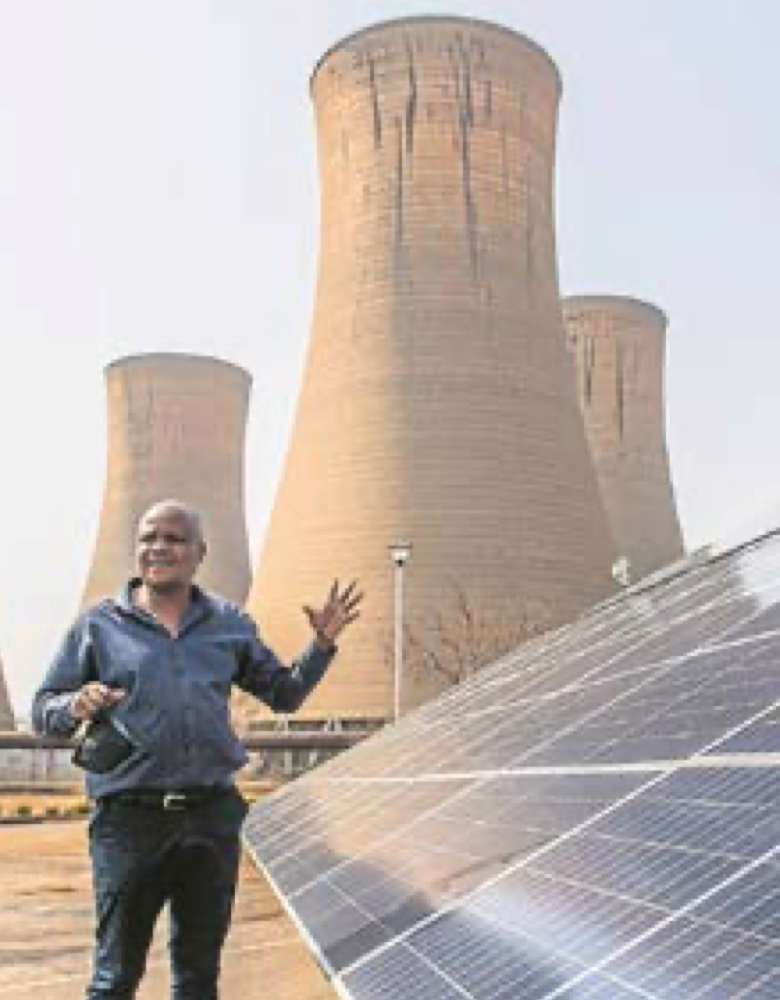
Komati’s decommissioning and repurposing have proven to be a harsh lesson in the technological, economic, and political obstacles to pursuing a transition away from coal within a neoliberal paradigm of macroeconomic and energy policy.
The South African state must stop relying only on foreign borrowing and private investment for a just energy transition. It must seriously pursue domestic resource mobilisation—direct public investment through reforming tax, trade and monetary policy. As argued by the Institute for Economic Justice’s Gilad Isaacs, any foreign climate finance should be through transparent, multilateral processes that acknowledge the Global North’s historical climate debt.
A narrow vision of job creation, local economic development and social support was another significant factor in the current failure of Komati’s renewal. Part of the issue is a reliance on Independent Power Projects, which must be bankable. So, they are not explicitly and primarily tailored to what is best for decarbonisation goals, environmental protection, energy security and job creation.
This was severely compounded by a lack of thorough planning years prior to the repurposing project and a lack of substantial public participation (not merely shallow ‘stakeholder consultation’). The communities of Komati (including labour, both permanent and contract, should have been informed many years before about the station’s closure and brought into the process of conceptualising and planning. This would have enabled Eskom (alongside local, provincial and national governments) to create proposals and eventually implement policies that included their economic and social needs. Having the money and the resources is particularly important, as those who lose their employment will need to be upskilled and provided with holistic social support as they transition to a new realm of energy labour.
Shifting away from coal-fired electricity production would require a state that has the financial, administrative and technical capacity, and energy sovereignty, to comprehensively plan and execute green industrial and infrastructure projects. Moreover, and this is crucial, a truly just energy transition will require a state that is profoundly democratic, transparent in its operations, and accountable to those it is meant to serve.
The Komati repowering and repurposing project can be considered a failure—but it didn’t have to be. What restrains the potential for a just energy transition in South Africa (and in numerous fossil fuel-dependent developing nations) is a corrosive dependency on private investment and private enterprise. If we expect to make renewable projects bankable, climate change will not be overcome, and sustainable, uplifting, green industrialisation will remain far beyond our grasp. Now, more than ever, working-class communities and energy sector workers must organise for a public pathway to climate jobs.
Andile Zulu is a political writer and Energy Democracy Officer at AIDC.