
South Africa doesn’t have a “statistical-error” unemployment crisis; it has a jobs crisis. Stats SA’s Quarterly Labour Force Survey (QLFS) counts people as employed even if they worked for an hour. This includes self-employment. So the claim by Capitec CEO Gerrie Fourie that our 32% unemployment rate would be 10% if Stats SA counted informal traders is simply wrong. The real question is why joblessness is so high and informal work so limited, and what that means for our historical reckoning and policy.
One day, the CEO of the largest bank in South Africa announced that the country’s most pressing economic issue, unemployment, was simply a long-running statistical error:
What is interesting is when you look at the unemployment rate, we talk about 32%. But Stats SA doesn’t count self-employed people. I really think that is an area we must correct. The unemployment rate is probably actually 10%. Just go look at the number of people in the township informal market, who are selling all sorts of stuff, who have a turnover of R1,000 a day.
The media went nuts. Is it possible that all the doom and gloom about this most intractable issue of unemployment is mere government polemic, and actually, things aren’t so bad? The CEO of Capitec can see over half the adult population’s bank accounts after all. Never mind that he didn’t bother to check whether Stats SA does ask questions about self-employment — why check with incompetent bureaucrats, when, as one of the most powerful people in the country, one can just proclaim?
The Stats SA head gave a diplomatic but firm reply: “Stats SA methods remain robust… We do not fix statistics to feel better about our reality. We reflect that reality, so the country can make evidence-based decisions to change it.”
Jonny Steinberg was more direct, saying that the Capitec boss “degraded public discourse”.
Being very successful can, paradoxically, lead to intellectual laziness, born from overconfidence. He assumes that his own intuition about the employment rate is right, forgetting that on statistical matters, everyone’s intuition is almost always wrong, no matter how knowledgeable they are.
Is there anything to the 10% claim?
Of course, there are serious conversations among academics and statisticians regarding measurement issues for the official unemployment rate. This means that there is a range in which the true unemployment rate probably lies. However, unemployment in South Africa is undoubtedly exceptionally high. In addition to the official Labour Force Surveys, several other surveys run by different organisations have asked about employment in different ways for the last 30 years. And all confirm an exceptionally high and persistent rate.
Is Stats SA excluding the informally employed? Stats SA counts you as employed if you did any work for pay, profit, or family gain in the last week— “even if just for an hour”—including self-employment and unpaid work in a family business. Explicit examples given include work in exchange for food or housing, brewing beer, looking after children or even unpaid work helping someone else in the household sell things. If you had no work and looked/were available for work, you’re unemployed.
A number of articles have already laid out the manifold problems with the CEO’s claims. For example, Haroon Bhorat explains the classic issue of selective sampling — those with the bank accounts and informal transactions the CEO sees, which he attributes to unemployed people, are more likely to be employed. This leads him to miss seeing the unemployed.
If anything, as is well known, the official unemployment rate is an underestimate of a reasonable definition of unemployment. If you failed to look for work for any reason during the seven days immediately preceding the interview, then you are classified as a discouraged work seeker and are not included in the “official’ unemployment rate, only in the “expanded” rate of 45%.
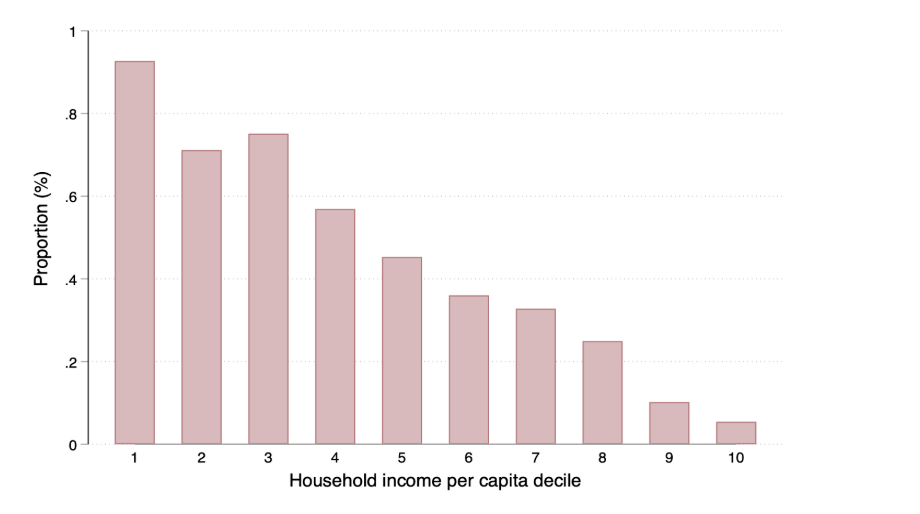
But a question arises: how do people survive if unemployment is so high? This graph shows, unsurprisingly, that the unemployed come disproportionately from the poorest households in the country, with much higher poverty rates, funded mostly by wages and grants.
Unemployed households as a proportion of each income decile
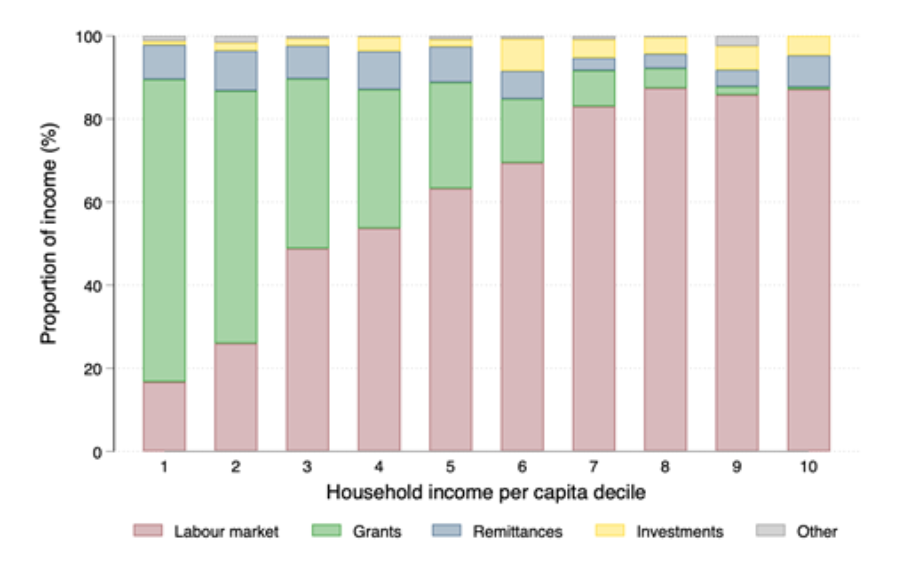
But the next graph shows that unemployed people live in households with other sources of income — usually with someone else who is employed. Most household income for the unemployed still comes from employed people (nearly 60%); most of the rest comes from social grants (about 30%). These households are larger on average, partly precisely to support such unemployed members.
Income sources for unemployed households in each income decile
Why is unemployment so high, and informality so low, in South Africa?
Most of the “evidence” in the media discussion has been at the level of anecdotes about informality. But it has never been claimed that there is no informality; in fact, official statistics suggest that around 1 in 3 employed people are employed informally. It’s just that this is low compared to other countries with similar levels of per-person income: in Sri Lanka, the informality rate is around 67%, Indonesia 81%, and Egypt 68% (Brazil is a bit lower at 37%).
Why aren’t more of the unemployed working informally? There has been a lot of research on this for decades (see reviews by Banerjee et al, 2008; De Lannoy et al, 2018; Shah, 2022). It is an active research question, and one of the most important in the country. Bhorat and others’ recent research explains such missing informality in terms of Apartheid urban legacies “designed to stymie the flourishing of the informal sector.” My forthcoming research with Joshua Budlender and Surbhi Kesar investigates the links to historical land dispossession.
Vimal Ranchhod points out the underappreciated fact that high unemployment is more broadly a Southern African phenomenon: “For example, in Southern African countries in 2022, the national unemployment rates ranged from 18 percent in Lesotho to 29.8 percent in South Africa”. This included Eswatini (25%), Namibia (21%), and Botswana (21%), all much higher that the world average of about 6%. This suggests the long and shared history in the region of colonisation and mining labour recruitment likely contributes to the long-lasting labour crises.
In any case, the consequences of such high unemployment are clear. Poverty rates in South Africa (19% according to one measure from the World Bank) are far beyond any countries at similar levels of economic development, such as Sri Lanka (under 2%), Indonesia (7%), Egypt (5%) or Brazil (4%). Similarly for inequality. These are persistent structural features of South Africa that it doesn’t help to wish away.
Worse than ignorance; the CEO’s narrative serves elite interests
The more grating part of the CEO’s proclamations was the narrative he pushed. Firstly, the idea that there is no crisis — “if we really had a 32% unemployment rate, we would have had unrest”). This comes less than four years after the July riots brought the country to a standstill, likely helping force the government to reverse its decision to halt grants to the unemployed.
Secondly, the CEO’s call to “go out and encourage these entrepreneurs”, as the way to address the country’s issues, individualises the problem as a behavioural deficiency on the part of those unemployed. This avoids facing the overwhelming structural causes, including the extreme historical economic coercion and dispossession. Ultimately, it feeds into a favourite gripe of the white upper classes, as revealed by another writer supporting the CEO’s claims. He asks about the South African narrative of inequality, poverty and unemployment: “Is it a government agenda, aimed at justifying BBBEE, Equity legislation, grants and a welfare state – all in the pursuit of justifying the National Democratic Revolution?”
Such narratives should be called out and shamed for what they are: unhelpful and often malicious falsehoods rooted in denial and an inability to face an impending economic reckoning. However, there is one part I agree with: after 30 years of little redistribution or growth, the clock is ticking on a revolution towards an economy that serves everyone.
Ihsaan Bassier is an Assistant Professor in Economics at the University of Surrey and a research affiliate of SALDRU at the University of Cape Town. Most of his research uses South African survey and administrative data to help understand workplace, household and structural aspects of inequality.