
Imperialism has regrouped behind an openly oligarchic project: billionaires, monopoly tech and finance now sit in the driver’s seat of the American state under Trump. Abroad, that power seeks to discipline whole regions, and at home it sells austerity and privatisation as ‘reform’.
Our task is to read the world clearly and organise accordingly.
The international situation
In the US, the wealth of the ruling oligarchs is surging. By September 2025, US billionaire wealth hit a record ±$7.6 trillion, underscoring who benefits from the new order. Meanwhile, Project 2025, the agenda of the Heritage Foundation, targets organised labour: curbing union recognition, rolling back wage protections, weakening unemployment insurance and even flirting with bans on public-sector unions. This is a frontal assault on working people.
In the Middle East, Gaza is not only a humanitarian tragedy; it is a test case of 21st century imperial transition—centralised control, corporate contracts and political tutelage—unless people’s power blocks it. Meanwhile, millions keep marching across the world, naming the genocide and forcing recognition of Palestinian statehood. By late September 2025, over 150 countries had recognised Palestine.
In the Sahel, popular anger expelled French troops’ influence. States are reasserting sovereignty after decades of security partnerships that delivered insecurity and extraction. We support the dethroning of the Paris neocolonial architecture and call for an end to foreign military tutelage. Our warning, however, is that purely military rule can sideline workers, muzzle unions and stall social transformation, unless popular, civilian, worker-led institutions anchor the transition.
South Africa
Which brings us to what’s happening at home. After 31 years, we are facing mass unemployment. Hunger grips 20 million people who skip a meal a day. This is a transition without liberation. A minority advanced, the majority got stuck with collapsing services, clinics without medicines, overcrowded schools, and police stations without vehicles.
We’ve written in Saftu about something we call a ‘disappearing bridge’. Let me explain. The number one citizen of South Africa used to stay in Chiawelo, in Soweto. But he has moved, not alone, but with thousands of other activists of the 1980s, trade unionists, and leaders, who once lived the daily realities of the poor. And the movement has widened to include professionals. While there is benefit in this, conservatism is beginning to rise amongst those who do not experience the hardships.

Ramaphosa’s houses in Chiawelo and Fresnaye. He moved, not alone, but with thousands of other activists of the 1980s, trade unionists, and leaders, who once lived the daily realities of the poor. Conservatism is beginning to rise amongst those who do not experience the hardships
 In the past, union membership used to be restricted to blue-collar workers. Most of the leaders of the unions were drawn from the blue-collar, and therefore proletarian, working class. Now, with the welcome unionisation of the public sector, we have seen that professionals, junior and senior managers, and other workers are leading the trade union movement, and they face different pressures in their lives. Blue-collar workers, the rock drillers of the platinum belt, could go on strike for six months; they felt they had nothing to lose. Their IDs were already confiscated by the Mashonisa. The middle strata have bonds to pay, car instalments to manage, and kids in private schools that require payment. Naturally, that brings an element of conservatism, even amongst leading trade unionists, across the board.
So militancy plunges, wage demands narrow, strike endurance shortens. Rank-and-file anger goes unheard; the leadership is no longer experiencing the frustration of early-morning taxi or train unavailability, standing in long queues in the township, waking up at four o’clock to face criminal elements on the way to the transport. They are celebrating that load shedding has ended. But the black working class is experiencing “load reduction” week in, week out.
This rising conservatism must preoccupy any left-leaning activist in South Africa and around the world. There is a reality of collapsing cities with potholes, water cuts, load reduction and corruption. This has become a breeding ground for right-wing clean-up politics.
Class bias of the media
And the media have also moved into the former whites-only suburbs. You get to know what’s the general feeling of the people who have a louder voice, because they speak better English on radio, they write more coherent articles in the newspapers. Workers have no capacity to phone the radio station. They don’t have money for data. And so there is a particular monopoly of ideas that is beginning to concentrate in those that are the biggest influencers of society, and that’s why, increasingly, the voices of the working class are being sidelined.
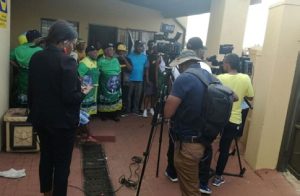
Last week, the 20th-anniversary celebrations of Abahlali baseMjondolo, attended by thousands of so-called shack dwellers from many provinces, were blocked from the media. Only GroundUp and one other daily newspaper covered the event or sent a reporter. South Africa is known as the protest capital of the world, with five major protests happening every day. But you will never know what the women and youth of those protests are protesting about. You are lucky to hear about the protest in the traffic report; if it goes onto the highway, the elites will get disturbed. Meanwhile, trade unions are blamed for the crisis that South Africa finds itself in.
Fascism rarely starts with jackboots. It starts with a quiet erasure, and it talks to an order without the poor.
Rise of the ‘strong’ man
And so there’s the rise of the ‘strong man’ as saviour. There is a danger in that. I’m not saying this to try to pour cold water on the euphoria in South Africa in praise of General Mkhwanazi. He has done a wonderful thing for our country. But when you listen to some of his solutions, you have to get worried. The number of his police officers has dropped from 25,000 to 19,000. But he doesn’t blame austerity and capitalism, or the hapless ANC state that is engulfed in corruption. He says the problem is that the unions are asking for too high wages for their members. And the middle class say yes, our general is speaking the truth. It is the unions that are a problem in the country.
And then the general says that, during things like the 21st July uprising period, we must cut social media so that nobody can communicate, because he felt that that crisis was fueled by Twitter, Facebook, TikTok, you name them. So he wants to turn the clock back to the dark days of the bannings. Follow the dictators elsewhere in Africa who blame social media instead of addressing the crisis.
So this is where we are. And this is not just in South Africa; it’s everywhere. We’ve got to re-awaken the fire in our belly; anchor our fight-back strategy to internationalism; pick up the Palestine battle; fight alongside the masses of Swaziland, the DRC, Western Sahara, and the Sudan. We’ve got to show the link between those struggles and the local struggles. We’ve got to expose the oligarchs and show the masses of our people that this is a project of the billionaires.
Our tasks
We’ve got to rebuild the bridges here at home; reroute the leadership back to the working-class communities; kill the phenomenon of the big man. We’ve got to magnify the voices of the people who are suffering from hunger and the collapse of services, not just the voices of the leadership. We’ve got to anchor our battles to the informal settlements and make them visible, even to the media. We’ve got to take on monopoly prices; take up the battle for food, for the transport crisis in South Africa, for finance, for data, for rolling actions, for the use of Section 77 notices, where that is strategic.
Yesterday, in a radio station debate, a worker said we need a special convention of the trade union movement, of the working class, to analyse and develop a programme of action against what is happening, to put the working class at the forefront of that fight-back battle. We’ve got to tackle the media and write more ourselves. We’ve got to expose them when they block out important voices of the working class. We’ve got to relink our struggles back to the youth and to the women, and defend the right to strike, to bargain, to build strike funds. And we’ve got to prepare for anti-union legal offensives.
The Sahel region shows that neocolonial chains can be broken. South Africa shows why we must rebuild working-class power now, centred around people before profits. Yes, we want order, but with justice, not without the poor; not the order of the Western Cape, which excludes the ordinary people. We’ve got to anchor to internationalism. And above all, we must fight for worker democracy from below, not worker democracy imposed by the leadership. Zabalaza must not be a slogan; it must be a plan.
Zwelinzima Vavi is General Secretary of the South African Congress of Trade Unions (Saftu).