
The Civic Action for Democracy and Equality (CADE) Gauteng was born from a People’s Assembly that was held in January 2025, following a prolonged period of interrupted supply to households during 2024. The assembly was attended by over 30 civic structures that fall mainly from within the municipal borders of the City of Johannesburg (CoJ). Representatives from the Vaal Environmental Justice Alliance were also present, as were some civic structures for the Ekurhuleni Municipality.
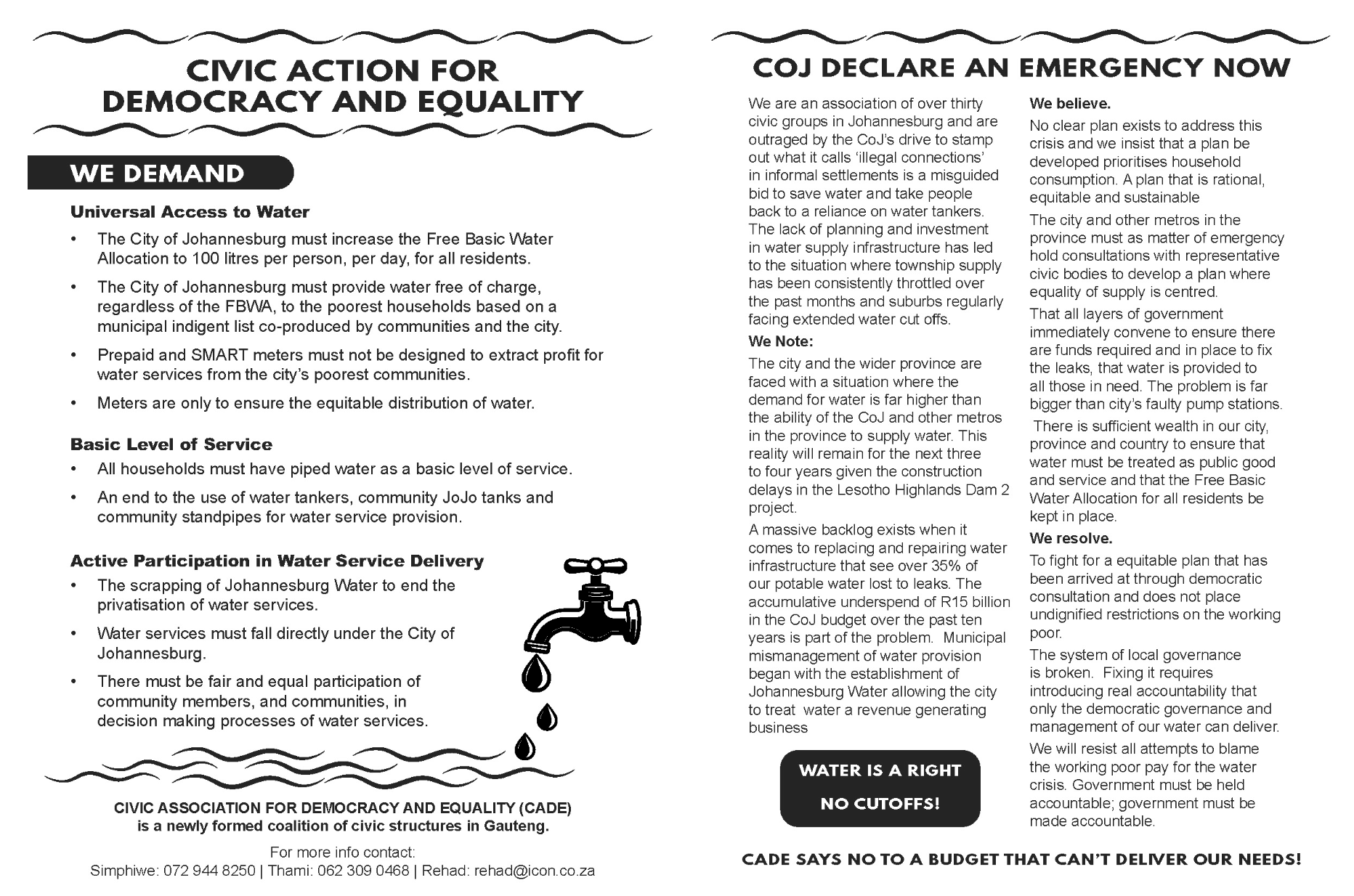
While CADE’s initial focus is water, it does not intend to limit itself only to the one service delivery issue.
Organisations that drove this initiative included the Gauteng Housing Crisis Committee, specifically comrades from Abahlali Freedom Park and Phumla Mqashi, Thembelihle Crisis Committee, and Mofolo Concerned Residents (Soweto). A residents’ association from Yeoville, Berea, and Kensington’s Water Justice Crisis Committee and SAFTU Gauteng. They were supported by researchers and activists from SWOP from Wits University, PARI, Water Can, Rivonia Circle and the State Capture and Beyond project, which includes the LRC.
The decision to come together was prompted by CoJ’s attack on nine informal settlements where they declared irregular connections to infrastructure that feed communal stand tapes to be ‘illegal’; many of these nine informal settlements were situated in region G, South Johannesburg. Phumla Mqashi led the resistance to the disconnections, bringing hundreds of residents onto the street to oppose the city’s decision to make them once again dependent on the water tankers, which often fail to provide the mandatory supply of 25 litres per person per day. A CADE/ Water Can protest was held outside the last council meeting in May.
Follow-up meetings led to the development of a set of demands on Johannesburg (see below).
In addition, CADE has joined forces with Cosmo City Civic Phakama Mhlali to defend three comrades facing criminal charges for opposing the imposition of smart meters. Of late, civic structures, a meeting in Springs has taken place to take CADE forward in the Erkerhuleni municipality. They will be meeting to organise for September to develop their own specific demands on the council.
CADE has met with the Johannesburg Crisis Alliance and will continue to participate in their summit process. Most importantly, it is working together with the JCA to build a mass protest scheduled for 30th October outside the council meeting.
At the national level, the newly formed Western Cape Water Justice Coalition and CADE participated in a conference convened by the Nelson Mandela Bay Water Crisis Committee and are involved in the process of forming a national coalition, which is being assisted by the Trust for Community Outreach.
CADE is led by a steering committee made up of civic structures and supported by an advisory group made up of comrades largely attached to supportive NGOs.
Numerous ZASO Gauteng members have been involved in the building of CADE since its inception.
Rehad Desai is a South African socialist activist and a documentary filmmaker.
*This article was first published in ZASO Online News.