Just before last weekend’s meetings of the World Bank and International Monetary Fund (IMF) board in Washington, South Africa's finance minister dropped us an obscure news item: “Gordhan concerned about rand volatility”(Reuters, April 16). Hidden away in the business...
rate
May Day: From history to saving the future | by Jeff Rudin
We are about to celebrate May Day. There are important connections between this May 1st holiday and the proposed amendments to key labour legislation, unemployment and climate change. Developing these connections is best begun by noting Labour’s very public outrage...
Vavi responds to Sharp attack on Trade Unions | by Zwelinzima Vavi
Cosatu general secretary Zwelinzima Vavi responds to an opinion piece in Friday’s Business Day by Adcorp’s Loane Sharp that ‘SA trade unions are the biggest obstacle to job creation’. He calls it “hogwash” that would not have shocked Joseph Goebbels, “whom Mr Sharp...
Economic policy PR without scruples
Originally in Business Day, 2012-03-05 Adcorp’s method of measuring employment "generates such massive employment levels that it does away with SA’s unemployment problem in one fell swoop, lowering the unemployment rate to around 5%", write Dr Kerr and Prof Wittenberg...
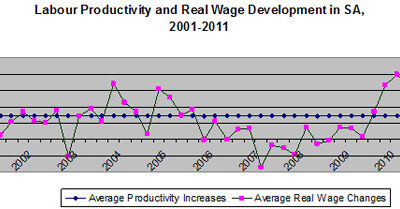
Productivity is rising even as wage share dips, data show
Last week, the Reserve Bank (SARB) issued its latest Quarterly Bulletin. It covers economic development in South Africa up to June 2011 and economic prospects for the coming period, as the SARB views it. As usual, the bank also discussed developments in labour...
South African economy still vulnerable, volatile and violent to poor and working people | by Patrick Bond
A slow dawn of realisation is setting in among sensible elites: that the world economy isn’t going to recover according to any prior experience, that financial markets are rigged to transfer from the 99% to the 1%, and that ecological barriers are emerging fast on the...
China cannot save the world from the economic crisis | by Bruno Jetin
While North America and Europe were hard hit, China has survived the international crisis of 2008, thanks to huge public spending, a low interest rate and consumption subsidies. China’s growth rate reached 9% in 2009 and 10.4% in 2010; in its wake, China dragged Asia...
What We Are For | by Richard Heinberg
Every activist engaged in combating human-caused climate change or specific elements of the current energy economy knows that the work is primarily oppositional. It could hardly be otherwise; for citizens who care about ecological integrity, a sustainable economy, and...
Undertsanding Climate Change: A beginners Guide to the UN Framework Convention and its KYOTO Protocol
WHAT IS THE GREENHOUSE EFFECT?In the long term, the earth must shed energy into space at the same rate at which it absorbs energy from the sun. Solar energy arrives in the form of shortwavelength radiation. Some of this radiation is reflected away by the earth's...