Introduction The Greek crisis represents the deepening of a long systemic contradiction whose origins lie in the 1960s, in the stagnation of monopoly capitalism and the emergence of the South. The industrial centers of the world economy were struck by a crisis of...
data
Lies, damned lies and statistics
Lies. damned lies and statistics. It’s a cliché that has been used several times in this column over the years. I have used it because statistical data, especially about employment and the cost of living, can influence attitudes, opinions and policy decisions. As...
Adcorp and CDE wrong about productivity decline
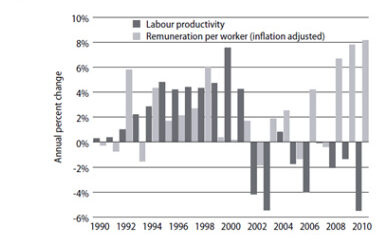
Press statement from AIDC, 14 September 2011 Arguing for cutting workers' wages, Adcorp and Centre for Development and Enterprise (CDE) mislead media and the public. The Centre for Development and Enterprise (CDE) and the labour broker Adcorp continue to argue for...
Productivity is rising even as wage share dips, data show
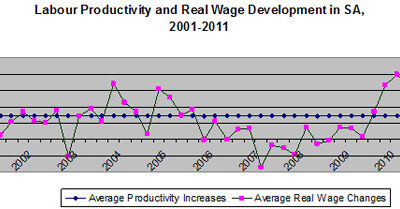
Last week, the Reserve Bank (SARB) issued its latest Quarterly Bulletin. It covers economic development in South Africa up to June 2011 and economic prospects for the coming period, as the SARB views it. As usual, the bank also discussed developments in labour...
Wages, profits and labour productivity in South Africa: A reply
Forslund’s final reply to Sharp and Kantor, originally published on PoliticsWeb.co.za and SA LabourNews.co.za, 24 January, 2012. In this final reply, I will correct an error, account for a new finding and try to give a principled answer to the replies Brian Kantor and...
Economic policy PR without scruples
Originally in Business Day, 2012-03-05 Adcorp’s method of measuring employment "generates such massive employment levels that it does away with SA’s unemployment problem in one fell swoop, lowering the unemployment rate to around 5%", write Dr Kerr and Prof Wittenberg...
Protests and Police Statistics: Some Commentary | by Prof. Peter Alexander
On 19 March the Minister of Police, Mr. Nathi Mthetwa, informed parliament about the number of ‘crowd management incidents’ that occurred during the three years from 1 April 2009. Table 1, compares the new data with similar statistics for the preceding five years.In...
Occupy Wall Streeters are right about skewed economic rewards in the United States | by Josh Bivens and Lawrence Mishel
The Occupy Wall Street movement has captured much the nation’s attention with a clear message: A U.S. economy driven by the interests of business and the wealthy has generated increasingly unequal economic outcomes where the top 1 percent did exceptionally well but...
European Crisis: Precise Solutions in an Imprecise Reality | by George Friedman
An important disconnect over the discussion of the future of the European Union exists, one that divides into three parts. First, there is the question of whether the various plans put forward in Europe plausibly could result in success given the premises they are...