
Amandla!: Ruth First was a product of both South African and international Marxist traditions. How would you characterise the ideological influences that shaped her political thinking?
Rob Davies: I knew Ruth first as my boss for three years until she was murdered in Maputo. So from 1979 to 1982, I knew her as the director of research at the Centre of African Studies at Eduardo Mondlane University in Maputo, and for about five years before that.
Ruth was someone who was very, very loyal to the movements that she was part of. She was a member of the ANC and the SACP, and she was committed to those organisations. But she was also someone who was very open to other ideas, particularly progressive ideas, progressive socialist and Marxist ideas that were very much present in the circles of British academia. There were very active debates in the 1970s on a whole lot of issues, including modern Marxist writers and the Althusserian tradition. There were journals like Economy and Society, which were major points of discussion about Marxist theory. Ruth was open to the inputs from those traditions, which were not the kind of thinking that emerged directly within the SACP. So were people like Harold Wolpe, and Pallo Jordan, who was in the ANC.
But unlike someone like Harold Wolpe, who was deeply engaged in a lot of theoretical Marxist debates, Ruth’s focus, and it was very much the way she conducted herself in Mozambique, was very similar to what later Chris Hani would say about socialism. Socialism is not about big ideas and deep theory. It’s about a whole lot of real material issues affecting working people. As long as working people were subject to the diktats of capitalism, the case for socialism would remain. That was Ruth’s focus.
So she was looking to generate, at the time she was in Mozambique, policy proposals that would advance what she saw as a very weak and fragile socialist project in Mozambique. So it was more the use of Marxist theory as a tool of analysis of the concrete reality of societies that she was operating within on the continent, and to the end of her life, it was in Mozambique. But it was also ways to understand the conditions of the working class in South Africa, and how to transform those conditions in a socialist direction. That’s how I would see the Marxism of Ruth First.
A!: Around race, class and gender, how did she navigate those intersections in her political thinking, especially within the context of South Africa’s racially divided working class?
RD: She understood the interrelationship of race, class and gender. Perhaps gender was a dimension that came a bit later in her political life, but she wrote a book on Olive Shreiner, which looked at the role of a particular female character at a particular moment in South African history. She recognised the importance of gender. But she recognised the fundamental issue of national oppression that shaped a racialised capitalism in South Africa. And so she was focused on the issues of the working class, but the working class understood in a context of national oppression, and also the particular relations of production that were forged in South Africa.
So she looked at things like households in Mozambique. She did a book on the Mozambican miner. She saw, for example, the way gendered roles played a part in the reproduction of migrant labour and made it possible; the dependence of household income on subsistence production, generated by households and by women households; the way in which the absence of men in migrant labour was a factor that enhanced and increased the oppression and exploitation of those women.
She understood the connection between those three critical dimensions. But as a Marxist and as a socialist, she understood that the class question was fundamental in shaping the direction of change and liberation that needed to unfold in terms of all of those three dimensions.
A!: If we can turn to look at the context in the party during the time that she was active. There’s some suggestion that she held a more critical, independent Marxist position than the official party line. What was going on in the party, and where did she stand?
RD: So, of course, she was married to Joe Slovo, who was the General Secretary eventually. And she and someone like Harold Wolpe, and someone even like Pallo Jordan, who was not in the party, influenced Joe into a greater openness than many other members of the party were used to. This was a time, the 70s, with a lot of Marxist analysis of South Africa beginning to emerge. Typically, people who were in British universities were turning out different pieces and analysis. And this was viewed with some suspicion by some members of the party. I remember I wrote a piece for the African Communist under the name of ‘A Reader from Maputo’, to respond to a critique which had said that all of this was undermining the national liberation movement. All of this was part of the Marxist Workers Tendency tradition. I said that there’s now a shifting in the terrain to start to see the issue in South Africa as an issue, fundamentally, of capitalism and capitalist exploitation. That must surely, for Marxists, be an advance. There was a certain reluctance and resistance to that among some comrades.
But the importance of someone like Ruth was that she had the respect, and she was someone who suffered no dogmas. What I didn’t say about her Marxism, as well, was that there was a concept which developed during the work that she was leading in the Centre, which they fought for in Mozambique as well, which was called ‘critical support’ for the liberation project. And that critical support is a dialectic. How is criticism supportive?
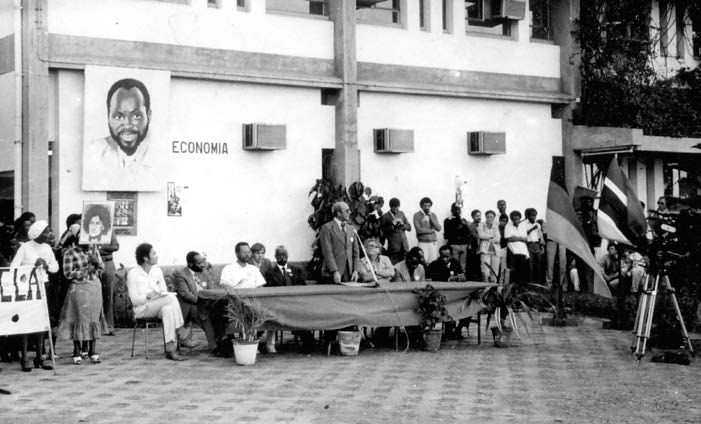
Memorial for Ruth First at Eduardo Mondlane University, Maputo, August 1982. Albie Sachs is seated far left. At the table: Jacob Zuma, interpreter standing, Moses Mabhida, Fernando Ganhão (rector), Joe Slovo and Malumi. (Photo: thealbiecollection.org)
In the case of Mozambique, the idea was that the objective as defined by the liberation organisation was not in doubt. Frelimo proclaimed itself to be wanting to build a Marxist, Leninist, socialist country. That was not in doubt. But she argued, along with Aquino de Bragança, the Director of our Centre, that the best contribution that researchers could make was to uncover issues, raise questions, criticise existing practice, with a view to improving the struggle for the objectives which were set in the political process—the liberation struggle.
There was a lot of dogmatic repetition kind of teaching of Marxism-Leninism at the university where we taught. And she was quite critical of that—historical and dialectical materialism, which was often styled by the students as hysterical and diabolical materialism, because it meant nothing to them. Just to recite a series of propositions without them having any relationship to the reality that they were part of.
Her influence was to have a more constructive and inclusive way of thinking within the SACP itself. And she was someone who had the prestige and commanded the respect to be able to inject that kind of thinking. I was no intimate friend of Joe or Ruth, but I personally sat in their lounge and heard Ruth and Joe having a real ding-dong about one or other theoretical issue. So she held her corner, and she said her piece. She was able to inject a greater openness to different kinds of ideas and different kinds of Marxist propositions than perhaps many of the long-serving members of the SACP at that stage were willing to accept. So she had an important role in the renewal of thinking within the SACP.
A!: How does that openness deal with the question of the Soviet Union, the bureaucratisation of the Communist Party leadership? Did she develop a criticism of Stalinism? Was that part of the engagement with the emergence of the new Left that you talked about earlier?
RD: I don’t think I ever heard her directly criticise the Soviet Union in those kinds of terms. But I do know that she was not enamoured with the way in which they conducted themselves, for example, in Mozambique, at two levels. One was the pedagogy of the university, and the other was the advice which Eastern European countries were giving, and the way in which they operated in the agricultural economy.
There were the state-owned farms, which were taken over from departing settlers and often consolidated into large units. And these were trumpeted, because they were state-owned, as socialist in character. So any increase in production was seen as an enormous step forward towards a socialist future. Some of the research that was conducted under her auspices was looking at the relations of production within those entities, which were still migrant labour. And she thought that there was an insufficient model of organisation of rural households, and tended to favour cooperatives, which were rather underrated in that transition.
So in practice, many of the things that she was trying to advance were quite different and distinct from what was emerging from the Soviet Union. At the same time, she would have recognised the importance of the Soviet support for the liberation struggle in South Africa, and the Soviet support for security in a place like Mozambique, which was under the challenge of destabilisation from the apartheid regime.
A!: If you look at something we could call Ruth First’s political thought, or the tendency of her thought, has that been adequately brought into post-apartheid South Africa’s Left traditions?
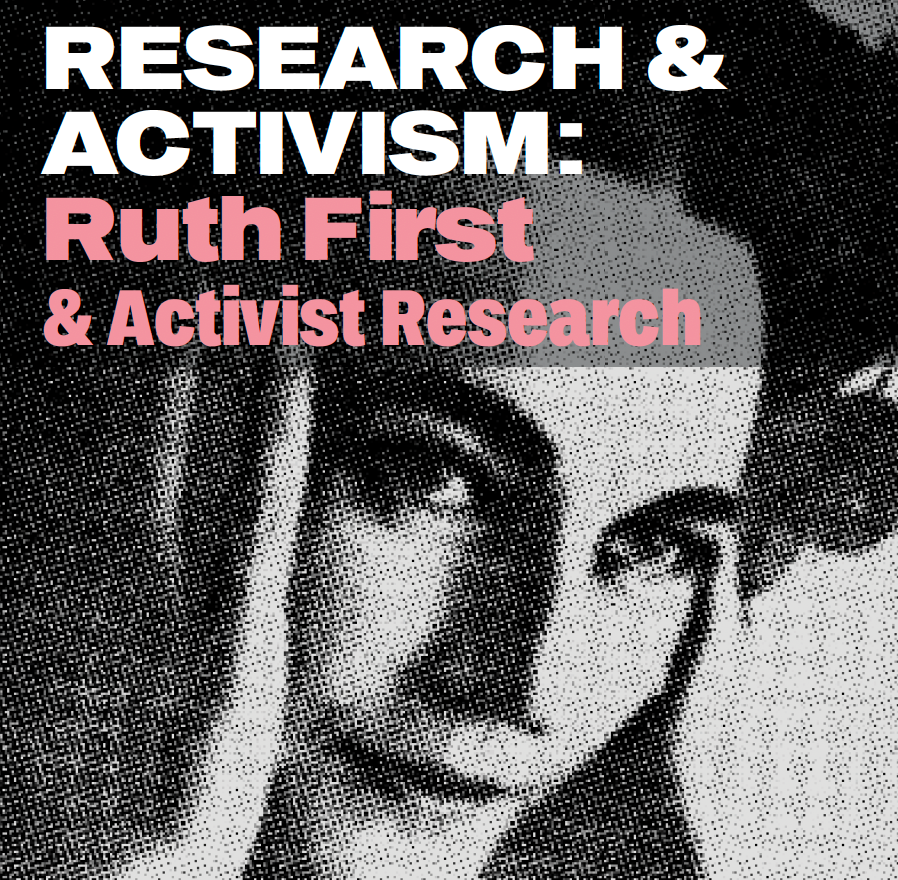
There’s an interesting volume that has just come out, edited by Salim Badat and Vasu Reddy, called Research and Activism: Ruth First and Activist Research, and it’s trying to look at the legacy of Ruth First in this regard.
RD: There’s an interesting volume that has just come out, edited by Salim Badat and Vasu Reddy, called Research and Activism: Ruth First and Activist Research, and it’s trying to look at the legacy of Ruth First in this regard. We haven’t captured or taken forward the spirit of the kind of engagement that she was developing at the time of her death in Mozambique, and even before that, and the engagement with the rest of the continent. Of course, the circumstances and conditions are very different.
I wrote a preface for the book, and suggested that I think that broad documents like the Freedom Charter can still serve as an important lodestone for where we need to be going. But the actual policies of governments of liberation movements can no longer command the kind of directive impulse that she understood when the notion of critical support was developed in Mozambique. There’s a much broader process that’s going on, with different actors, with labour movements, and with those parts of civil society that are actually rooted in communities and represent the interests of communities (as opposed to some NGOs). There’s a whole different ball game that we’re in. But activist research is a direction that at least research ought to focus towards. There needs to be a greater understanding of the global environment and the way in which policy frameworks that have come to inform government policy have gone in other directions than those in the interests of the working class and the poor in South Africa.
A!: What aspects of Ruth First’s vision would she regard as most urgent or relevant for us in South Africa and for the international Left now?
RD: Well, I can’t think that Ruth would be other than horrified by the fact that, more than 30 years after the liberation movement has been in government, we have unemployment at a level which is higher than it was in 1994. And linked to that, where we have half the population living below the upper bound poverty line, more than half the female population, and with inequalities among the highest in the world. I can’t think that she would think that that is anything other than a matter of major concern.
And she would probably feel that the movement had become too bureaucratised, too enmeshed in governmental processes and distant from the needs and interests of ordinary people. Whatever form it takes, a liberation project has got to retain its links with the ordinary masses and the conditions of the ordinary masses of people in the country. 100 years on from her birth, her legacy would probably lead us to want to reconnect with the real interests of ordinary working people and the poor, and to try to drive their interests further forward in the national agendas of the country.
A!: Maybe I can sneak in a question to you at the end here. Can these fundamental problems that you refer to be addressed in South Africa today without an equally fundamental change in macroeconomic strategy?
RD: Well, I think not myself. I don’t know whether we always understand this macroeconomic policy framework. It’s a framework derived from the interests of the erstwhile global hegemon at an earlier period in time. It drove a process of hyper-globalisation and neoliberalism. And we still adhere to its fundamental tenets. And there’s been enough evidence now that that is antithetical to the needs and interests of working people and the poor. The outcomes that we continue to have are just another demonstration of that reality. Macroeconomic policy, which for the last 30 years or so has been held to be sacrosanct and unchangeable, is a real constraint on us achieving the kind of transformation that we need to achieve in this country.