
The government’s political choices are weakening public schools and creating space for private actors to step in. This has concerning implications for equity and democratic control.
National budgets shape society by determining how public resources, responsibilities, and risks are distributed. As we await the tabling of the next budget, we might still be surprised by another attempt to hike regressive taxes or cut real expenditure further. But even without these measures, there are increased attempts to entice private actors to substitute for public investment.
The SONA largely affirmed the policy recommendations from the IMF’s Article IV staff report – agreeing to maintain fiscal consolidation, de-risk private investment, and open up public goods to the market. While similar structural reforms to the basic education system are not explicitly mentioned, the overarching fiscal framework makes these developments implicit. Austerity drives a more stratified, more privatised, and less democratically accountable schooling ecosystem.
Years of austerity have decimated our public education system. Minister of Basic Education, Siviwe Gwarube, has flagged seven out of nine provincial education departments for being in financial distress. The neglect is clear: stories of unadmitted students, dilapidated infrastructure, overcrowded classrooms, and nutrition programme shortfalls. These are perennial problems which the government has not demonstrated the political will to solve. Nor have they attempted to mobilise sufficient resources. Instead, their response is displayed in increased efforts to incentivise the private sector to step in.
Unlike other goods, which consumers can opt out of purchasing, basic education is a constitutional right, fundamental to the future of each individual and society as a whole. There is a global consensus, rooted in various UN conventions, about the importance of basic education and states’ obligation to realise this right for all. We cannot opt out of education.
Mushrooming private schooling
Beyond the rights-based argument, an economist’s lens tells us that public education systems are more efficient because the benefits of a generally educated populace accrue to society as a whole, not just the individual recipient of an education. When the state reneges on providing universal public education, then an array of perverse outcomes ensues.
Costs have to be borne privately, and so inequality deepens as access to decent schooling becomes increasingly determined by household income. No-fee public schools in South Africa are increasingly putting inordinate pressure on poor learners and parents to provide in-kind and cash donations for public services. Fee-charging public schools are increasing fees, while at the same time reducing the number of fee-exempt students. Because households generally cannot afford to absorb these costs, overall schooling quality degenerates.
As a result, private schools are mushrooming – the proportion of private schools in Gauteng grew from 23% in 2017 to 33% in 2025. Families who can scrape the means are increasingly exiting the public system, while poor and working-class children are left in overcrowded classrooms with fewer teachers, textbooks, and support services. This stratified education system thus continues to reproduce apartheid-era patterns of racialised inequality.
This is the crude reality at the coalface of our education system under the present fiscal framework. Its failures are blatant. But beneath this lies a series of other emergent developments that may also threaten the ideal of a public and equitable education system.
Consequences of privatisation
Both internationally and in South Africa, austerity has created the foundation for an increasingly stratified and marketised public school system. Logics of accumulation, competition, and enclosure (privatising the control of and access to resources) become embedded in the way schools are controlled, accessed, funded, and taught at. To understand this, it is useful to draw on a typology developed by Mockler and other education researchers to explain the location of publicness in the provision of education, reproduced here. The framework helps to categorise some of the areas in which forms of privatisation, commercialisation and marketisation reshape public schooling.
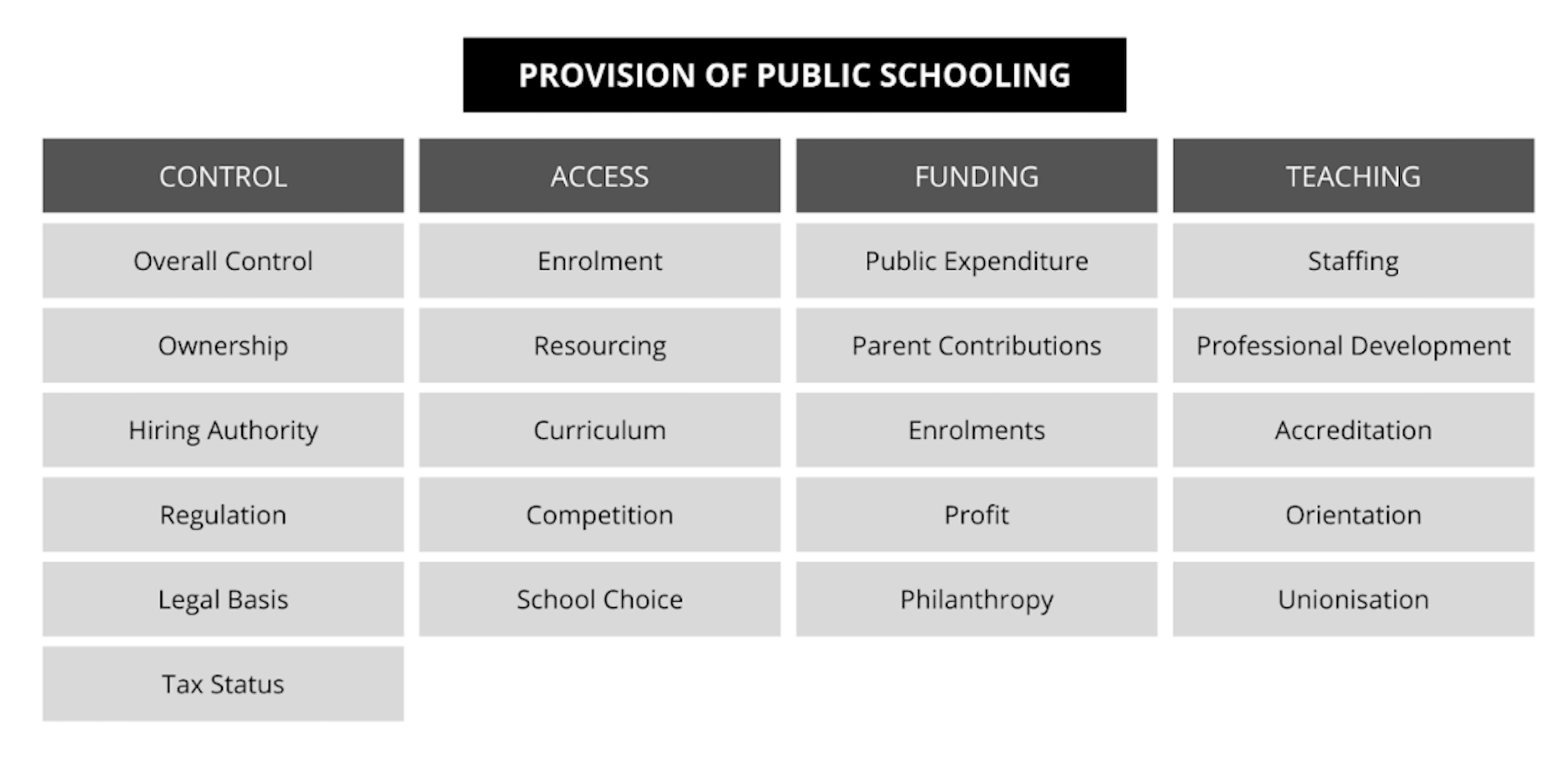
While education departments are increasingly pressured to ‘do more with less,’ perverse incentives emerge in the sector. Those with resources are given more power to control, enclose, and exploit the education system at the expense of those without.
On school control: the emergence of collaboration and donor-funded schools – where private actors hold half of all seats on the school governing body – threatens community-grounded democratic governance in schools. Notably, the Western Cape’s legislation develops loopholes for private actors to significantly influence school governance. But it does not specify what skills, expertise, or educational experience these private actors must possess. The ability to bring money to a school is essentially the sole criterion for granting significant decision-making authority over public education institutions.
On access: the contestation over the Basic Education Laws Amendment Act (BELA) is illuminating. Right-wing bodies are still invested in diluting regulations and duties of education departments to prevent discriminatory language and admissions policies at schools. Central to their fear is the idea that public schools are resource-constrained. So, efforts to induce greater and more diverse learner enrolment, especially at former model-C schools, would force schools to distribute their resources more broadly. The more BELA is diluted, the more power these schools have to enclose both public and privately-raised revenue.
On teaching: there is an array of affronts that teachers endure in the wake of austerity, but one of the more alarming trends is in the low-fee private sector. Some of these schools are piloting blended learning models, in which technology-mediated instruction is ‘blended’ with face-to-face supervision, often by ‘facilitators’ who are not fully qualified. This allows them to reduce their wage bill by holding classes of over a hundred learners and employing facilitators at low wages to guide learners through the technology-mediated lessons.
Some of the private encroachments are relatively in their infancy in South Africa. But evidence of similar adoption from around the world raises serious red flags about the consequences they have on democracy, equity, and social cohesion. Amidst an austere fiscal environment, they can appeal as quick-fixes to plug fiscal holes and promote innovation. But in reality, they are difficult to scale, carry hidden costs, and limit bottom-up accountability.
Of course, interventions by private actors are not necessarily always bad. Many are promoted by ostensibly well-meaning individuals and institutions. But it is important to be wary of the context in which they emerge, the incentives they introduce, and the structural risks that they pose. Decision-makers and legislators have a responsibility to assess these against their statutory and moral obligations. Strong laws are needed to promote equity and enforce transparency and accountability. Without these, private actors – even those not seeking a financial profit – can exert undue influence over the public good.
Perils of the current trajectory
If this year’s budget follows the blueprint of previous years – prioritising a primary surplus while attempting to cushion its spending blows – the outcome will be predictable: Further exit from the public system by those who can afford it, worsening conditions for those who cannot, and a steady erosion of education as a public good.
The choice tabled before parliament is not between an underfunded public system and benevolent private intervention. It is a different choice. On the one hand, deepening an austerity-driven model externalises costs onto communities while introducing incentives that make them more vulnerable. On the other hand, a decisive recommitment to public provision.
A government serious about inclusive growth, reducing poverty, and building a capable state cannot outsource its constitutional obligations to the market and call it reform.
Mahfouz Raffee is Head of Research at Equal Education.