




“There are decades where nothing happens, and there are weeks where decades happen.”- Lenin
This quote has haunted me for years. It captures something that unnerves me about being young in South Africa right now: we live inside a liberated nation while feeling absolutely politically abandoned, not as sentiment but structurally. I can only hope that our own rupture is progressively organised and can be sustained for as long as it takes to meet true liberation.
Young people under 30 made up 54% of those eligible to vote in the last electoral cycle, yet less than a fifth of us were registered. We are expected to participate in civic duties, while decisions are made without us. We are ignored or labelled vigilantes when we demand our rights. Meanwhile, tens of thousands join the millions in waithood every year, as the jobs bloodbath deepens. Not from laziness. From systemic political abandonment.
Our struggle is clear—our common enemy is capitalism and its neoliberal agenda: organise society for profit over people. It asks poor and working-class communities to tighten their belts now, and promises dignity later, once the markets stabilise, or once economic growth trickles down, like holy water, from the Sandton boardrooms.
That is why this anniversary cannot only be about commemoration. Memory without organisation is just performance. The class of 1976 did not risk their lives so we could reduce them to annual hashtags and carelessly curated nostalgia. I believe that the June 16 uprising was a rupture inspired by political imagination. Without romanticising their struggle, those actions were organised across local communities and crossed borders for solidarity. It’s our turn to accept the fiery baton.
On Mabaphil’ABANTU
Last week, Mabaphil’ABANTU recorded its first podcast. This is not a polished media product or an experts’ panel but a conversation; an offering and an invitation into what we are calling a political reflection space. A mantra for ABANTU: for collective healing and reckoning.
Mabaphil’ABANTU exists because activists and our communities need intentional spaces to reflect on our own attempts at justice. Spaces for strategic pause, as Freire understood it. Spaces for rest, for study, for radical joy. Spaces where people can think together before burnout becomes ideology. We are answering bell hooks’ call: building love schools—political homes where reflection, care, contradiction and imagination are treated as necessary for struggle.
The conversation featured Dinga Sikwebu, a retired union organiser and lifelong justice seeker; Sindisa Monakali, a 29-year-old student, activist and scholar from Khayelitsha; and Yolanda “Bunny” Sewela, a 19-year-old student, former ‘Equaliser’ and education activist. What emerged between them was not consensus—I have been itching to witness what comes from true intergenerational conversation, because I truly believe that real movement building happens, also, in the contradictions.
Urgency vs the long game
Dinga reflected on organising during and after 1976, warning against the politics of ultimatums. Not because urgency is unnecessary, but because movements built only on reaction eventually collapse under exhaustion. You must do the slow work of consciousness-building, convincing people to act collectively through their own political understanding and not emotional momentum alone.
Then Sindisa and Bunny interrupted that sentiment, respectfully. They argued that political ultimatums are exactly what this moment demands. What happens when institutions no longer respond to engagement? When our memorandums become ceremonial theatre? When young people are deliberately excluded from the mechanics of governance, while leaders keep asking for patience?
“We are tired of waiting”, they said, in different ways, throughout the conversation. Tired of waithood. Tired of protest fatigue. Tired of speaking politely into systems that only respond when communities burn tyres or when we occupy campuses.
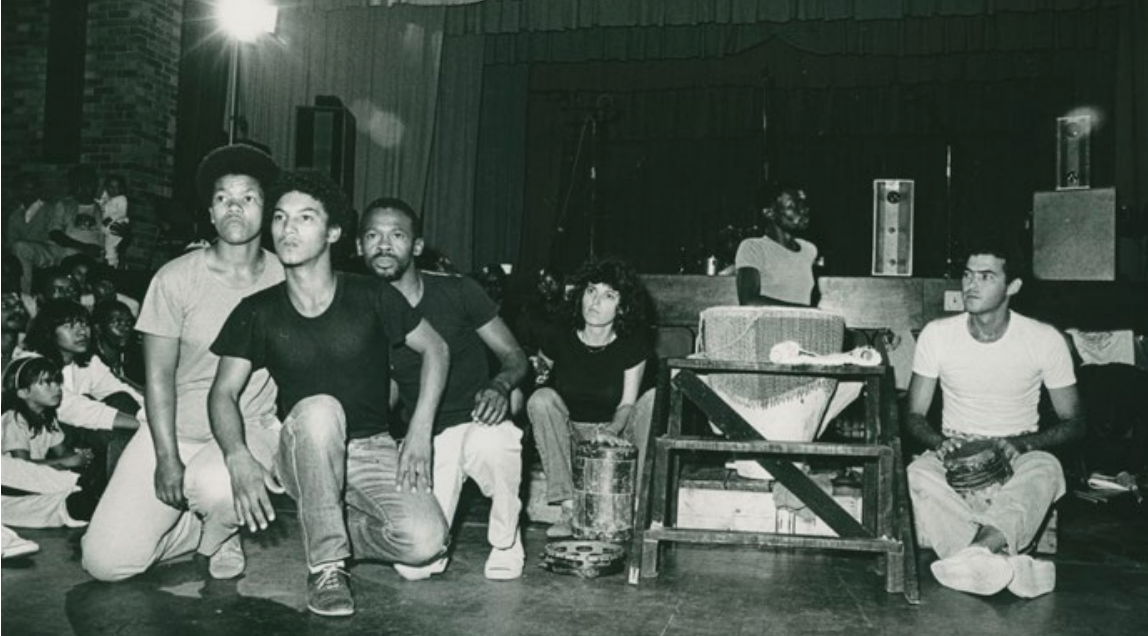
1985. The UDF Players present a play. We occupy a political culture where music, art, memes, love, fashion, grief, colloquial language and resistance travel across borders faster than institutions can contain them. (Unknown Afrapix photographer)
One of the most moving moments came when Bunny told Dinga: “I want to struggle with you… but on my terms”. That stayed with me. Intergenerational organising cannot mean young people quietly taking the baton of exhausted institutions or tactics. Nor does it mean dismissing elders as irrelevant. It must mean collaborative building and solidarity, with young people insisting on their own political agency.
Sindisa spoke powerfully about rejecting xenophobia entirely, arguing for a Pan-African political imagination rooted in solidarity against our common enemy. Political and economic inequality is producing dangerous desperation worldwide. Poor and working-class people are being mobilised to hate one another, instead of confronting the systems that oppress them.
This conversation reminded me that we do, in fact, possess an arsenal. We know how to find each other beyond hegemonic politics. We are making community in our own way. We occupy a political culture where music, art, memes, love, fashion, grief, colloquial language and resistance travel across borders faster than institutions can contain them. Solidarity does travel—the Palestinian solidarity movement is but one example.
Reflecting on social media, Bunny acknowledged its limitations: that platforms cannot sustain movements alone, that algorithms can flatten politics into consumable aesthetics, and that outrage becomes content. But she also insisted that social media has expanded political consciousness. And she is right. The purple movement against gender-based violence and femicide in that moment re-energised public discourse in South Africa. Survivors stand tall. Rage became visible. Silence is growing less. Thousands of women are reminded that they were not alone in their experiences, and this matters.
The task now is moving beyond just visibility towards organising against the big man, aka capitalism, for a sustained struggle. How do we embed our version of justice into institutions, culture, economics and everyday life long after hashtags disappear? How do we build political forms capable of surviving beyond clickbait and trends? How do we organise for the long run?
What to do with this fiery baton?
Over 508 parties have registered to contest South Africa’s local government elections. More than 100,000 candidates for approximately 10,000 seats. Some call this democratic vibrancy. I am less convinced. This local government election will see no outright winners, but we must make sure not to become collateral damage to political party interests.
Local government is where ideology becomes basic services. Every dry tap, every eviction, every broken library, every closed clinic, every piece of land left vacant while young people beg for opportunities is ideology presented as municipal priorities/objectives.
Some parties claim ideology is irrelevant and that service delivery alone matters. Nonsense. Service delivery is ideology. The Western Cape illustrates this: a province where comfort and mobility are carefully protected for those who have, while poor communities are criminalised and displaced. This is modern-day spatial apartheid with excellent branding.
And here is what makes it worse: much of the actual money still sits in provincial and national coffers. Municipalities are expected to deliver housing, sanitation, clinics and spatial transformation while remaining financially dependent on higher spheres of government that are politically invested in maintaining that dependence. Local government is simultaneously blamed and structurally restrained. That is not accidental. It is designed.
An entire White Paper process is underway that could reshape local government financing and participatory democracy in South Africa. Yet where are young people in this conversation? Where is the public political education? Even calls to extend the deadline for participation have been refused. Once again, democracy risks becoming something administered to young people instead of built with them.
Some parties claim to represent the poor while embracing xenophobia. Others perform democracy publicly while operating internally through elite handshakes and closed boardrooms. Some reject basic income support for unemployed youth while claiming to care about inequality. Others market themselves as anti-establishment while openly endorsing authoritarianism and genocide in other regions.
Our voting choices are less than underwhelming. Still, I refuse to be hopeless. We must go out there and vote, but young people must also organise independently and permanently, outside of electoral cycles. Build political cultures rooted in accountability, transparency and community leadership.
This should not be a neutral movement, not apolitical and not easily captured. A movement capable of holding all political power accountable, regardless of the t-shirt. A movement undoubtedly rooted in progressive politics and intersectional in its nature; strong on international solidarity and practising democratic participation from below.
Maybe the task of our generation is not to “become the next 1976”, but rather to become the generation that accepts the baton and refuses to normalise capitalist greed and fascism. The invisible hand has governed long enough. The transformation of society is imminent, but not through one perfect uprising, or during one election; and certainly not through one charismatic leader. But through the long, unfinished, deeply human struggle that the class of 1976 placed into our hands 50 years ago and believed would inspire those who came after.
Noncedo Madubedube is a social justice organiser, movement strategist and founder of Mabaphil’ABANTU.
*Featured Image by Peter Magubane

