
Youth of 2026: do it for the kids
By Kopano Mashike
The youth of 1976 placed their bodies between oppression and the future. The question now is whether the youth of 2026 still believe the future is worth fighting for.
Fifty years ago, young people took to the streets and changed the course of history.
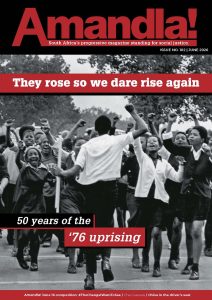
In 1976, thousands of Black school children marched against the apartheid government’s decision to force Afrikaans as a language of instruction in schools through the brutal system of Bantu Education. But the march became about more than language. It became a rebellion against oppression itself. Against a government that had decided Black children deserved less, less dignity and opportunity.
Many of those children never came home, and yet, they fought anyway.
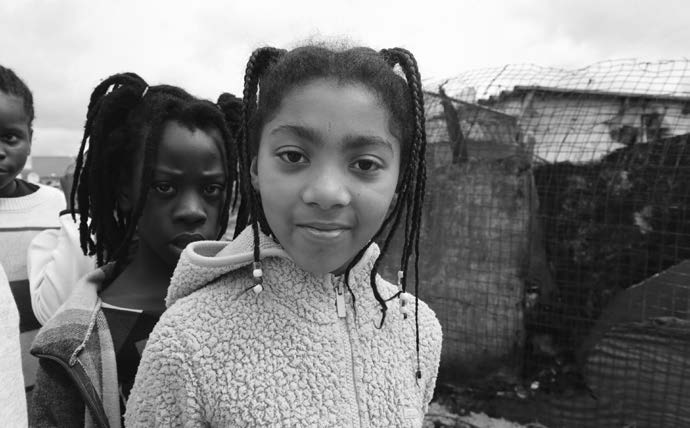
Photo: Kopano Mashike
Today, as we mark fifty years since the Soweto Uprising, I think about something said recently by mayoral candidate Lukhona Mnguni during an interview with Sizwe Mpofu-Walsh: “The future is getting younger”. And he is absolutely right. But perhaps the truth is even deeper than that. The future was always young. It has always belonged to children. History has always shifted because young people refused to accept the world as it was handed to them.
That is why I often wonder what the youth of 1976 would think if they saw us now. Although we are no longer forced to live under many of the legal injustices they fought against, we are still trapped inside the aftermath of apartheid. We live with unemployment, violence, alcoholism, corruption, inequality, and the continued psychological violence of being told directly and subtly that Black life is still worth less. And when something is repeated enough times, it begins to sound like truth, even when it is not.
What concerns me most is not us, but the children growing up inside this reality. The ones whose futures are sitting in our hands while we scroll past suffering, debate politics like gossip, and watch the collapse of our country as though we are powerless to interrupt it.
Sometimes I think we have collectively accepted defeat. We are disinterested collectively. Not angry enough. Not tired enough. Certainly not as fearless as the students of 1976. And that is terrifying. Because the tragedy of South Africa today is not only corruption or unemployment. It is also the slow death of imagination. We no longer know how to dream collectively. We no longer believe another world is possible. We survive, but we do not imagine. And perhaps that is the most dangerous thing any system can do to a people, convince them that resistance is futile before they have even begun resisting.
But despite this, I still believe change is possible. I just cannot imagine that change coming from anywhere outside of the arts and academia.
Academia gives language to our suffering. It reminds us that what we experience today is not accidental. It tells us that poverty in Black communities is not a moral failure but the aftermath of a deliberate political design. It teaches us that apartheid was not only about segregation but about engineering generations of economic exclusion and psychological inferiority. It reminds us that corruption hurts so deeply because many of the people now in power know exactly what injustice feels like, yet still choose greed over service. They eat from the pregnant cow and leave nothing behind for the generations still to come.
And then there is art, which I believe is inherently political. It may not carry a gun, but it starts conversations. It documents memory. It mourns, archives, and confronts power. It allows people to imagine a different tomorrow while interrogating the failures of today.
As Kitso Seti says in his debut album Sons of Perdition, “In the beginning we were homes”. Art reminds us of that. It reminds us that before displacement, before land dispossession, before violence and survival, there was humanity. There was belonging. There were people who dreamed freely.
And there are still artists and thinkers among us carrying this work forward. The Tiisetso Mashifanes, the Iphupho L’ka Bikos, the Nomfundo Xaluvas, and the Kitso Setis of our generation. People using art, research, theatre, music, archives, and scholarship to tell us where we are, how we got here, and how we might still find our way out.
The change I want to see is a South Africa that invests seriously in both the arts and education. A country that understands that songs, theatre, academic papers, community archives, poetry, documentaries, and storytelling are not luxuries but real survival tools. They are blueprints for liberation because no society can heal if it cannot first tell the truth about itself.
And finally, I want us to remember the children.
The ones we birthed, the ones we are raising, the ones inheriting the emotional, political, and economic consequences of our decisions.
I think of the children in overcrowded classrooms. The ones walking home through violence. The ones learning hunger before they learn algebra. The ones already being taught to shrink themselves before they have had the chance to discover who they are.
What kind of country are we handing over to them?
Because the youth of 1976 did not fight so that freedom could become a performance. They did not die for us to inherit a democracy where dignity remains a privilege. They fought because they believed the generations after them deserved better. And maybe that is the question we must ask ourselves fifty years later: do we still believe the children deserve better?
Do we still believe enough in tomorrow to fight for it?
I hope we do.
Because history has already shown us what young people are capable of when they decide they have had enough.
The change I want to see
By Lerato Mphirime
Coins in the soil
By Boitumelo Mohlabane
I am Boitumelo Mohlabane from Sekgakgapeng village in Limpopo, South Africa.
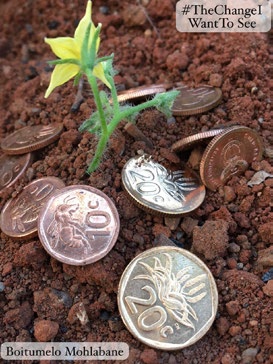
Photo: Boitumelo Mohlabane
In my village, poverty is something we wake up with every day. Many young people grow up believing that dreams are too expensive. We see coins every day, but they are never enough to change our lives.
In this picture, I planted a small flower among coins in the soil. The coins represent the little money many families survive on. The dry soil represents hardship, hunger, and struggle. But the flower represents hope, the youth of South Africa.
Our parents and grandparents fought hard during apartheid so that we could have freedom today. Nelson Mandela once said, “Education is the most powerful weapon which you can use to change the world.” I believe the youth are that weapon. Even when we come from poor villages like Sekgakgapeng, we can still grow, just like this flower growing from hard ground.
Youth Day reminds us of the brave students of 1976 who fought for a better future during the Soweto uprising. They planted seeds of freedom for us. Today, it is our turn to plant seeds of change.
This picture is called The Change I Want To See because I dream of a South Africa where no child’s future is limited by poverty, where young people rise from the soil of struggle and bloom into something beautiful.
*Featured Image by Sophie Dlamini