
Each generation must, out of relative obscurity, discover its mission, fulfil it, or betray it.
– Frantz Fanon
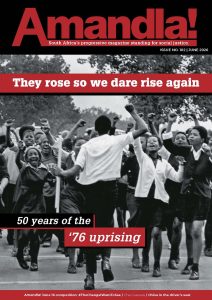
On June 16 1976, Black students in Soweto organised to stay out of school and take to the streets because of the apartheid government’s imposition of Bantu Education and Afrikaans as a medium of instruction. That day reverberated across the country throughout the ongoing months of 1976. But the actions of students of 1976 did not end that year; they ignited a wave of resistance that helped transform the fight for liberation.
At the time, all political organisations were banned after the Sharpeville massacre. Movements and organisations were forced underground. There were increasing levels of violence and suppression, and politically, people felt weak.
The South African economy was declining, with high levels of inflation and unemployment. There was not enough space, and there were not enough services and facilities for the growing urban population. In Soweto and other communities, this led to frustration and anger as the living standards of residents declined substantially.
The future for Black high school students looked hopeless. Not only were ‘Black’ schools overcrowded and under-resourced, but many students were not receiving an education at all. Afrikaans had been introduced as a medium of instruction, and many teachers were not able to teach in it. But most striking was that Bantu education was not to support Black students to become doctors, teachers, or lawyers. It was to ensure that they would make up the next layer of Black workers.
The struggle for a decent education was part of the broader fight against an oppressive and dehumanising system. And the answer to freedom, justice, dignity and liberation was the defeat of apartheid.
Not only were young people organising and mobilising against the apartheid system, but they were shaping a political ideology. Young people like Tsietsi Mashinini, Sibongile Mkhabela, Seth Mazibuko, Steve Biko, Onkgopotse Tiro and others were inspired by the politics of Black Consciousness (BC). BC placed the raising of political consciousness at the centre of liberation. It sought to help the oppressed masses to understand the reasons for their oppression; to develop the consciousness needed to counter the destructive psychology of racism; and to resist the destructive, limiting curriculum and pedagogy of Bantu Education and Bush Colleges. This consciousness would free the black majority from the chains that confined them as servants to white society.
Today, the 1976 uprising that started in Soweto and spread throughout South Africa is commemorated on June 16 as a public holiday—Youth Day. As a result, in many ways it has lost its significance, acting more as a symbol than an embodiment of a politics of resistance. It has put us into a state of historical amnesia.
And that amnesia allows for the scapegoating of fellow Africans for the failures of the South African elite. Ironically, solidarity and internationalism were a core part of the consciousness of the 1976 generation of activists. Today, we witness its polar opposite—children being hounded out of school because they are ‘foreigners’. And the governing elite energises these attacks because they divert attention from its own failure to deliver on the promises and dreams of the 1976 generation.
If we are serious about honouring the students of ‘76, we must look unflinchingly at what South African youth face today.
The classroom
Fifty years after the students of 1976 marched for the right to a dignified education, the achievement of that right remains grotesquely unequal. The overcrowded primary school classroom is where it starts, at the desk where a hungry child is expected to learn.
The scale of overcrowding in South African schools is a deformation of learning itself. More than 8,200 schools nationally are overcrowded, and this number is skewed, as usual, along racial and class lines. The Department of Basic Education has estimated it would cost R32 billion to fix this crisis—a figure the state has no credible plan to raise. In Gauteng, enrolment has more than doubled from 1995 to 2026, and yet infrastructure has failed to keep pace. This leaves a shortage of roughly 5,500 classrooms. Classrooms run with 60 to 70 pupils per teacher in township and inner-city schools. In the Eastern Cape, community members have turned to the courts as class numbers routinely exceed 80, sometimes even surpassing 100. South Africa’s national learner-educator ratio stands at 33:1; the OECD average is 16:1. Beyond the difficulty of trying to learn in these conditions, overcrowding also raises questions of sanitation and, in turn, dignity.
The government is cutting teachers, gutting the education workforce at precisely the moment it needs to expand. More than 23,000 education posts were cut in a single financial year, nearly 5% of the public education workforce. In the Western Cape alone, 2,407 contract teacher posts were eliminated due to a R3.8 billion budget shortfall, the result of the National government funding only 64% of a nationally negotiated wage agreement. Minister of Basic Education, Siviwe Gwarube, has projected that seven of nine provinces will be unable to afford their education budgets by 2028.
Then, there is the hunger. Approximately 9.7 million children from indigent households depend on the National School Nutrition Programme for a daily meal; for many, this is the only reliable meal of the day. More than a third of enrolled learners come from households existing below the poverty line; the Child Support Grant falls short of the monthly cost of a basic nutritious diet for a child. A child who arrives at school hungry cannot learn. A child who cannot learn is already being shaped by a system indifferent to their survival.
And then there are the children who are not in school at all. Four in ten learners who enrol in Grade 1 exit the system before matriculating. Financial pressure, teen pregnancy (often as the result of statutory rape), family caretaking responsibilities, and the simple exhaustion of poverty drive them out. The dropout rate sharpens in the senior phases. Over 60% of young people aged 15–24 are unemployed. And the connection is direct: leaving school early is both the product of poverty and a near guarantor of it.
Structurally, the problem compounds. 74% of South African schools have no libraries, 83% have no laboratories, and only one in three schools has a computer centre. In rural communities, children still learn in conditions that would scandalise the parents of the Sandton schools, whose matric results anchor the national average upwards.
Our schools cannot be measured by matric pass rates. They are measured by the 70 children in the primary school classroom, with one teacher, no library and the starving children in the front row.
The university that remains out of reach
For those who do survive the school system and dare to imagine university, the terrain beyond the school gates is no less treacherous. The National Student Financial Aid Scheme, an institution meant to make higher education accessible, is in structural collapse.
NSFAS faces a nearly R14 billion funding shortfall that threatens to exclude over 100,000 eligible students from support in 2026.
These are students who have overcome seemingly insurmountable barriers, once more made victims of circumstances beyond their control. In 2024, over 600,000 students were unable to receive their graduation certificates due to unpaid fees. They studied, graduated, and then found their qualifications held hostage by a debt the state helped to create. Many students received either partial allowances or went months without any allowance at all. This makes it nearly impossible to buy food or pay rent, let alone focus on an academic career.
The cycle has become deeply predictable. A surging demand coupled with inadequate resources leads to yearly exclusion; protests follow; some are allowed to register, but most are left behind.
A proper tribute to 1976
An honest tribute to 1976 is not a march to a monument. It is a serious, funded, politically courageous commitment to the education system. A commitment to infrastructure, to school meals, to a solvent NSFAS, to an economic policy oriented towards youth employment. A commitment to an emancipatory world outside of the white supremacist, capitalist, patriarchal system that has entrenched poverty, inequality, oppression, exploitation and violence.
But it is not just the situation in schools that is against us as young people; our society in general is in crisis. The deepest levels of poverty, inequality and violence impact the majority of working-class people in South Africa. Every day, people are hungry; in fact, 63% of people living in South Africa are hungry. This would make fertile ground for organising, building a movement, and organising a revolt. But it seems that we have to go back to the tasks that SASO pointed out in the development of Black Consciousness — how do we rebuild consciousness towards action in our schools, in our workplaces and in our communities? This is our generational mission.