
To understand the current political situation in Brazil, we need to situate it within Donald Trump’s renewed offensive across Latin America.
Trump’s election has opened a new stage in the relationship between US imperialism and Latin American countries. Now led by the Trumpist far right and its circle of billionaires, US imperialism wants to impose a new form of colonisation, targeting the Global South.
On the one hand, the neocolonial agenda has a far-right laboratory with the genocide in Gaza. On the other hand, Trump is positioning himself to confront the expansion of China, which, through the BRICS, is increasingly vying for more space in the world market.
And Trump is acting on several fronts to harass the Latin American continent: the tariff war; threats against Panama; the persecution of immigrants within the US (the vast majority of whom have Latin American origins); and now the recent siege of Venezuela and Colombia.
How Brazil responds to these contradictions—and to the need for resistance to Trump’s neocolonial project—is the central theme of discussion.
The main political battle in Brazil
Brazil today is shaped by a contest that pits different sectors and social classes against each other, reflecting the broader international conflict. Two major strategic challenges, exposed during the Bolsonaro government, remain decisive:
- Confronting the far right, which has a clear coup project. This became clear with the revelation of its plans and in the attempt to stage a ‘Brazilian Capitol’ on 8 January 2023.
- Halting environmental devastation, which threatens catastrophe for the entire planet. Deforestation, the predominance of agribusiness, and extractivism continue to destroy the country.
Faced with these two fundamental tasks, how do the main political actors behave?
The far right continues to flatter Trump in an attempt to return to power in 2026, even with the successful impeachment of Bolsonaro. It wants to use the rhetoric of ‘narco-terrorism’ to support an even harsher security policy, as seen in the recent massacre in Rio de Janeiro.
The government is an important bulwark against the return of the coup plotters. It is attempting to balance confronting the attacks of imperialism, a greater need to deepen social agendas such as reducing the working day, and relying on its (very limited) strategy of class conciliation. This shows its limits. It doesn’t go to the end in the fight against the far right, and fails to present itself as an alternative at COP30, where the environmental issue is on the agenda.
Social movements and critical sectors of the Left, including within PSOL (the Socialism and Freedom Party, an independent, anti-capitalist party), face a dual challenge: fighting in the streets against the far right, while maintaining political independence and defining their differences with the government, and embracing the agenda of the working class and all the people.
This scenario is not unique to Brazil. Mamdani’s victory in New York is part of this general process, marked by polarisation. The far right continues to exploit the crisis of liberal democracies. This is reflected in the lead that Trumpist parties have in the polls of the four largest countries on the European continent. On the other hand, Italy’s general strikes were the high point of solidarity with Palestine, marking for millions an internationalist example, seen in the actions of European workers. This was also seen in the Flotilla, in Greta Thunberg, and in Colombian President Gustavo Petro’s denunciation of imperialism at the UN General Assembly, among other expressions, such as the rebellions of Gen Z.
Three contradictions of the national situation in Brazil
Right now, the national situation is marked by preparations for the 2026 election. There, the presidency will be elected, and the national and regional chambers and parliaments will be renewed, as well as the governments of the country’s 27 states. However, this prelude to the electoral process combines different crises and tensions that reflect Brazil’s structural contradictions. There are three major tensions in the immediate situation:
1. The political fight against Bolsonarism, the imprisonment of coup plotters, and relations with Trump
The demonstrations of September 21st, in which more than half a million people mobilised in hundreds of cities across Brazil, expressed widespread indignation at the Proposed Constitutional Amendment on Protection of Persons (the PEC da Blindagem). This was a proposed constitutional amendment to protect members of Congress from facing criminal charges or being investigated, charged or arrested, and to pave the way for amnesty for coup plotters. These mobilisations signalled that the mass movement still retains significant strength. It has resumed the offensive in the streets, which until then had been inclined only towards Bolsonarism. It was a breath of fresh air and a hopeful sign. The mobilisation reshaped the parliamentary agenda, provided a social base for the STF’s (Supreme Court’s) positions, and buried the amendment.
In this context, with Bolsonaro no longer a viable electoral factor, Lula opened negotiations with Trump. The government also recovered popularity as it defended causes such as a wealth tax and the campaign to end the 6×1 working-week regime: workers in many industries work six consecutive days and receive only one day off.
The far right, on the defensive, has attempted to reposition itself with the public security agenda, as it already does in many countries, such as Ecuador and El Salvador, where President Bukele is held up as a model for intensifying internal repression and competing for the most backward sectors of the population.
2. The ‘public security’ narrative and the genocide of Black youth
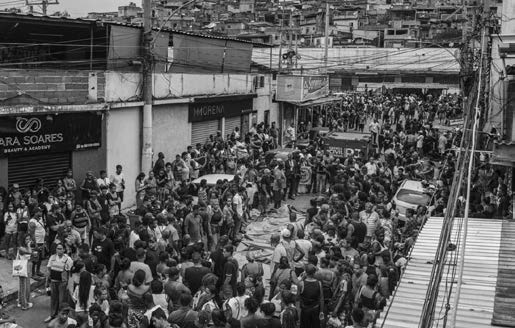
Bodies lined up in the street after the police operation ordered by Governor Cláudio Castro on 28 October produced the deadliest police operation in Brazil’s history: a massacre, a slaughter, was carried out, with 128 fatalities (probably still underreported).
A police operation ordered by Governor Cláudio Castro on 28 October produced the deadliest police operation in Brazil’s history: a massacre, a slaughter, was carried out, with 128 fatalities (probably still underreported).
This is a crime committed by the state, a barbaric act of violence that reinforces the spiral of the so-called war on drugs policy, which surrounds the hills and favelas of Rio, placing the working population in the line of fire between state forces and factions (whether militias or drug traffickers). The death toll surpassed even the Carandiru massacre of the 1990s in São Paulo.
The UN condemned the operation as a barbaric crime. Claudio Castro, the right-wing Governor of the State of Rio de Janeiro, ordered it directly, seeking media attention and prestige. The use of the justification of ‘narco-terrorism’ marks a dangerous escalation which is aligned with far-right strategy in the Trump mould — provoking Venezuela and Colombia militarily and politically, seeking to destabilise their governments, and exert direct influence over the two countries.
A broad mobilisation led by the Black movement, and by grassroots organisations rooted in the favelas and working-class urban peripheries, showed the urgent need for a strong street response—protests and actions demanding a different path that will end the massacres and state violence against the population.
3. COP30, social mobilisation and the limits of green capitalism
COP30 opened shortly after the federal government authorised oil exploration in the Amazon River estuary. It marks an abandonment of the emissions-reduction goals established by the 2015 Paris Agreement. According to COP president André Corrêa do Lago, the focus will now be on climate-change adaptation. This implicitly admits the inability to act in the face of the interests of the fossil fuel industry, and accepts the very serious points of no return already reached, or on the way to becoming so.
Support for the Tropical Forests Forever Fund (TFFF), which seeks to combat deforestation through the financialisation of preserved forests, is another example of the severe limitations of the government’s environmental stance. It is a Brazilian government proposal to create a global, market-based fund that would pay countries to keep their tropical forests standing.
COP30, therefore, mirrors Brazil itself: both the government’s contradictions in the face of so-called ‘green capitalism’ and the urgent need to confront climate denialism and far-right violence.
We oppose oil exploration. We oppose the TFFF, which integrates itself into the logic of green capitalism by financialising the preservation of tropical forests, treating them as a cog in the capitalist accumulation process. We oppose the government’s decision to add more than 3,000 kilometres of the navigable stretches of the Tocantins and Madeira rivers to the National Privatisation Programme (PND), which sparked protests from Indigenous and traditional peoples. These decisions directly contradict the government’s stated environmental commitments.
Debates on strategy and the role of the socialist Left
In this complex scenario, the role of socialists within the PSOL is to occupy the front line in confronting the far right, without renouncing an independent and combative stance towards the government.
To build a social majority, the Left must defend programmatic issues, such as reducing working hours, taxing billionaires, rejecting oil extraction in the Amazon estuary, and ending the so-called “war on drugs”. This must be part of transitional measures towards another solution that involves advancing the fight against financial capital and defending ecosocialism.
Israel Dutra is a sociologist, Social Movement Secretary of PSOL, a member of the party’s National Directorate and of the Socialist Left Movement (MES/PSOL).