

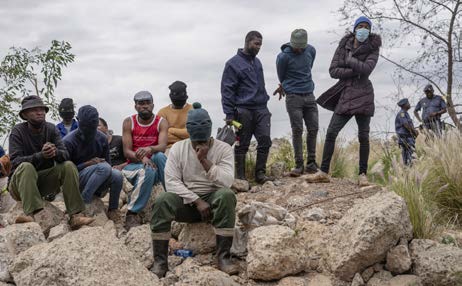
Volunteer rescuers at Stillfontein mine. The real story of zama zamas is tragic. It is a story of impoverished people, many former mineworkers, disposed of by capital because they are no longer needed. The only way they can think of supporting their families is to sell their labour in the parallel economy of informal mining.
Here we go again. Smoke them out. Starve them out. They’re only foreigners, after all…although, in fact, many of the informal miners (‘zama zamas’) are actually South Africans. But wherever they come from, they are desperate people. To spend months down an abandoned mine to eke out a living, you would have to be desperate.
And their desperation all has the same fundamental cause, whether they come from Mozambique, Zimbabwe, Lesotho or Klerksdorp. Economic policies whose purpose is to serve the elite while the masses of the people suffer.
But, of course, there has to be a narrative that accounts for that suffering. It used to be the ‘legacy of apartheid’ that was supposed to be why change is so slow. Now it is illegal immigrants and our porous borders.
There are two issues that have dominated the news in the past weeks—the ‘zama zamas’ in Stillfontein and the deaths of children from food poisoned by pesticides. Both are tragedies entirely of the government’s own making. Yet both are tarred with the same brush—‘makwerekwere’…foreigners. Taking our jobs. Poisoning our children. Terrorising our communities.
‘Zama zamas’
The real story of Zama zamas is much more tragic. It is a story of impoverished people, many former mineworkers, disposed of by capital because they are no longer needed. The only way they can think of supporting their families is to sell their labour in the parallel economy of informal mining. They are workers, not criminals, any more than the mineworkers slaughtered in Marikana were criminals, whatever Cyril Ramaphosa said.
Conditions of work for these workers are far worse even than those at Anglo or Sibanye-Stillwater. They have no rights, brutally exploited by gangsters who head up criminal syndicates, ultimately scavenging for those who control the global markets.
And of course, as is so often the case, there is a solution at hand. Legalise and regulate the industry. This is scarcely a revolutionary strategy. It is already implemented in so many other African countries—Angola, Chad, Eswatini, Madagascar, Malawi, Mali, Niger, Sierra Leone, Tanzania, and Uganda. But here, in South Africa, with the biggest, most developed mining industry on the continent, artisanal mining remains illegal. And the government’s ‘strategy’ is to brutally punish the informal mineworkers, not deal with the cause. Meet violence created by the state with the violence of the state. So much for national liberation.
The children killed
Of course, Cyril Ramaphosa is rather more sophisticated than his ‘smoke them out’ minister Ntshavenhi. When he finally got round to speaking to ‘the nation’ about the poisoning of the children, he was at pains not to blame foreigners. Instead, he made use of another narrative—the narrative of false promises.
So he admits that:
One of the reasons that people use pesticides is to deal with rat infestation. The problem of rat infestation is due in part to poor waste management in several municipalities.
But why are these municipalities so remiss? Where is his explanation for that? Are they lazy? Are they sleeping? Are they stupid? Because without a proper analysis, you are unlikely to come up with a real solution. Which, of course, he doesn’t. Instead, he promises that the state will do many things that it has shown itself, time and again, incapable of doing. And it is incapable precisely because of the policies of his government and of ANC governments since 1994.
Killed by outsourcing failure
The waste management system has almost completely broken down in most parts of South Africa. Landfill sites are closed. Waste is piling up everywhere. Back in the day, there were municipal refuse departments. No contracts for friends and family. Now, of course, the ‘service’ is outsourced.
That outsourcing bears a heavy responsibility for the deaths of the children. Creating jobs for the friends of the elite at the expense of the children of the poor and working class. That’s a big price to pay to create a Black middle class.
And then there is the refusal of the government (in this liberalised world of theirs where they continually promise to ‘free up’ the economy) to regulate the pesticides. This problem was not unknown. In 2010, Hanna-Andrea Rother, a professor at the School of Public Health and Family Medicine at UCT, published a paper in the International Journal of Occupational and Environmental Health in which she was very explicit. First, the nature and cause of the problem:
Highly toxic pesticides, such as aldicarb…are easily available in informal markets in Cape Town’s urban periphery. Demand and supply for street pesticides is driven by joblessness, poverty, and inadequate pest management strategies.
And then the scale of the hazard:
The aldicarb sachets sold on the streets of Cape Town ranged from 50–60 mg/kg sachets, giving these the potential of killing five to six children weighing 10 kg or less. The inability of national and international legislation to protect children from exposure to this chemical constitutes a gross human rights violation.
These words are eerily prophetic. 14 years have passed in which the government has had the time and opportunity to regulate and has failed.
Killed by austerity
And then there are the government’s budget cuts. Even the ANC Chairperson of the Portfolio Committee on Cooperative Governance and Traditional Affairs (COGTA), Zweli Mkhize, said that the reduction of about R1.3 billion in COGTA’s budget “will compromise the department’s ability to support municipalities.”
The vast majority of COGTA’s budget goes to municipalities as grants. These grants are crucial, particularly for many of the poorest municipalities, which have little or no other source of revenue.
And let’s look at what the President expects these underfunded and poorly governed municipalities to do.
Our local municipalities will be required to take urgent action to address the problem of rat infestations by cleaning cities and towns and removing waste.
Apart from the irony of this President telling anybody else to “take urgent action”, how will these dysfunctional, underfunded municipalities take urgent action? When have they ever taken urgent action? The first cholera cases in the Hammanskraal area were reported in February 2023. And the water supply is still not fixed. And of course, the President spoke to us all at that time, in May 2023:
The Department of Water and Sanitation has issued many directives to the City of Tshwane to address pollution from the Rooiwal Wastewater Treatment works. Regrettably, these directives were not acted upon.
So, the solution this time? With the pesticide poisoning? Issue more directives, which also won’t be acted upon.
What is the directive this time?
Integrated multidisciplinary inspection teams will undertake compliance inspections of food handling facilities, manufacturers, distributors, wholesalers and retailers. This will include spaza shops and general dealers.
Where are the resources?
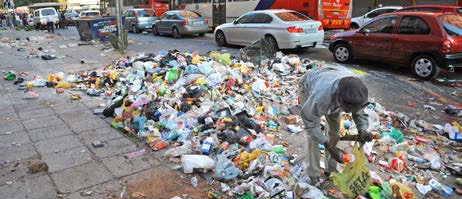
Piles of rubbish on the streets of Joburg. Now, of course, the ‘service’ is outsourced. That outsourcing bears a heavy responsibility for the deaths of the children. Creating jobs for the friends of the elite at the expense of the children of the poor and working class.
Let’s look at only one aspect of this ‘directive’—the health inspectors, or ‘Environmental Health Practitioners’, to give them their official title. South Africa has one-quarter of the number of health inspectors that the World Health Organisation says we should have.
Here we sit with 11.6 million people unemployed and 1,712 health inspectors in the whole country. The City of Tshwane has 73 health inspectors, one for every 60,000 people. The correct ratio, according to the minister, is 1 for every 10,000.
Even if their only job was to inspect spaza shops, these 73 would struggle. But in fact, the job is far broader than that. It includes:
- Food and safety hygiene in restaurants, food outlets, and food production facilities.
- Environmental health, including water and air quality and waste management.
- Workplace health and safety.
- Disease prevention and control.
- Housing and urban sanitation.
- Licencing and regulation of food vendors and businesses involved with hazardous materials.
Our honourable President expects these few health inspectors to inspect not only all spaza shops but also all food handling facilities from manufacturers to retailers. And not just once—regularly.
South Africans are so tired of these fantasy narratives which can only be carried out by non-existent resources. It’s the same old story. Empty promises. Stories that bear no relation to reality. Remember the National Development Plan?
Some real solutions
It is time to focus on solutions that address the root causes of these tragedies. The government must:
- Regulate the pesticide industry: ban all highly hazardous pesticides and enforce stringent controls on the production and sale of pesticides, holding manufacturers accountable for their distribution.
- Strengthen food safety monitoring: invest in health inspectors and provide resources to informal traders to comply with food safety standards instead of shutting them down.
- Insource all essential services: restore municipal refuse departments.
- End Austerity: allocate adequate funding to municipalities to improve waste management, water provision, and pest control services.
- Tackle unemployment: introduce a universal basic income grant and implement a wealth tax to address the crisis of systemic poverty.
- End trade liberalisation: develop policies that protect local industries and create sustainable jobs rather than flooding the market with cheap, imported goods.
The tragic deaths of the children and the suffering of informal mineworkers should unite South Africans in demanding systemic change rather than scapegoating vulnerable groups.