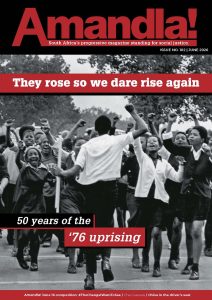

The 1976 students’ uprising was the first national protest movement by Black school students in the country’s history. It was unprecedented in its scale, character and impact. Soweto was at the centre of the struggle from January, culminating in the historic march by thousands of students on 16 June 1976 to demand the scrapping of Afrikaans as a medium of instruction. Thereafter, protests quickly spread across the country, forcing the government to rescind its racist language policy.
This movement shattered the political quiescence that prevailed after the Sharpeville massacre. With the workers’ strikes of 1973, it inaugurated the process of constituting the mass movement that would overthrow apartheid.
Students who took to the streets initially to oppose Bantu Education proceeded to create new politics and movements of resistance. In the early 1970s, this new generation of student activists constituted a relatively small and fragmented group, but they began to coalesce in various social networks and nascent organisations. The eruption of protests in 1976 placed them at the centre of mass mobilisation. Although relatively inexperienced, they drew inspiration from Black Consciousness and quickly formulated tactics and strategies to strike effective blows against the state and capital.
New social force
H.F. Verwoerd, the so-called architect of apartheid, explained the underlying objective of Bantu Education: “There is no place for him [Africans] in the European community above the level of certain forms of labour”. It was a system designed to prepare students to be workers in the system of racial capitalism, and to entrench the structural subjugation of African people. However, there was an unintended consequence of the expansion of Bantu Education, particularly from the late 1960s. It created a large population of Black students that transformed into a potent political force in 1976.
When Bantu Education was introduced in the mid-1950s, there were about one million African school students. By 1976, that figure had grown significantly to 3.7 million. The rate of growth of Africans in secondary schools was even more impressive: between 1965 and 1976 their number increased by more than 500%, from about 66,000 to approximately 389,000. In Soweto, the student population nearly doubled, from 90,000 at the end of the 1960s to 170,000 in 1976. Between 1972 and 1974 alone, the number of secondary school students rose sharply from 12,656 to 34,656.
African students now constituted a significant social force, whose size was unparalleled in the country’s history. Their large numbers also reflected Black society’s emphasis on the importance of education.
However, they had to contend with overcrowding, poor infrastructure and limited resources, which became more acute in the 1970s. The deterioration of Black schooling contributed to mounting discontent among students. It was from their ranks that a new cadre of protesters and activists emerged, who were markedly different from previous generations of township youth.
Black Consciousness
These students were, mostly at least, second-generation urbanites whose social and political horizons extended beyond the townships. They were interested in global politics, especially anti-colonial movements and Black resistance generally.
Due to state repression from the early 1960s, this new cohort of politically conscious youth had little, if any, direct connections with older Black resistance organisations such as the ANC and PAC. They had no allegiance to the political programmes and strategies of these movements and had to create their own emancipatory politics. They were inspired by the rejection by the Black Consciousness Movement (BCM) of apartheid’s racial categories and its espousal of Black unity as a means to emancipate the oppressed majority from psychological and physical oppression. These ideas offered them a framework to understand oppression and to imagine pathways to liberation. As students, they identified especially strongly with Black Consciousness’s emphasis on conscientisation as a key to emancipation.
Radical readers
These young people exhibited an insatiable thirst for political knowledge, manifested by the proliferation of a reading culture. Newspapers such as The World, The Post, The Sunday Times and the Rand Daily Mail circulated widely among parents and their children. Students were especially attracted to the African Writers Series. These novels, Kasonde Mukonde argues, “spoke directly to students, now armed with BC thought, and challenged them to look at their own marginality and transform their consciousness to perceive the beauty in themselves while radicalising them”.
Books and pamphlets on Marxism, anti-colonial struggles and the civil rights movement were also widely read and debated. Works by anti-colonial intellectuals such as Frantz Fanon and Kwame Nkrumah were popular, as were speeches and writings by Malcolm X, Martin Luther King and Mao Zedong.
Leading cultural theorist, Bheki Peterson, described the 1970s as marking “an important cultural renaissance in the practice of African arts and literature in South Africa”. Poetry, music, art, theatre and literature all flourished, as a new desire for ‘self-definition’ and ‘self-actualisation’ took root. There was an explosion of writing and publishing by Black authors, including luminaries such as Oswald Mtshali, James Matthews, Wally Serote, Sipho Sepamla, Gladys Thomas, Fatima Dike, Nomsisi Kraai, Chris van Wyk, Mafika Gwala and Don Mattera. This radical cultural milieu was shaped by the BCM and had a profound influence on emerging student activists.
Nascent networks and organisations
When protests erupted in 1976, student political organisations were generally weak and small. However, that reality hid a less visible development from the early 1970s: networks among students that created the critical bases for conscientisation and mobilisation. In the formative years of rebuilding movements, students coalesced around friendship- or school-based groups. In conditions of repression, familiarity and trust were critical ingredients in constituting rudimentary political communities. At the same time, in Soweto, debating societies were established in most secondary and high schools and between schools, with debating competitions becoming ‘unofficial training grounds’ for activists and leaders. The proliferation of other associations, including sports clubs, cultural societies and religious groups, also contributed to the growth of a cohort of socially active youth.
Some of these groups began to focus on local issues, such as the authoritarian behaviour of school principals or teachers, and the absence of social facilities in the townships. While not explicitly political at the beginning, they invariably transformed into spaces of political education and activism. For example, the Sharpeville Youth Club was created to keep youth from the streets, but within a few years, it became involved in the creation of the National Youth Organisation. In the coloured group areas of Johannesburg, school students in the early 1970s protested Republic Day celebrations and gravitated to Black Consciousness.
Religious organisations, influenced by liberation theology, also became sites of politicisation. The University Christian Movement and the Student Christian Movement served as spaces of political apprenticeship and were closely associated with Black Consciousness. The Young Christian Workers and Young Christian Students defined themselves as “a movement of the working class … involved in mission and ministry to the working class”. This was where activists such as Kaizer Thibedi and Shepi Mati received their formative education about working-class politics and even socialism. Sibongile Mkhabela, a prominent woman leader in 1976, was a member of the Young Women’s Christian Association, where she was inspired by an older generation of committed, educated and caring women activists.
Co-ordinated protests
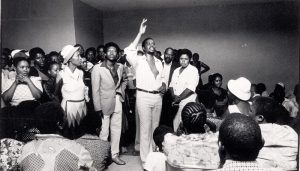
Crucially, they produced a generation of activists who became pivotal in building mass movements from the late 1970s — trade unions, civics, women’s movements, student and youth organisations —that were ultimately responsible for overthrowing apartheid. (Photo: Paul Weinberg)
When the protest erupted in Soweto, the South African Students Movement (SASM), an affiliate of BCM, was the main political organisation of Black school students. It had a handful of members in high schools, while its reach beyond Soweto was limited. Nonetheless, it was arguably the main training ground for student leaders of the uprising. In the weeks before June 16, SASM connected with student activists who had led the protests in early 1976. Crucially, on June 13, it created the Action Committee (led by Tsietsi Mashinini), which organised the historic march three days later.
It marked a decisive turning point in the mobilisation of student protests. In early August, a representative meeting of students established the Soweto Students’ Representative Council (SSRC) that soon became the leading voice of protests in the township. The SSRC convened assemblies of students and shifted its strategic focus to mobilising united action with workers/parents. In August and September, it organised marches to the city centre and called stay-aways to strike blows against the white state and capital. Although these actions faced problems, they sought to forge unity between students and workers, two strategically important sectors of the Black population, against white power. Similar action took place in Cape Town, where marches to the city centre disrupted the apparent normality of the status quo.
The success of the 1976 student movement was built to a large extent on the foundations established in the preceding years by intersecting networks, associations and political structures. Crucially, they produced a generation of activists who became pivotal in building mass movements from the late 1970s—trade unions, civics, women’s movements, student and youth organisations—that were ultimately responsible for overthrowing apartheid.
Noor Nieftagodien is the Head of the History Workshop at Wits University and a member of Amandla! Collective and a founding member of Zabalaza for Socialism (ZASO).
*Featured Image by Peter Magubane