

The problem of gender-based violence and femicide (GBVF) in South Africa is stubborn. Stopping the scourge may often look hopeless. The end does not appear to be anywhere near.
At the same time, there is a widespread and growing awareness in the country of the immensity and horror of GBVF. Academics write about it. Activists march against it. Politicians talk about it. And many governmental policies and programmes are aimed at ending this social scourge. The public has been made aware of this pervasive problem to such an extent that even shopping bags urge “us” to end gender-based violence. All this awareness-raising of, and fighting against, the epidemic of GBVF is utterly necessary.
A common feminist approach makes its point about the horror of GBVF by listing statistics and telling the stories of the despicable things that men do to women in this country (and other countries). The approach has been central to combatting rape and forms of sexual violence. It is an approach that can be impactful, and has been. It has the potential to stop readers and audiences in their tracks, and it does. It can force us to take notice, and we do. It can even call some of us to action to combat GBVF in our personal and professional lives, and it has.
The approach of numbers and experience has been particularly successful in highlighting the harms of rape and the historical problem of low prosecution rates. According to those who have championed the approach, a massive social change is needed in how we think about and deal with rape. Anti-rape campaigns using this approach have helped to generate glimmers of hope and have contributed to justice for women and girls.
The possibility of justice begins when a person is believed when she says she has been raped; that is what is called testimonial credibility. That is vital. It is clear, then, that the approach to single out and call attention to the harms inflicted on girls and women remains essential. We continue to need to build a collective understanding of the extent of the dire problem we face, and opposition to it.
Male homicide epidemic
But an approach that focuses only on men’s violence against women and girls, and has nothing to say about violence against, and the traumas of, men and boys, has the potential to create defensiveness and backlash. Such reactions from men do not help to ameliorate the problem of GBVF. In campaigning against men’s violence, the hope is that some men in positions of authority, such as policemen, male magistrates, male managers, male judges, and a male president, will do something about the problems some men cause for others.
Of course, this does not mean that women should kowtow to a negative response from the very group they are addressing – men who perpetrate violence against women and girls, and complicit men. In fact, it is arguably understandable not to care about the feelings of males, since they are by far the majority of perpetrators of violence. However, there is another, different approach that needs accentuating.
What might happen if we focus on violence against boys and men as well as on violence against women and girls? Including boys and men implies broadening the focus to the problem of violence as such. A shift of focus to violence as a general problem shows that boys, and particularly younger men, make up a high percentage of victims of grave and fatal violence.
In highlighting this simple yet heartbreaking fact, we do not in any way wish to detract from the appalling violence of men against girls and women. We also do not lose sight of the fact that most of the male victims of violence are victims of male-perpetrated violence. However, the fact that men are the main perpetrators of violence does not invalidate the fact that young males are major victims of much of the grave and fatal violence in the country.
As a society, we have to incorporate into our collective consciousness and violence prevention efforts that males make up a larger percentage of victims of violence. Males are perpetrators of violence against women and girls. But studies are clear. Over 80% of murder victims are males, although this seems to be an uncomfortable fact for South Africa.
Researchers from the South African Medical Research Council led a study on what they refer to as the male homicide epidemic. They found that homicide rates are higher among males than females in all age groups, and rise to eight times higher for the age group 15 to 44 years. To ignore this glaring fact is detrimental to the fight against all violence, GBVF included. It also betrays a lack of empathy about violence against males, and as we know from other studies, other kinds of trauma experienced by boys and men.
South Africa has a violence problem
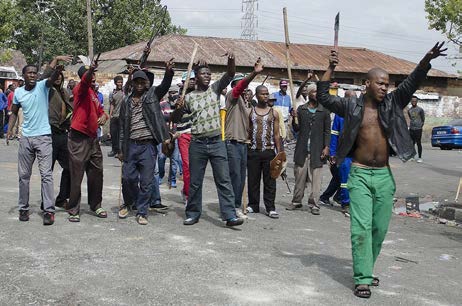
Xenophobic violence in Joburg. South Africa does not only have a gender-based violence and femicide problem. The country has a violence problem.
South Africa does not only have a gender-based violence and femicide problem. The country has a violence problem. Yet the focus on GBVF (counter-intuitively) obscures this more general problem of violence. To integrate into our focus, violence against boys may ultimately benefit everyone. If we reduce the violence against everyone, GBVF will be reduced.
The fact that it is so difficult for many people, including many activists and political leaders, to speak about males as victims of violence is curious. As suggested, there is an obvious reason: boys and men may be the biggest victims of grave and fatal physical violence, but they are also, compared to girls and women, the greatest perpetrators of physical and sexual violence.
Unsympathetic observers might therefore feel that boys and men ought to be left to their own devices and continue harming each other. Protection should be extended to the ‘real’ victims.
This attitude may seem to be an understandable stance to take because, while boys and men participate in and initiate violence against each other, women and girls are subjected to violence. But are we prepared to admit that we are a society that does not care for its male children and youth? And what if the lack of care for the traumas in men’s childhoods and adult lives is one of the sources of men’s violence against women and girls? This is a point to delve into in future articles.
A zero-sum game?
There is a related reason for reticence we observed about tending to boys. It is the perception that to talk about boys and men as victims of violence might detract attention from girls as victims. But this is to take a zero-sum view of the problem of violence; it says, if we concentrate here, we lose focus there.
It is, understandably, based on the idea that we have limited resources, such as attention, time, and money, to deal with the problem of violence against women and girls. This is partially true. There are surely certain resources that are limited. If funding for interventions, support, and prevention goes to one cause, it does not go to the other. With specific reference to GBVF, the zero-sum approach says that if we have to choose, we should choose to spend our limited resources on girls and women, the ‘real’ victims, because their situation is more urgent, more serious, more tragic. So we should not squander a limited resource on the group of people who are also part of the problem.
But is the plight of males as victims of violence so acceptable to us that we are not willing to worry about their well-being and safety? What do we lose, and what might we gain, by focusing on young males as victims? Ultimately, it is as though we have forgotten, in our understandably angry reaction to male perpetrators, that males can be as vulnerable to violence victimisation as females, and at times even more so.
Boys are not men
When it comes to boys, we seem to forget that they are not yet adult men. Boys are often mistakenly accused of having a power and a privilege that they do not possess. Male children are not patriarchs (though some might hold the view that they are patriarchs in training). They are raised in the same families as female children, by the same parents and grandparents. But they seem to be subsumed under movements such as #MenAreTrash. While the aim of such a slogan was surely to target adult male perpetrators, it has seeped, via social media, into public consciousness. Young males, too, are contaminated with this notion that their masculinity is “trash”.
Some writers have described how this has caused many boys to flock to the ‘manosphere’, with its communities of incels, pickup artists (PUAs), Men Going Their Own Way (MGTOW) and men’s rights activists (MRAs). The identity crisis that boys and young men are facing is exacerbated by this societal description of them, from a young age, as having a heinous identity. The monstrousness of masculinity as inherently toxic becomes almost inescapable. It might almost become a self-fulfilling prophecy.
Boys are not men. Young men are not adult men. Some men are perpetrators of violence; others are victims of violence. We should spend time reflecting on these simple facts. There are many programmes aimed at promoting the performance of girls and young women in education and the labour market. But there seems to be a gap that needs to be filled that addresses the struggles that boys and male youth face in social institutions such as education, family and the labour market.
In addition to the obstacles they face in these institutions, young males are also struggling because they are so frequently victims of violence and psychosocial trauma. Hence, all too many may live with the feeling that their injuries, physical, mental and emotional, do not really matter to others. We need to reflect more on that—mattering, that is—as we seek to reduce GBVF.
Charla Smith is a philosopher and Kopano Ratele is a social scientist. They are at Stellenbosch University. This is the first of three articles by Ratele and associates focusing on boys, men and masculinity.