
Venezuela’s crisis raises fundamental strategic questions for socialists worldwide. How should the Left engage with Maduro’s authoritarian regime? Do we need to defend Venezuela against imperialist threats? What about the rising popular opposition?
As the global right advances and socialists worldwide grapple with how to build Left alternatives, Venezuela’s crisis raises fundamental strategic questions that extend beyond regional borders. The current political, economic and social situation under Nicolás Maduro’s government represents one of Latin America’s most complex contemporary authoritarian cases. It requires clarity from the international Left on how to navigate between opposing authoritarianism and resisting imperialism.
Following the fraudulent presidential elections of July 2024, the government has intensified its authoritarian trajectory while facing a multidimensional collapse. At the same time, Donald Trump’s return to the US presidency has heightened interventionist threats. Naval operations in the Caribbean have caused numerous civilian casualties, and mass deportations have targeted Venezuelan migrants. Meanwhile, the anti-government camp has fractured, with key sectors aligning with international far-right forces.
Venezuela’s crisis raises fundamental strategic questions for socialists worldwide. How should the Left engage with Maduro’s authoritarian regime? Do we need to defend Venezuela against imperialist threats? What about the rising popular opposition? These questions require answers that go beyond sectarian stances and acknowledge the complexity of the Venezuelan situation.
Maduro’s authoritarian consolidation
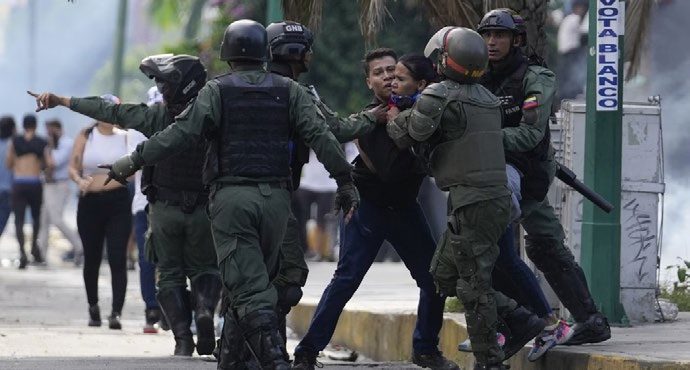
Maduro’s government has drifted into becoming a fully autocratic regime. The process of authoritarian consolidation has been gradual, with social and political repression intensifying after the July 2024 presidential elections, effectively reducing popular mobilisation. In those elections, people voted for radical change, but the official electoral results were never released. The National Electoral Council (CNE) has not published detailed results by state, party, or municipality.
The state is strong on coercion but weak or non-existent on protecting social rights. As of May 2025, public sector workers’ minimum income (combining basic salary and bonuses) stood at approximately US$160 per month, with the basic minimum wage alone being much lower, at around US$3-3.50. Meanwhile, the basic food basket costs between US$500 and US$700 a month. To survive, families must resort to informal work, remittances from migrants abroad, and bonuses distributed through local participatory mechanisms—what Venezuelans call matar tigritos (“killing little tigers”), meaning quick and informal work that uses whatever skills people have to earn money to cover basic needs. The economic and social crisis has generated an exodus of nearly eight million Venezuelans—almost a third of the population.
Yet Maduro and his business partners are absolutely convinced they must never give up power, no matter what they have to do to keep it. Political prisoners remain incarcerated in harsh conditions. Many are held incommunicado, without private lawyers, unable to see family members, and with seriously worsening health conditions.
Far-right alliances
On 8 February 2025, the European Parliament’s far-right group, Patriots for Europe, met in Madrid under the slogan “Make Europe Great Again”. Leaders, including Spain’s Marine Le Pen, Hungary’s Viktor Orbán, Italy’s Matteo Salvini, and Spain’s Santiago Abascal, attended. During this meeting, the main leader of the Venezuelan opposition, and this year’s Nobel Prize winner, María Corina Machado, intervened via streaming to thank “the work of the Patriots for Europe group within the European Parliament, which has always been at the vanguard of the struggle for the Venezuelan people’s freedom”.
Her participation confirmed historical alliances between the right-wing opposition leader and global reactionary forces. Machado enthusiastically supported the Trump government’s expulsion and imprisonment of alleged Tren de Aragua members in the Terrorism Confinement Centre (CECOT) in El Salvador, arguing a link between the criminal gang and Maduro’s government. This is precisely the argument the White House has used to declare the Venezuelan gang a terrorist organisation, accusing people of membership for reasons as banal as having a crown-shaped tattoo.
Trump’s return and the escalating imperialist aggression
The relationship between the Maduro government and the White House has fluctuated in recent years. In January 2025, Trump’s special envoy Richard Grenell arrived in Caracas. A transactional, mutually functional relationship between the governments seemed possible at that time. Maduro’s government actively participated in Trump’s deportation policy, including sending planes belonging to Conviasa, the Venezuelan national airline, to collect deported migrants. Goodwill towards the Trump administration was evidently motivated by questions around sanctions and oil policy.
In the second half of this year, the US government significantly shifted its policy. Chavismo’s most vocal opponents reached the White House and secured positions in the Senate and House of Representatives. From Florida, Republican politicians like Marco Rubio have built careers on direct opposition to the global Left, promising to vigorously attack the Cuba-Nicaragua-Venezuela triad. For many Venezuelans, the ‘American dream’ has suddenly and catastrophically vanished, yet they still hope Trump’s government will strongly oppose Chavismo. The harshest measures against the Venezuelan government are only just beginning, and military escalation cannot be ruled out.
Reject military actions

Socialists worldwide must categorically reject US naval operations in the Caribbean, carried out under the pretence of fighting drug trafficking. They are used as an excuse for interventions that prioritise geopolitical interests over regional peace.
Socialists worldwide must categorically reject US naval operations in the Caribbean, carried out under the pretence of fighting drug trafficking. These operations have included bombings of Venezuelan vessels, resulting in dozens of deaths since the beginning of September, impacting coastal communities and increasing the risks of conflict. Such actions, violating international law, do not solve issues like drug trafficking, which is used as an excuse for interventions that prioritise geopolitical interests over regional peace.
The country is extremely weak in the face of foreign aggression. Internationally, it is practically isolated. Internally, the social fabric is torn apart. Instead of recognising this and taking steps towards national reconstruction—for example, releasing all political prisoners—the government relies on a single and ineffectual response: the mobilisation of millions of militia members. This has worsened the atmosphere of conflict and deepened the militarisation of civil society. And it disregards the 1999 Constitution (CRBV), which emphasises peace and dialogue.
Venezuelan progressive political and civil society organisations, such as the Plataforma Ciudadana en Defensa de la Constitución (Citizens’ Platform in Defence of the Constitution), have issued urgent and compelling calls. They appeal to all democratic and popular forces and to the broadest spectrum of the Venezuelan opposition to set aside political or ideological affiliation and overcome all forms of sectarianism and arrogance. They call for Left forces to radically distance themselves from any belligerent adventure and from all forms of foreign interference. This means openly rejecting all forms of interference and promotion of violence by foreign powers on Venezuelan territory, as well as the repressive actions of Nicolás Maduro’s own regime.
Questions for the international Left
The international Left cannot defend an authoritarian government that systematically violates human rights, keeps 900 political prisoners in deplorable conditions, and has presided over the exodus of millions fleeing intolerable living conditions. The regime’s consolidation of power through electoral fraud, systematic repression, and the suspension of fundamental rights places it squarely within patterns of authoritarian rule that socialists have historically opposed. Nonetheless, this necessary critique must not lead to alignment with right-wing opposition forces, whose alliances with international far-right movements show how segments of the opposition have embraced reactionary politics incompatible with genuine democratic transformation.
True anti-imperialism involves strengthening popular sovereignty, democratic institutions, and social movements. Maduro’s regime has systematically sought to destroy all of these. The Left must therefore support the country’s sovereignty, while demanding that the government take measures to genuinely strengthen it: releasing political prisoners, restoring democratic freedoms, and engaging in peaceful dialogue to achieve a constitutional resolution.
The challenge lies in building international solidarity that strengthens autonomous popular organisation within Venezuela, rather than bolstering either the regime or the right-wing opposition. This involves recognising that Venezuelan workers, students, community organisers, and ordinary citizens seeking dignity, democracy, and social justice are the true popular opposition, whose struggles align with Left principles.
Colombian President Gustavo Petro represents Latin America’s democratic Left. In a recent message on social media, Petro said:
I don’t defend Maduro, I didn’t recognise his election, but even less do I defend an invasion of Bolívar’s homeland. That would be the ultimate betrayal of the history and future of all of Latin America and the Caribbean. Venezuelans’ problems are resolved by Venezuelans. That is the principle of people’s self-determination.
Petro’s formulation provides a framework for the international Left. Only through principled internationalism can the Left meaningfully contribute to overcoming Venezuela’s authoritarian maze, while defending Latin American self-determination against resurgent imperialism under the Trump administration. Venezuela’s future depends not on external saviours—whether imperial or otherwise—but on the Venezuelan people’s ability to build democratic alternatives that transcend both authoritarianism and reaction.
Daniel Chavez is a Uruguayan-Dutch political economist. He is a Senior Project Officer at the Transnational Institute (TNI) and a Senior Research Associate at the University of Johannesburg.
*This article was written and published before the US invasion, but its analysis remains highly relevant afterwards.