
A wealth tax? A permanent public employment programme? Rent control in urban areas? Trade protectionism? The South African government persistently avoids implementing such economic reforms that would diverge from the principles and practices of neoliberalism. Substantial redistribution, expanding public ownership and stimulative government intervention in the economy are off the policy choice table.
A key component of resistance to any policy reform is the rejection of any policy that would challenge or undermine private property relations. Why? Because private property is the fundamental social relationship under capitalism. It is this form of ownership that creates the mechanisms for dispossession, exploitation, profit-making and wealth accumulation.
Often, a chorus of conservative economists, business-sponsored think tanks and liberal political commentators manufactures consent for neoliberal policies. And their messaging is amplified by a network of corporate media houses, ensuring that private property relations retain a sacred status. This is nourished by a respect and reverence for the property (i.e, the capital) of the ownership class.
The priests of capitalism, whether in the offices of National Treasury or the editorial rooms of corporate media houses, work to present private property relations as economically efficient, morally justified and a political necessity that is as natural as the air we breathe.
Private property is not a natural right
Defenders of private property relations will often define private property as a natural and fundamental right. Natural rights are entitlements that are universal and inalienable, not dependent on customs, culture, laws or the authority of a government. And they deploy a broad definition of private property that makes little or no distinction between the private personal property used for an individual’s consumption (e.g a car, fridge or vinyl collection) and private property as exclusive ownership of the means of production.
Marxists, on the other hand, accurately describe private property as a social relation. In it, the tools of economic production (natural resources, machinery, infrastructure) are exclusively owned by specific individuals or entities. How these means of production are used is solely subject to the will and interest of their owners. And that creates a set of relationships that determines not only who holds power in society, but how a society operates and whose interest it operates in.
The right to private property firstly requires dispossession. It involves taking common resources or products and services produced by collective labour and asserting individual ownership and control over them. This forges a relationship of dependency between the ownership class and the rest of us, through which that economic exploitation can occur. For those who don’t own capital, the only way to survive is to sell their labour in exchange for a wage, with which they can then purchase goods and services.
When neoliberal propagandists argue that private property is fundamental to the exercising of individual freedom, they are arguing for the freedom of the few to politically dominate and economically exploit the many.
Original expropriation
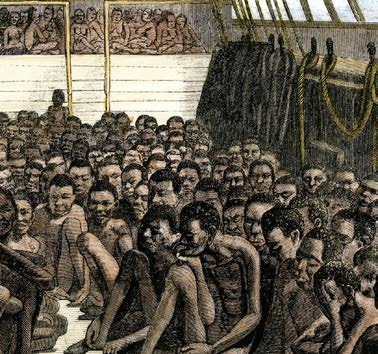
The historical record of capitalism’s birth and evolution tells a tale of violence, alongside political coercion, wielded to seize land, labour and natural resources for the initial accumulation of capital.
The property of capitalists did not fall from the sky. Those who support private property relations will have you believe that capitalists gained their property through ingenuity, tireless hard work, ethical legal contracts of exchange, or morally neutral inheritance. Yet the historical record of capitalism’s birth and evolution tells a different story: a tale of violence, alongside political coercion, wielded to seize land, labour and natural resources for the initial accumulation of capital.
The wars waged by the Dutch East India Company against the Khoikhoi for land and livestock in South Africa; the abduction of Africans into the transatlantic slave trade; the Spanish conquest of the Aztec and Inca empires for gold and silver in South America; and the dispossession of the English peasantry during the enclosure movement. These show that the establishment of private property relations is a destructive and destabilising process. It is this destructive process of original expropriation that was vital to the creation of new class relations, eventually turning the dispossessed from peasants or craftspeople into wage labourers.
Private property and forms of capitalist control
The principle of private control over resources and production severely constrains the possibility of realising an economic and political order beyond the grim horizon of capitalism.
The first problematic form of control is over the decision-making about what is to be produced, by directing the flow of investment. This takes place regardless of whether it benefits the vast majority of people. This is evident through the flourishing of the financial sector since the 1990s.
The largest sector of South Africa’s economy, as a contributor to GDP, is finance (including real estate and business services). In a country with a 42.9% unemployment rate, the biggest sector of the economy is the least labour-intensive—each rand of investment produces fewer jobs. Moreover, the blossoming of finance has trapped the country in a cycle of short-term capital inflows and long-term capital outflows. These lead to currency volatility, economic downturns and price increases on basic commodities like food, as the liberalisation of trade has allowed companies to list offshore and globalise their operations.
As a result, investment in labour-intensive industries is delayed, and significant tax revenue is lost, both legally and illicitly. Reducing trade barriers like tariffs and quotas boosts cross-border trade and financial transactions. But it also fuels illicit financial flows through tax evasion, profit shifting, money laundering, and trade misinvoicing. It is estimated that South Africa loses an annual $62 billion to the illegal movement of money across borders.
In the past decade, South African manufacturing industry has lost 300,000 jobs. Sadly, the country’s de-industrialisation, and capitalists’ preference for investment in financial assets and speculation, has resulted in most people funding their consumption through credit. In 2024 it was estimated that most households spend 65% to 75% of their income servicing debt.
The most damning example of this near-dictatorial control is fossil fuel companies profiting massively while climate change threatens civilisation. This shows that investment and production are driven by profit maximisation, not by benefit to society.

The most damning example of this near-dictatorial private control is fossil fuel companies profiting massively while climate change threatens civilisation. This shows that investment and production are driven by profit maximisation, not by benefit to society.
A second form of capitalist control is authority over how goods and services are produced. The process of fossil-fuel production has led to oil spills, severely damaging marine ecosystems and coastal fishing communities. Burning fuels such as coal causes extensive air pollution, resulting in millions of premature deaths across the world. Industrial agriculture fails to feed most of the human population. Yet it propels deforestation and water pollution through the use of fertilisers or pesticides, while often displacing rural communities and selling food that is nutritionally deficient or chemically contaminated.
Domination over the workplace and workers is the third form of capitalist control. There is fierce competition in the private sector, and the imperative to maximise profits, minimise costs and endlessly accumulate. So capitalists never pay workers a wage that truly reflects the value of their labour.
This forms the basis of economic exploitation across sectors of the economy. In South Africa, five million people can be classified as “working poor”. 95% of workers in domestic services and 90% of workers in agriculture earned less than R4,125 a month, and were thus unable to meet their individual and household basic needs.
The rise of neoliberalism, in South Africa and abroad, has also entailed the rapid absorption of more people into precarious work that is temporary or casual. An estimated 40% of formal sector workers in South Africa are now in precarious work. These workers are not only paid much less than permanent workers. They are also more vulnerable to exploitation in a broader sense, where employers take unfair advantage of them due to their financial precarity and desperation.
Precarious work often entails working longer hours in mentally and physically debilitating conditions. And there is no security from benefits such as healthcare or retirement plans. The short-term nature of precarious work rarely allows for collective bargaining, making workers vulnerable to predatory practices by employers with an insatiable appetite for easy profits.
Finally, private control over resources and economic production influences government decision-making, especially given state dependence on economic revenue. This grants immense leverage to capitalists, who threaten supposedly sovereign governments with disinvestment and capital flight. Choosing to diverge from achieving the interests of the ownership class will be met with resistance and punishment. So governing politicians with egalitarian leanings have a difficult choice to make: will I be destroyed like Salvador Allende or capitulate like Nelson Mandela?
Going beyond private ownership
The power and presence of capitalism, and its uneven, exploitative and oppressive property relations, are pervasive, seemingly enveloping every moment of our daily lives. Grim as things are, resistance is not only necessary but, as history shows, inevitable. Overcoming the private power of CEOs, asset managers and wealthy shareholders will require the practice of collective power. We need not only resist but collectively imagine and create new relations of democratised ownership, led by those whose labour makes the world go round.
Andile Zulu is a member of the Amandla! Collective and the Energy Democracy Officer at the Alternative Information and Development Centre.