
Interview with Thapelo Mohapi, General Secretary of Abahlali baseMjondolo
Amandla!: I would like to start with a couple of things that I noticed when I looked through the State of the Nation address. Some quotes from the President: “Our strength comes from our respect for one another, even as we may differ on various issues”. Then he says, “As we reflect on the state of our nation, we can say that we are stronger today than we were a year ago”. And then, “most importantly, our democratic system is maturing and growing stronger”. What do you have to say about those kinds of comments from the President?
Thapelo Mohapi: I think the President, as we have always said, and in particular the ANC, has been detached from reality and what is happening on the ground. And that, of course, stems from their arrogance.
First and foremost, people in South Africa are not safe. We have become a mafia state. We have seen what has happened in the criminal justice system. Corruption has been rampant, and it is open. We have seen in the public health system, in places like Thembisa hospital. People have been found to have been involved, and yet they continue to roam our streets, continue to drive in fancy cars. People continue to die in Thembisa hospital, more than in any other public hospital, because of the looting.
So I don’t think that the President is giving us any hope, and I don’t think that the ANC realises the damage that it has caused in South Africa. We are living in a state of hopelessness for as long as the ANC is in power. We see a president that has no direction; we are living in a leaderless society.
A!: If we can turn to the issue of political assassinations, I believe that these killings started with Nkululeko Gwala in 2013. The latest is the assassination of Comrade Zweli “Khabazela” Mkhize in Gauteng. Can you give us a brief history of this terrible state of affairs—the assassinations of leaders and members of Abahlali?
TM: Those who stand against any form of marginalisation of the poor will face the consequences. In KwaZulu-Natal alone, we’ve lost 14 activists through assassinations. Some of the assassinations have taken place at protests, where government officials and police will come and shoot to kill. We have here in Durban an armed wing called the Land Invasion Unit that demolishes people’s homes and shoots with live ammunition. And of course, when you are poor in South Africa, you are killed with impunity. No investigation takes place, and there is no follow-up as to why an activist was killed.
And of course, it’s not only Abahlali baseMjondolo. We know Fikile Ntshangase, who was fighting against the mining that was taking place in her community. And she was assassinated. Still, up until today, we have not received justice.
In 2022, Abalhlali lost four activists through assassination: one on 8 March, Ayanda Ngila, a Deputy Chairperson of eKhenana. That is one of the settlements where our comrades have occupied land and use it for communal projects. When you go to eKhenana, you will see that this is a different people’s plan of how houses must be provided to the people. They have lovely food from the food gardens. They have started a chicken farm. You still see the flag of the MST, the landless people’s movement from Brazil. It is the largest movement in the world that has used land for agroecology, ensuring that people eat food that is healthy.
The question of land in this country is very important in addressing the issue of food security. These comrades in eKhenana have faced businesspeople who are members of the ANC. They get tenders from the ANC-led municipality here in eThekwini to build houses and sell those houses to people who are well-to-do, rather than to benefit the poorest of the poor. We know the allocation of housing in KZN has been corrupt, and many of our leaders have been killed as a result. These businesspeople wanted to use this particular piece of land for profit rather than for social value.
On 8 March 2022, Comrade Ayanda Ngila was shot seven times. On the 11th of the same month, Siyabonga Manqele was shot and killed in an unlawful raid by the police, who knocked on his door and opened fire. And on 5 May, the leader of the Women’s League in eKhenana area, Nokuthula Mabaso, was assassinated at night, at 7 pm, shot while she was attending to a pot of rice. And they shot her in a very traumatic way—shot in the back twice, then turned over and shot in the breast, to ensure that she was dead. We know that Nokuthula Mabaso was actually at the commune when Ayanda Ngila was killed, and she had seen the assassins of Ayanda Ngila. Then, in the morning of 20 August, the Chairperson of the same branch, Lindokuhle Mnguni, was assassinated.
The leadership of Abahlali were threatened in public, and we had to go underground and seek the assistance of organisations that can protect us, human rights organisations such as Amnesty International. So it has been a very difficult and stressful time to be working under such conditions in a democratic country. Hit men have been hired here in this province, from the taxi industry. Some of the politicians are involved in the taxi industry as a business, and whatever profits they make out of the taxi industry, that money is used to pay these hidden men to target us.
Out of the 26 killings that we have so far, we’ve only had two convictions, both of which point to the ANC. In the case of Thuli Ndlovu, who was killed in September 2014, two ward councillors of the ANC were convicted and sentenced to life imprisonment in 2016. Recently, in the killing of Ayanda Ngila in 2022, a young person who is associated with the ANC in the Cato Manor area was sentenced to 15 years’ imprisonment. So when we say that it is the ANC that is killing us, we are not casting aspersions.
The last assassination of Zweli Mkhize, also known as Khabazela, was very concerning. On 7 June, I went to his area in Midrand, which the people of that area have named eNkanini, to launch a branch. A group of men wanted to use that particular piece of land. I was stopped by six armed men, who were led by a Mr Sithole, an induna in the Ladysmith area. And he told me that as an induna in his area, he is still an induna wherever he is. And there would be no committee of Abahlali that would be launched in the area. If I wanted to continue with the launch, I would then face consequences. And he says this while I’m surrounded by these armed men.
And it was Comrade Mkhize who was the one who said, “No, we will launch, even though we are faced with guns”. And then the community in that area forced that there should be this democratic process taking place, because they were sick and tired of being ruled by people who elect themselves. And the launch went ahead.
So from that day, Comrade Mkhize was a target. He received death threats, and he informed me about it. He told me that he had received a call from the hitman, who was offered R30,000 to remove him, and the hitman wanted him to offer more than the R30,000. And unfortunately, Comrade Mkhize said, I did not have that money, and even if I had, I would not actually pay. And you can do whatever you want. And then, as we know, on 12 February, he was assassinated.
A!: Is that, in fact, the first assassination of Abahlali members outside of KZN? And does it show that you, as Abahlali, are growing in other provinces apart from KZN?
TM: Yes, it is the first assassination outside of KZN, and of course, despite the assassination and repression that we continue to face from the government, Abahlali continues to grow. The movement has been in great demand in Gauteng, the Free State, the North West, and other communities, and other provinces also want to have Abahlali. Because there’s no post-apartheid social movement that stands on the ground for the poor and marginalised. And of course, this growth of Abahlali has been a threat to power, to the ruling party. We have seen a lot of people, some of the politicians, even in Gauteng, starting to speak about our movement as a threat.
So that’s what has caused our movement to grow. Our movement has been a threat because it speaks truth to power, but also it protects the rights of every human being that exists in this country.
A!: What interests are you threatening that use these extreme measures of assassination and physical attack?
TM: It is mainly land. Land in this country is seen as a commodity that should be sold and bought for profit. Land is not seen as a social thing that people should use for food security or for living. A country that has a policy that focuses on profit-making at the expense of the poor and working class can never deal with the issues of poverty, inequality and unemployment, because their focus is in business. Our government is more concerned about protecting corporations than protecting human lives.
A!: This level of violence, which you live in, and you, Comrade Thapelo, have lived in for many years, what does it do to people’s willingness to organise, people’s willingness to speak out, and has it changed the way that Abahlali itself organises?
TM: Yes, it has changed, particularly for the leadership. We have to watch our backs. It’s a very difficult, hostile environment.
We are socialists, so we don’t go to a community because there’s a meeting; we go to discuss political ideas that are going to liberate the people. We want to be grounded with the people. But sometimes we have to watch how long we spend with that community, when you don’t know when is the enemy going to come. And that, on its own, means that our organising changes. And you can never be leading a protest, for instance, that goes to the Mayor, because as a leader, you become a target. So we empower the community, conscientise our people, so that they understand the politics and the system that we are facing, so that they are the ones who are able to lead those protests. And sometimes we have to go there with close protection so that we are not removed.
A!: The other question in my mind is, how does this affect you personally? You’ve been living under this kind of threat for a long time now, and others like you.
TM: At a personal level, it is a very difficult situation. We chose to be in this kind of work for ourselves. But you don’t want the enemy to come while you are with your family. So it restricts time with your family. We have to be on our own most of the time. So we live a very lonely life.
I love jazz. I used to attend a place called The Rainbow in Pinetown, where there’s live jazz, beautiful music. There’s some historical element to it—it was a place where all races used to gather together. I used to go there at least every weekend, but now I only go there when I have close protection, and I don’t have it all the time. I have to report in time to leadership, and leadership will then say, Okay, we’ll send you with somebody to go there.
And I read. I must keep myself busy and my brain functioning. But I do that because I no longer can visit my neighbours or go outside and have some drinks and enjoy myself. So it’s a very stressful type of life.
A!: So what’s the way forward? What could make a difference from the government, from civil society?
TM: Look, the great Steve Biko once said, Black man, you are on your own. And I believe that we are on our own unless social movements come together.
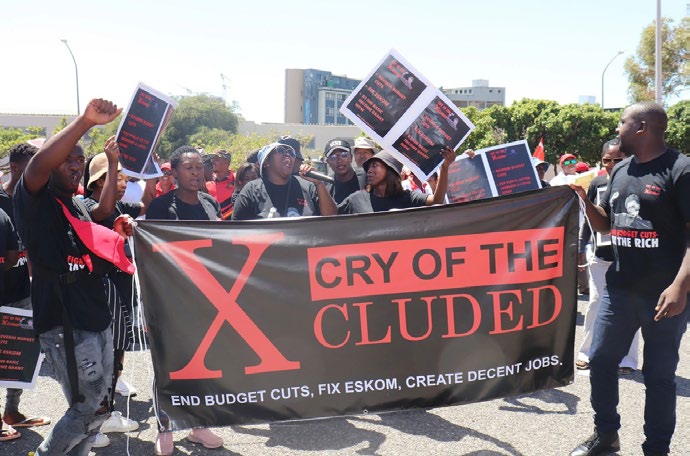
We have the Cry of the Xcluded, which is bringing together the poor and marginalised that have been excluded by the government. We are outside and saying that we must be included. We must include the poor and marginalised in social movements, in the informal settlements, in the rural areas, the peasants and so forth. I have called on the social movements in the Cry of the Xcluded to say, there’s no government, there’s no one that is going to liberate ourselves, besides ourselves. So the liberation that needs to happen now is a liberation that comes from the masses on the ground.
The world needs socialism. The world needs socialists, true socialists, but democratic socialists that are going to ensure that the world becomes a better place for everyone to live. Political parties have failed, so we find hope in the Cry of the Xcluded.
The world needs socialism. The world needs socialists, true socialists, but democratic socialists who are going to ensure that the world becomes a better place for everyone to live. Political parties have failed, so we find hope in the Cry of the Xcluded.