

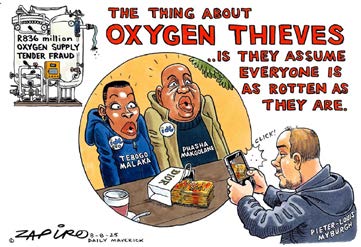
 At the beginning of August, it was revealed that journalist Pieter-Louis Myburgh of Daily Maverick had been offered R60,000 in a Dior bag at a meeting with the CEO and the spokesperson of the Independent Development Trust (IDT). In exchange, they wanted Myburgh not to publish his investigation into how EPWP wages in the Free State, Limpopo and elsewhere have been used to build a luxury mansion for IDT’s CEO, Tebogo Malaba, rather than being paid to the workers.
According to Myburgh’s investigation, the mechanism for achieving this was to suddenly award the NGO Colleen Mashawana Foundation most of the EPWP projects that the IDT put out on tender in 2024.
This was not a one-off event. It came on top of an IDT tender scandal over an R800 million oxygen plant for public hospitals. An entity described as a “ghost company” had managed to inflate the cost of the project by over R500 million. In addition, the IDT has failed to get a clean audit since 2019, with audit disclaimers for 2019/20 and 2020/21 and qualified audits for 2021/22 and 2022/23.
A “qualified audit” means that there is information in the financial statement that is wrong. An audit with a “disclaimer” means the auditors don’t have enough information to be able to say whether the financial statements are accurate or not. The IDT’s auditors recorded “fruitless and wasteful expenditure” of R55 million and “irregular expenditure” of R384 million over the four years, with the 2023/24 audit not yet completed. It has obviously been too difficult to check.
So where does all this come from?
The state is a tender-issuing machine. The IDT is just one of the numerous tender-issuing state entities we have in South Africa: over 150 government agencies. Then there are the local municipalities, State Owned Enterprises, provincial governments with their departments, national government and its departments, and so on.
If a national, provincial or local government department needs two laptops, their own office doesn’t check for the best value and makes the purchase themselves. They put the purchase out on tender. There is a supply chain and bid evaluation process, which then compares the bids and chooses the supplier. The bids take into account that the successful supplier will make a profit, and then the suppliers’ costs in complying with the tender process must be paid somehow. And then, of course, there is the space for corruption and nepotism.
In this way, brown paper bags, or a “power punch single hole paper drill” for the Department of Agriculture, are procured through a tender instead of being bought directly. Tenders are not only about fixing potholes or building schools. They are about e-v-e-r-y-t-h-i-n-g.
Last year, I personally was offered a tender to supply a paper shredder to the Department of Public Works and Infrastructure. They had my email address. That was the only qualification I needed.
On the single day of 14 August, the website ‘Tenders in South Africa’ advertised 3,906 open tenders. It boasted that there are over 1,000 new tenders on the website every week. And there are many tenders that do not appear on the ‘Tender in SA’ website. In the middle of August, ‘Tender in SA’ only had 10 tenders open in the name of IDT, but on the IDT website, there were 204 tenders open for bidding. So maybe we should follow the maths and multiply that number of 3,906 tenders by 20 to get a more accurate figure.
The fact that the state is a tender-issuing machine makes the DA and the ANC partners in a neoliberal quest for a small public sector and privatisation. Its purpose is to create a Black capitalist class, to rectify the situation where non-whites were excluded by apartheid from being a part of the elite. Corruption only speeds up this transformative project of capital accumulation through the state.
There is a priceless ironic contrast between this political reality and what it creates, and the official description of IDT’s role in society in line with the official pro-poor policy of every political party, not least the ANC.
So what is the IDT?
The IDT was started in 1990 with a R2 billion grant from the National Party government. It wanted to show goodwill towards the Black majority, whilst at the same time, it was busy killing them.
After its incorporation into the democratic state, the IDT is today “a grant-making institution for the development of disadvantaged communities in South Africa, particularly in rural areas”. The trust “implements projects commissioned by national and provincial government that involve social infrastructure programmes as the basis for accessing communities and developing assets within them”. The quotes are from the Estimates of National Expenditure (ENE), a budget document that the MPs vote to approve every year.
To achieve this, the ENE says that the IDT will “focus on empowering poor communities by providing project management services for delivering and refurbishing social infrastructure such as schools, clinics and community centres, mainly in rural areas.”
In May, Parliament gave a scathing review of social infrastructure projects, such as the building or repair of school buildings. Too many of them were abandoned, unfinished or poorly done by the successful bidders for the IDT’s tenders.
They come from different directions, but the ANC and DA are now united in their view of the role of the public service in society. Without that unity, they couldn’t be in coalition. And without it, the IDT’s EPWP programmes would be useful public service employment activities run by local governments, instead of what they are: outsourced and procured services through a process that makes it easy for ‘successful bidders’ to shamelessly steal the minimum wage from the workers, which is currently R15.23 per hour. And the procurement process allows them to do this, either as they did in the IDT scandal or by the common practice of paying less than the minimum and skimming off the rest for the ‘supplier’.
When Public Works Programmes are made into Private Works Programmes via institutions like IDT, the space is wide open for such profiteering. The ENE “expects” the IDT “to create 43,000 work opportunities each year over the period… Mainly through the Expanded Public Works Programme” and “a total of 8,637 work opportunities through other programme portfolios”.
The future of the IDT?
The old Greeks came up with the concept “unity of opposites”. It was picked up by philosophers after them and by Marxists 150 years ago. It has been criticised as too simple and rigid a concept, but the Independent Development Trust show that it has its merits.
The IDT is designed as a pro-poor government institution. In that role, it must have done some good during its existence, maybe a lot. But the procurement scandals surfacing in 2025, and the fact that its finances have been in disarray since 2019, show that it is also pro-rich.
So which side of this “unity of contradictions” is dominant in the IDT today?
We have studied the budget document, Estimates of National Expenditure, and it raises questions:
How can a government agency with such a commendable pro-poor purpose employ 27 managers at an average labour cost per person of R3.7 million per year? How can this be allowed in public service?
What did the four employees do who got an average 24% increase from R1.65 million last budget year to R2.05 million this year?
Why did “Compensation of Employees” increase by 22% on average for three years in a row, partly through wage increases and partly through a 30% increase in staff from 247 to 320?
What is the reason? We would like to see such staff increases in Public Health and Education, and indeed such wage increases for the lowest-paid ground staff.
Every year, the cost of running the IDT is “expected to increase at an average annual rate of 7.4% from R529.2 million in 2024/25 to R655.3 million in 2027/28”. How will this be financed? “The bulk of the trust’s revenue, amounting to R2 billion over the medium-term, is generated through management fees paid by the Department of Public Works and Infrastructure and other client departments”. The IDT’s revenue from “management fees” is “expected to increase at an average annual rate of 12%, from R520.2 million in 2024/25 to R731.5 million in 2027/28”.
Why must the payments from departments increase so much? Well, IDT’s management services business with the government ran at a R9 million loss in 2024/2025.
The IDT may still carry out useful projects. But the reality is that its pro-rich function now outweighs its pro-poor mandate. Until the tender machine itself is dismantled—and public services are delivered by public institutions accountable to the people—scandals like this will keep repeating themselves.
Dick Forslund is an economist at AIDC and a member of Zabalaza for Socialism.