

On 31 July 2025, the EFF introduced the Insourcing Bill to the National Assembly. This Bill is a decisive and historic intervention to rebuild the capacity of the South African state. For decades, the state has outsourced even its most basic functions to private contractors. This has hollowed out skills, wasted resources, and subjected workers to exploitation. Instead of a capable developmental state, South Africa has been left with a weak and fragmented public sector. It is dependent on tenders for everything from cleaning schools to guarding hospitals, from plugging in computers to cutting grass outside municipal offices.
The Insourcing Bill is a recognition that the tender system has failed. It has failed workers, it has failed the public, and it has failed the democratic state. To continue outsourcing is to continue on a path of corruption, inflated prices, and poor delivery. To insource is to restore dignity to work, ensure value for money, and rebuild the state’s ability to meet the needs of its people.
Consequences of outsourcing
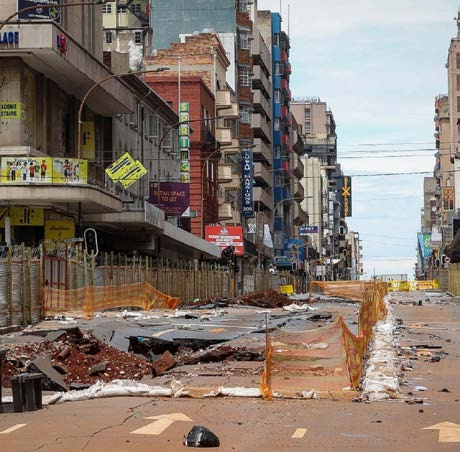
The Lilian Ngoyi Street disaster was worsened by the failure of contractors who were appointed to do the work but abandoned the site after being paid. This is not an isolated case. Across municipalities, the same story repeats: contracts are signed, money is spent, but no lasting service is delivered.
For too long, our state has been captured by a tender system that has become a breeding ground for corruption. Service providers realised long ago that many government institutions do not have the ability to monitor contracts or enforce compliance. They inflate prices, cut corners, and in some cases simply walk away from projects after being paid. The collapse of roads, the breakdown of water infrastructure, and the constant crises in municipal services are all symptoms of a system where the state has been reduced to a contracting authority, rather than an institution capable of doing work in the public interest.
And this is the daily reality of a collapsing state. Roads are left unrepaired for months, water pipes leak without being fixed, and basic services are undelivered. A striking example was the Johannesburg gas explosion that closed Lilian Ngoyi Street for more than two years. The disaster was worsened by the failure of contractors who were appointed to do the work but abandoned their sites after being paid. This is not an isolated case. Across municipalities, the same story repeats: contracts are signed, money is spent, but no lasting service is delivered.
The outsourcing model has stripped municipalities of their core skills. Artisans are no longer hired. The everyday work of gardening, plumbing, cleaning, and electrical repairs is outsourced. Some municipalities even outsource basic IT tasks, like plugging in computers. Instead of strengthening capacity, outsourcing has left the state unable to even manage contracts effectively. As the Auditor-General reports every year, institutions cannot ensure compliance, verify the suitability of service providers, or confirm that they deliver what is paid for. The result is a toxic mix of corruption, inflated prices, substandard work, and failed systems.
Outsourcing is a deliberate programme
What is often forgotten is that this collapse of capacity is not accidental. It has roots in a deliberate policy shift. South Africa went through a phase of privatisation that began with the 1987 White Paper on Privatisation and Deregulation. This was part of a global neoliberal wave that began in the mid-1970s, combined with the fear of the ruling elite in South Africa that they would soon lose political power. In response, there was a wholesale looting of state assets and a dismantling of state capacity.
The list of what was privatised is staggering. Security services at public buildings, cleaning and catering, auditing, laundry, transport of schoolchildren, messenger services, and even the transcription of court proceedings were outsourced. Core economic functions like the operation of water and sewage purification plants, the printing and publishing of statutes, forestry, road construction, and maintenance of telephone systems were shifted into private hands.
Escom, at that time one of the ten largest utilities in the world with more than 60,000 employees and an installed capacity of 28,000 MW, was earmarked for restructuring. Its electricity generation, transmission network of 172,000 kilometres, and even its support functions were identified for private involvement. Iscor, the steel giant with assets worth more than R20 billion, was also on the list. The South African Transport Services, which controlled harbours, railways, roads, and airways, had assets valued at more than R60 billion and was marked for break-up. Forestry covering 300,000 hectares, housing stock valued at more than R25 billion, government land worth R10 billion, and surplus SATS property worth R1 billion were all prepared for privatisation.
And the reach of privatisation was not confined to these big entities. Hospitals for tuberculosis and psychiatric patients, educational institutions worth R5 billion, sawmills, and even functions such as the transcription of court proceedings and the preparation of study materials were to be outsourced. Security at public buildings, cleaning, catering, auditing, laundry, and transport of schoolchildren were also identified for contracting out. It was a wholesale dismantling of capacity.
This was not just about raising money or making government smaller. It was about systematically hollowing out the state. For decades before, the South African state—however oppressive under apartheid—maintained its own artisans, engineers, technicians, and administrators. The construction of roads, bridges, dams, and water purification works, as well as the running of communications systems, forestry, and hospitals, was done largely in-house. The apartheid state invested heavily in these capacities from the 1930s onwards, laying the basis for industrialisation. When privatisation arrived, that capacity was deliberately dismantled.
The democratic government that came into office in 1994 inherited this fragile system. Instead of breaking with it, outsourcing and tendering were entrenched as the main tools of delivery. Municipalities no longer recruited artisans, departments no longer employed technical staff, and reliance on private contractors deepened. The result is that today the state cannot fulfil even the most basic of functions without tenders, and the tender system itself has become the most corrupt and exploitative space in public life.
Why insourcing is better
The Insourcing Bill is about returning to the principle that the state must have its own internal capacity to deliver essential services. This is not simply about efficiency; it is about justice. Workers who provide security, cleaning, or catering in public institutions are exploited by labour brokers and contractors. The state pays inflated amounts—sometimes as high as R14,000 per security guard per month—yet the worker takes home only R3,500. In other cases, Expanded Public Works Programme workers are hired for six months but paid for only two. These exploitative practices thrive under the tender system.
By insourcing, the state will not only save money but also create sustainable, dignified jobs. Workers will earn a living wage, receive benefits, and work under decent conditions. The state, in turn, will regain the skills it desperately needs to function. Insourcing means that when a pipe bursts, when a school needs cleaning, or when IT systems must be maintained, the state will no longer rely on fly-by-night contractors but on its own trained employees.
Insourcing is about fairness for workers, but it is also about efficiency and accountability. When services are insourced, the state saves money by cutting out profits and inflated invoices. It gains the ability to plan for the long term and to build up institutional memory. It also takes direct responsibility for delivery. No longer will departments be able to point to contractors when things collapse. The state itself will be responsible, and the public will know who is accountable.
The Bill
The Insourcing Bill is a political and moral commitment to rebuild the state and put an end to the corruption and inefficiency of outsourcing. It restores the principle that the state must serve the people directly, and not through middlemen whose only interest is profit. It also ensures that the money allocated for services does not disappear into the pockets of contractors and labour brokers but goes directly into decent wages and reliable delivery.
The importance of this Bill cannot be overstated. Without it, the state will continue to drift into irrelevance, outsourcing more and more, while corruption deepens and service delivery collapses. With it, we can rebuild a capable state, create sustainable jobs, and restore the principle that government exists to serve the people, not private contractors. This is why the Insourcing Bill has already won the support of workers’ organisations such as Saftu and Cosatu. Their endorsement demonstrates that this is not only an EFF proposal but a demand of the working class and of millions of South Africans who are tired of exploitation and failed services.
We are under no illusion: this Bill will not be accepted without resistance. Those who benefit from tenders and labour broking will fight to protect their profits. They will argue that insourcing is costly or impractical. But no political party that claims to represent the people can honestly oppose it. The choice is stark. Continue with privatisation, corruption, and collapse, or embrace insourcing, justice, and renewal.
Omphile Maotwe is EFF Treasurer General and a Member of Parliament responsible for the Insourcing Bill.