

Contestation among private industry lobbies, factions within the state, university academics and some well-resourced civil society organisations dominates public discussion on South Africa’s energy transition. Despite some well-meaning attempts, the tensions surrounding the Just Energy Transition (JET) have served as a smokescreen for advancing policies that restructure the electricity sector. The purpose is to enable greater participation of private capital ownership and operation of basic infrastructure. This shift appears to be framed as a move toward sustainable energy. In fact, it masks a deeper agenda: transforming electricity from a public good into a commodified, marketised system. This is an approach long championed by institutions like the World Bank and International Monetary Fund (IMF).
If left unchallenged, the working class can expect painful consequences: rising electricity prices, reduced investment in basic infrastructure, and deepened socio-economic divisions. Wealthy residents, large commercial retailers, and heavy industry are already manoeuvring to insulate themselves from the fallout. This will leave low-income communities increasingly vulnerable.
A history of reform
Electrification in South Africa initially emerged as a fragmented and localised infrastructure. It was driven by private interests catering to industrial needs, such as mining and manufacturing in the north, as well as lighting, early telecommunications and pumped water schemes. The discovery of gold in the late 19th century and the resulting industrial boom increased demand for early electrification projects. But these efforts were limited in scope and highly unequal, favouring urban centres and white-owned enterprises.
By the mid-20th century, state intervention was the basis for nationalisation efforts that transformed this patchwork system. Eskom, established in 1923, became a cornerstone of South Africa’s industrial and economic development. Operating as a state-owned monopoly, it harnessed economies of scale, streamlined operations through vertical integration, and benefited from state-backed financing mechanisms. This enabled it to deliver some of the cheapest electricity in the world. This drove industrialisation and extended grid access to previously excluded rural and urban areas. However, the expansion of electrification remained deeply racialised. This reflected broader apartheid-era inequalities, with Black South Africans systematically excluded from its benefits.
After the end of apartheid, Eskom charted a new path. Through a massive public initiative, it was able to electrify millions of households previously excluded from the grid. This demonstrated the potential of state-owned utilities to develop infrastructure which could make possible universal access to electricity as a matter of public good.
The push toward liberalisation formally began with the 1998 Energy White Paper. This laid the groundwork for restructuring Eskom. It called for the unbundling of generation and transmission, the increased inclusion of privately owned generation, and the shift towards tariffs that reflected costs. At the time, Eskom was financially stable, reliably providing electricity and spearheading electrification initiatives. Therefore, it has been acknowledged that the reforms were not driven by poor performance or financial distress. They were driven by the ideological commitment of a small group of people to align with global trends in electricity liberalisation.
By 2001, these proposals became policy. Eskom was prohibited from investing in new generation capacity (as it is now again), leaving future energy development to private players. Furthermore, the 2001 Energy Conversion Act corporatised Eskom. This transformed it from a public enterprise into a tax-paying, dividend-distributing public company. This marked a departure from Eskom’s historic self-financing model, forcing it to rely on the National Treasury for funding.
The consequences of these reforms were soon evident. While privatisation efforts stalled, Eskom was left unable to build new capacity. By 2004, the utility warned of impending power shortages, which materialised as widespread load shedding by 2008. The government’s eventual reversal of its prohibition on Eskom’s investment in generation came too late. The Medupi and Kusile coal-fired plants were intended to address capacity deficits. But they were plagued by corruption, mismanagement, and technical failures, resulting in exorbitant costs and inefficiencies.
The contested rise of renewable energy
The early 2010s and South Africa’s hosting of COP17 (the global climate change conference) saw a wave of movement on climate change and renewable energy policy and activism.
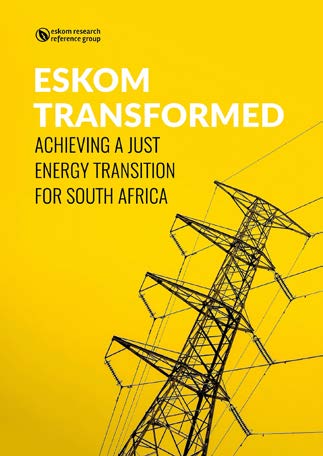
‘Eskom Transformed’, a report produced in 2020, warned of a ‘Green Structural Adjustment Programme’ where governments are encouraged to derisk investments for private entities through public guarantees, subsidies, and partnerships. This ensures private profits, while public funds bear the risks.
Unions played a key role in this, leading the call for a transformative just transition. In 2011, Cosatu unveiled its flagship climate policy document. This laid out a vision for a transformative approach to climate change that prioritised equity, sustainability, and worker rights. This was followed in 2012 by a landmark resolution from the National Union of Metalworkers of South Africa (Numsa). This emphasised the critical need for social ownership within the emerging renewable energy sector. Numsa’s resolution also underscored the necessity of systemic socio-economic restructuring to address the dual crises of inequality and climate change. It framed these efforts as integral to fulfilling South Africa’s historical mandate of creating a just and egalitarian society.
Despite these efforts, the private route won out. In 2012, the Renewable Energy Independent Power Producer Procurement Programme (REI4P) was launched. This initiative introduced privately owned renewable energy projects. Eskom was to act as the single buyer through long-term power purchase agreements. The programme was praised for the large investment and high selling prices aimed at stimulating local industry. However, it has failed to create the long-term, decent jobs promised and effectively financialised electricity infrastructure. It has excluded local municipalities and concentrated the benefits amongst multinational corporations, sidelining local manufacturing and labour.
In 2020, the Alternative Information and Development Centre (AIDC) in Cape Town, Trade Unions for Energy Democracy (TUED) in New York, and the Transnational Institute (TNI) in Amsterdam, working closely with Numsa and the National Union of Mineworkers (NUM), produced a report, Eskom Transformed. This report challenged the liberalisation path for the sector. The report warned of a ‘green Structural Adjustment Programme’ where governments are encouraged to de-risk investments for private entities through public guarantees, subsidies, and partnerships. This ensures private profits, while public funds bear the risks. This approach mirrors past structural adjustment programmes implemented across the Global South since the 1980s under the advice of the World Bank and the IMF. These have left a legacy of austerity policies, unaffordable electricity prices and a structural inability to address the scale of energy poverty, particularly in Africa.
As the performance of Eskom’s generation fleet began to decay, most sharply from 2018-2023, the market reform process was accelerated in the name of addressing load-shedding. Eskom was deemed incapable of driving the energy transition, while private capital was simply waiting to invest in public-private partnerships if a stable and enabling policy environment could be established.
This period of reform has been marked by two key structural changes. First, the amendment to Schedule 2 of the Electricity Act removed the licensing requirement for private generators. This enabled the uptake of private small-scale embedded generation projects (almost exclusively solar). This legislative change has seen a significant upscaling in investment in infrastructure by large commercial retailers and energy-intensive users. The second includes the advancement of the process to unbundle Eskom into three separate divisions: generation, transmission and distribution. This process, which is fundamental to neoliberal power sector reform, is a precursor to the establishment of an electricity market. It signals a clear shift towards a strategy which expects private capital to play a driving role in new-generation infrastructure investment.
From 2021, Europe and the US started to have a larger influence over the direction of our energy sector and the transition through the Just Energy Transition Partnership (JETP). The JETP is a deal for $11.6 billion in finance, largely in the form of loans. Through it, these countries have been able to select the projects they wish to see in South Africa’s JET process and exert their own strategic interests.
Through these developments, unions and other progressive actors have tried to push for a genuine, just transition process, outlining potential pathways to get there. Some recent examples include the Cosatu Blueprint document and public submissions to the Presidential Climate Commission critiquing the JET investment and implementation plans. There have also been challenges to the industrial policy debates on renewable energy technologies (see IEJ-Cosatu comments to the South African Renewable Energy Master Plan).
These initiatives represented significant milestones in aligning the labour movement with climate justice. However, they struggled to evolve into sustained, widespread campaigns driven from within their own ranks. Over time, many of their foundational ideas have been absorbed and diluted by mainstream climate policymakers. This has particularly been the case around democratic control and social ownership, and even the concept of a just transition itself. Stripped of their radical potential, these ideas have been put into bed with neoliberal, market-based reforms, acting in the name of the climate emergency.
The challenges ahead
The energy landscape is marked by a series of interrelated challenges. These threaten the realisation of universal access to electricity as a public good, and the stability of the sector and the broader economy. Electricity tariffs are being restructured to ensure that they become more reflective of the cost of provision. This is a principle which is typically crucial to the establishment of an electricity market. This shift will push up electricity prices, disproportionately affecting low-income households and making energy poverty worse. Simultaneously, affluent households, large commercial entities and heavy industry are increasingly turning to private solar systems. This reduces their reliance on the national grid and helps them avoid future Eskom and municipal price hikes.
This trend ultimately undermines cross-subsidisation between different income groups, placing additional financial burdens on poorer households. It also has significant implications for municipalities which rely heavily on electricity sales for revenue. They now face a growing crisis, as grid defection by the wealthy and non-payment in low-income areas threaten their financial viability. This could push many municipalities—particularly under-resourced ones—into a spiral of debt and collapse. At the national level, Eskom itself is caught in a precarious ‘death spiral’ as it struggles to balance mounting debt with the need to invest in enabling infrastructure for private sector projects. The resulting price hikes risk alienating consumers further while jeopardising the utility’s ability to lead a just and equitable energy transition.
South Africa’s energy transition cannot succeed without centring the needs of the working class. Labour unions and progressive organisations have proposed a range of alternatives to our current path, including:
- Reform of Eskom: to make it the driver of a public-led energy transition rather than unbundling and privatising it.
- Strategic localisation: to promote domestic manufacturing of renewable energy components, which are essential for creating jobs and building industrial capacity.
- Municipal funding reform: to replace the reliance on electricity tariffs for municipal revenue with progressive taxation mechanisms, such as wealth taxes, to ensure equitable access to services.
- Democratic ownership: to expand public and community ownership of energy infrastructure that can ensure that the benefits of the transition are widely shared.
Yet, despite these extensive efforts to develop coherent policies and responses to the energy transition, trade unions have struggled. They have been unable to build a cohesive political platform capable of challenging the state’s market-oriented reforms. As a result, the state has largely disregarded labour’s demands and recommendations. This has further marginalised the interests of workers and low-income communities in the energy transition process. Together, these fault lines highlight the urgent need for transformative action to prevent the deepening of inequalities and the collapse of South Africa’s energy infrastructure.
A fork in the road
South Africa’s energy system is at a crossroads. The current trajectory is playing out the liberalisation agenda of the 1990s. It risks entrenching inequalities and perpetuating exploitation under the guise of climate action. The neoliberal reforms are touted as solutions to inefficiency, but they have introduced new avenues for rent-seeking and financial speculation. These undermine the potential for a truly transformative energy transition.

South Africa’s biggest solar farm. Affluent households, large commercial entities and heavy industry are increasingly turning to private solar systems. This trend ultimately undermines cross-subsidisation between different income groups, placing additional financial burdens on poorer households.
A genuinely just transition requires breaking from the neoliberal paradigm. It demands not only a shift in energy sources but also a fundamental rethinking of ownership, governance, and distribution. Without this, the promises of the energy transition will remain hollow, serving only to deepen the divides within South African society. Despite this having been acknowledged by a range of progressive social forces, there remains relatively weak political action to oppose the market reform process.
The nation’s residents are on the verge of waves of price increases, which are due to accompany the restructuring process. The social unrest it will produce provides a significant opportunity for community organisations and the labour movement to come together to produce an alternative vision with momentum behind it.
Brian Kamanzi is a researcher at Trade Unions for Energy Democracy at the City University of New York. Katrina Lehmann-Grube is a climate change and inequality researcher at the Southern Centre for Inequality Studies at Wits University.