




Interview with Henriette Abrahams, Chairperson of the Bonteheuwel Development Forum
Amandla!: Tell me a bit about the Forum. What do you do?
Henriette Abrahams: The Bonteheuwel Development Forum was started in 2018. We had lots of gang violence and lots of bodies on our streets. So we started street committees to patrol, focusing on gang violence, drug merchants and creating safe routes and passages for our children during this gang warfare. We mobilised, linked the politics to it, took on SAPS and government. We shut down in Cape Town in September 2019. Other communities came out, and it spread to Westbury, Eldos, and other areas across South Africa.
Then we broadened out; we looked at safety and food security; we branched out, because we understand that these are systemic issues, into youth empowerment, women’s empowerment, and psychosocial support work.
A!: For people who don’t know Bonteheuwel, just describe briefly what kind of a place it is.
HA: Under the Group Areas Act, people were thrown out of areas such as District Six, and they landed up in Bonteheuwel, Hanover Park, Manenberg. Bonteheuwel is a working-class area. Originally it was built for 35,000 people. Today we have 85,000 people. So we have a lot of overcrowding; we have a lot of backyard dwellers. Of course, where you have such density, unemployment, poverty, and so forth, you will always have crime. We have overburdened infrastructure, because all these years they’ve never expanded our public works. We have people sitting with overflowing drains, sewage in the yards and streets, and floods. The infrastructure was never upgraded at all. And yet we are seeing Seapoint’s boardwalk being upgraded today, as we speak.
We have your typical issues that any working-class area would have, which are hunger, poverty, violence, and unemployment.
A!: Has the army been in Bonteheuwel since that announcement by the president?
HA: Yes. The army is here. This is not the first or second time that the army has been deployed to assist with gang violence. They are not physically deployed in the police precinct, like the Anti-Gang Unit. They are stationed somewhere, and then they hit certain areas. So you would have the army once or twice a week.
A!: So they pop in and out. And when they’re popping in, what do they do?
HA: They have joint force operations. SAPS and the army and metro police go to hot spots where gangs are, where there are killings. They search people who are walking on the streets. They search them on the street, and they also search drug merchants and suspected and suspicious homes of gangsters or gang activity. But there’s a lack of intelligence-driven operations. For them to hit Bonteheuwel streets or Langa streets without a proper intelligence plan does not make sense to me. It’s a waste of money. R800 million, that’s almost a billion rand, right? But if intelligence and the police are compromised, as we are seeing today in the Madlanga Commission and the parliamentary committee, as well as among politicians and the government, then what are they doing? What’s the success rate going to be? Are they not set up for failure if we already have a compromised police?
We really have a trust deficit between communities and SAPS and criminal intelligence departments. They continually undermine the intelligence that communities are sitting on, in structures or neighbourhood watches or street patrols.
So, for instance, we’ve had shootings last night. We have the immediate information—we know these were the shooters, they ran that way, they pitched the gun that way. We know that if the police are looking for a particular gang member, then that gang member from our area would go and hide out in Woodstock, or in Mitchells Plain, where the others are, or even go and live on the Sea Point / Camps Bay strip as homeless people for a while, or run to informal settlements and hang out there, lie low.
That’s the type of intelligence that I’m talking about. But even within our own precincts, there are police that we don’t trust to give information to. Or we will only work with one particular police officer, not a couple of them.
A!: What was the situation of violence and gang-related activities before the 1st April, before the mobilisation of the army?
HA: Even today, whilst the army is deployed, there are still bodies everywhere. Five people were shot just last night in Beacon Valley, for instance. Violence has increased to the extent that these gangsters are shooting indiscriminately at an entire family. You’re sitting outside on a Sunday afternoon, playing dominoes or drinking beer. They shoot everybody that’s sitting there. At first, the gangs just took out their rivals. Now they shoot everybody who is in the room. And they’re going for headshots. The intention is to kill you in such a fashion that your family can’t have an open casket.
A!: What has been the effect of the army’s presence in Bonteheuwel?
HA: For me, there’s no effect. Like I’m saying, they pop in and out. If we see them twice a week, it’s a lot. We don’t see the difference; we don’t feel safer, we don’t see it, we don’t feel it. As long as we have hunger, as long as we have poverty, as long as we have unemployment, we will always have crime. If the state does not put its resources and its energy into the root causes of crime and gangsterism and violence, we will forever have to deploy the army.
And they must stop militarising the poor. They come into our area. Many people are complaining of innocent children being roughed up in the streets by SAPS and the army. They’re brutalising our people, whether they are gangsters or not. I haven’t seen any effective changes or change in behaviour or attitude or feeling safer since the deployment of the army,
A!: So you’re saying that it’s not only that they’re not doing anything good; they’re actually doing harm.
HA: Yes, and it’s not just the army, it’s SAPS too. The army is not trained as a civilian protection force or in how to deal with our people. Obviously, we have people that speak up for their rights: “Why are you arresting him? He’s got nothing on him, he’s not a gangster.” And their response is a typical brutal state response: “You’re not going to tell us about your rights”. You can lay a case afterwards, but in the meantime, your child is already in the system. Then he gets sent to the police cells. He gets mixed in with those gangsters and robbed.
So it’s also about how we work around a caring state, a caring response? How do we work on an unlearning on both sides of our community, as well as the state, unlearning and relearning? When we started, for instance, in the 94 and 95 period, with the Bill of Rights, we were still talking about Batho Pele and building a culture of human rights. But that is out the window. If cops come in with disrespect, they’re going to get disrespect in most cases, right? And then they want to use their badges, positions, and uniforms to force respect.
A!: Obviously, this R800 million is a terrible waste of money. What would you like the government to be doing with it to make the situation better in places like Bonteheuwel?
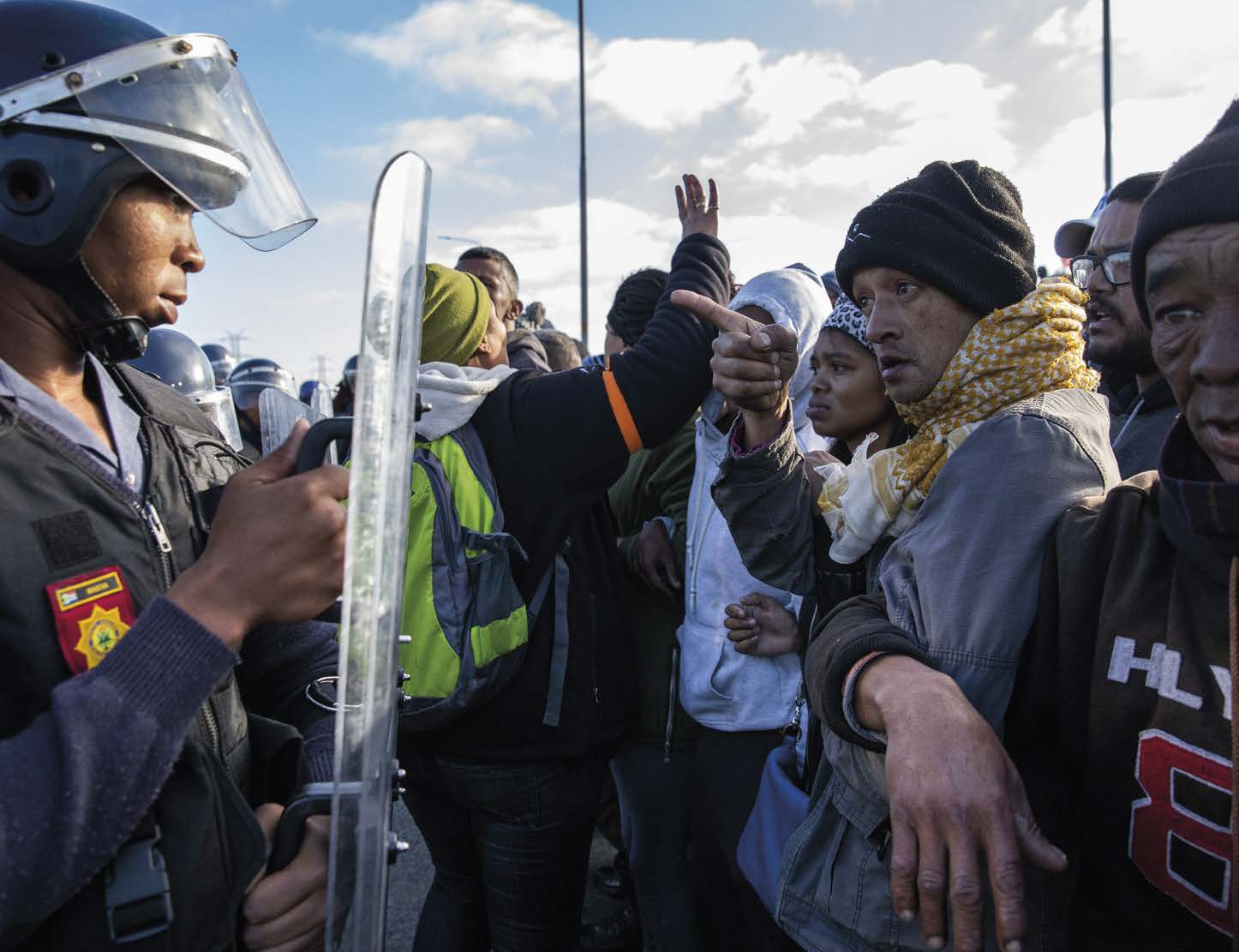
2018 Bonteheuwel protests against gang violence and crime. (Ashraf Hedricks/GroundUp)
HA: We would have used that money for youth development programmes, youth extracurricular programmes. For the whole of the December holidays, we played soccer and netball on the fields in every block every Saturday. Twice we held coaching clinics for the kids, and we took them swimming as part of the preparation for the Saturday tournaments. We fed them and offered psychosocial support by talking to the kids and youth. Government must come to the party, and we must develop programmes that speak to the issues of our children, that occupy our youth, that develop other talents and interests, be it arts and culture, be it sports, be it academia, or just general fun stuff that youth enjoy. Many of us bring whatever we have in our cupboards, or we give R50 towards something for them to eat while they’re at the swimming pool.
So I think that money could be better spent on putting programmes there that are focused on the prevention of crime, on psychosocial support, on drug rehabilitation, on so many other things that our youth can just live- live a normal life, a safe life.
*Featured Image by Ashraf Hedricks/GroundUp

