Beginning in 2000, Zimbabwe experienced a decade of unprecedented political and economic crisis that was only temporarily alleviated by the inception of a government of national unity in 2010. Despite the occasional populist and radical pronouncements of the head of...
time
Mali: folly of war in the Sahel | by Professor Issa Ndiaye
The current crisis in Mali is not the result of the March 22 coup d'état, which marked only the collapse of a misguided and corrupt democracy which has been so noisily eulogized. The current disaster has been produced by the monopolization of the State and other...
A tale of two museums | by Andre Marais
Landlocked Timbuktu in Mali and coastal Cape Town are 6,000 kilometres apart from one another but they are both under threat: one museum by a religious fundamentalism, the other by economics. Both museums are preserving important historical and heritage sites. Both...
It’s time for the real fight | by Harmony Goldberg
The re-election of Barack Obama represents one of the most important political opportunities of our time. I know that many people on the left will read that opening line, dismiss me as a hopeless radical-turned-liberal and refuse to read any further. They'll be wrong....
It’s time for women to lead South Africa | by Nozizwe Madlala-Routledge
You who have no work, speak. You, who have no homes, speak. You, who have no schools, speak. You, who have to run like chickens from vultures, speak. We must share the problems so that we can solve them together. We must free ourselves. Dora Tamana Should we as women...
‘We cannot walk freely’| by Jeanne Hefez
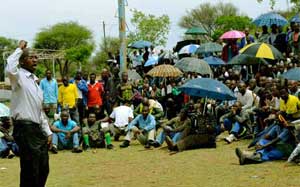
Voices from Marikana: Lonmin workers speak It's nearly four months after the Marikana massacre, and the atmosphere in and around Lonmin is still one of fear in the face of a de facto state of emergency. As Amandla! goes to press, police continue to use excessive force...
Embryos of working-class power and grassroots democracy in Marikana
The formation of a workers' committee is an act of power by the working class. It has shaken capital by advancing far beyond trade union bureaucracy. The workers' committee in Lonmin had only been in existence for a week when the Marikana massacre took place on the 16...
The strike committees: Organising against all odds | by Amandla! correspondants
Whether the aftermath of Marikana will spell the downright end of the National Union of Mineworkers, the resentment against the traditional structures of bargaining and the union leadership is palpable in the platinum belt, sometimes bordering on murderous anger. The...
Tebogo: the plight of a female mineworker| by Jeanne Hefez
My name is Tibugo, I'm one of the strike committee leaders at Anglo American in Rustenburg. I work as a PTV (personnel transport vehicle operator) at Amplats, I do mostly pipe work. Sometimes I clean the tunnels. It's extremely labor intensive. I've been here for a...