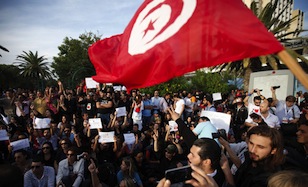
I first visited Tunis four years ago. I liked its French-Arab feel, the streets that still carried such French names as Lafayette, Jaures and Pasteur, and the tram connecting the city center to the residential area that the locals proudly referred to as a "metro."...
police
Newsbriefs
International The Citizens' Revolution advances in Ecuador The radical social and economic reforms of President Rafael Correa, known as the Citizens' Revolution, received an overwhelming stamp of approval by the Ecuadorian people when he won more than 60% of the votes...
South Africa’s New Apartheid | by Sabine Cessou
A group of building workers relaxed on the pavement in central Cape Town, enjoying their lunch break. Every minute was precious; nobody was in a hurry to get back to work. "They pay us peanuts," said a bricklayer with a gold tooth. On the equivalent of $1,470 a month,...
The Warning: South Africa Is An Angry And Frustrated Nation And On The Brink | by Danny Schechter
Durban, South Africa: These are not the best of times in South Africa. It seems clear that there is fear and loathing everywhere as the press is packed with fresh allegations of corruption, and a restive mood spreads even as the country prepares to host the economic...
The Third Intifada? | by Uri Avnery
Is this the third intifada? This question was raised this week by a number of Israeli security experts. And not only by them – their Palestinian colleagues were almost as perplexed. All over the West Bank, Palestinian youth threw stones at Israeli soldiers. All the...
End rural slavery in South Africa!
During the month of November last year, the world watched farm workers strikes, particularly those working in vineyards in the Western Cape Province, in South Africa. They were protesting against exploitation and poor working and living conditions on farms, demanding...
Farm strikes: Radical changes needed.
Farm workers began the centennial year of the 1913 Land Act with a continuation of the most militant industrial action in the sector in decades. On January 9th, various Western Cape farming towns were turned into warzones as protestors demanding an increase to a...
Marikana mine massacre: why British lawyer has joined fight for justice
James Nichol explains his decision to volunteer to represent forgotten families of dead strikers When South Africa's apartheid police massacred 69 people in Sharpeville in 1960, the revulsion spread as far as northern England. James Nichol, then 15, took part in his...
AMCU at the Commission: “It was one big crime’ | by Jeanne Hefez
In its first months of hearings, the Farlam Commission has shown us clear evidence of a bungled police cover up of a massacre, the National Union of Mineworkers' (NUM) own attempt to hide its role, and an alarming level of complicity between state and capital. The...