by Sungar Savran Istanbul has become a battlefield covered by tear gas. The police, no doubt at the behest of the Prime Minister Tayyip Erdogan and his AKP government, have been attacking protestors in the centre of the city, near Taksim Square, for five consecutive...

major
Industrial agriculture vs. food sovereignty | by Stephen Greenberg
Large-scale commercial agriculture produces an estimated 90% or more of marketed food in South Africa. Two-thirds to three-quarters of food is purchased from supermarkets, even by the poor, and corporate agribusinesses dominate supply chains from inputs to retailing....
Syria’s Bloody Civil War: an interview with Gilbert Achcar
Interview with Gilbert Achcar, academic, writer, and activist, Professor at the Development Studies Department at the School of African and Oriental Studies in London (SOAS). Amandla!: What would you say to those who argue that the Syrian uprising may be an opening...
Nicolás Maduro is Venezuela’s vote for Chávismo| by Mark Weisbrot
Hugo Chávez's economic policies were successful but a close vote means the new president cannot become complacent After a short but bitterly fought, insult-laden campaign, Chávista standard-bearer Nicolás Maduro defeated challenger Henrique Capriles, thus assuring...
Two years after Fukushima | by Pierre Rousset
The triple disaster of 11 March 2011 constituted a major turning point in contemporary Japanese history — its political impact is not however unequivocal. It has provoked a radical break in the way in which many Japanese people perceive the authorities and...
Crises are part of Capitalism’s metabolism
A crisis in the capitalist system is a kind of wake up call: speculative bubbles burst, the price of assets [8] moves back towards their real value; the least profitable corporations go bankrupt, and capital is destroyed [9]. Crises are in a way part of Capitalism's...
Amplats’ Restructuring: reflective of broader trends
Anglo's platinum operations are not "unprofitable". Rather, they are not "profitable enough". Plans to restructure will jeopardize the income of 14 000 workers and more than 100 000 dependents. AMCUs call to nationalize in response reflects the growing consensus on...
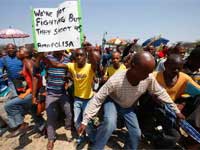
Marikana … from June 16 to August 16: 36 years
South Africa is by all accounts the world's richest country in terms of the value of its mineral resources. In 2010 these were valued at $2.5–$4.5 trillion. Mining is a lucrative business opportunity right now. The demand for commodities for the growing economies of...
Economics for people
Amandla! introduces a new column: Economics for people. In this column we demystify basic economic processes, concepts and debates so that activists are able to participate better in the struggles over the nature and direction of economic policy. One of the factors...