

Amandla!: I suppose one of the most important things to understand is the nature and scale of gender-based violence in this area.
Anele Gqasana: Langa is the oldest township, the first township in Cape Town. Yet it’s the smallest when it comes to size. It’s overpopulated. There’s decaying infrastructure. People don’t want to move out of Langa, and they are sitting on top of each other.
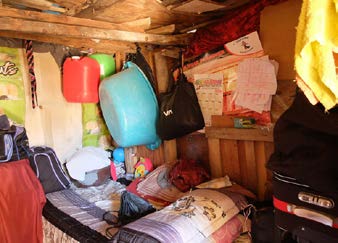
COVID-19 was where we started seeing the pressure of gender-based violence rising. The husband has to sit at home. He’s got grandchildren. It’s a one-room house. He’s got his wife and mother in the same house. Then he starts getting violent.
COVID-19 was where we started seeing the pressure of gender-based violence rising. The husband was used to going to a shebeen, sit, grab a beer, chill with other friends, chat, go back home around 7pm, have supper, go straight to bed or read the newspaper. Now it was lockdown. He has to sit at home. He’s got grandchildren. It’s a one-room house. He’s got his wife and mother in the same house. Then he starts getting violent because the wife doesn’t have food to cook. He has been told to stay at home. There’s no job for him. The company has closed down.
There was a lot of pressure during COVID, so GBV increased. That’s when we launched this programme.
We tried to create GBV-free zones within the community, saying that everyone has a responsibility to fight GBV. We have a method that says everyone belongs to a street where they stay. In that street, there’s a street committee. If we start on that level, everyone can take accountability within their streets, and it’s easier to mobilise people on their streets than on a wider scale. So we started by saying, let’s create GBV-free zones in our streets. We want to have ambassadors and monitors in our streets; ambassadors will advocate on GBV, and monitors are for people to report, access information and also to listen, rather than running to a police station. But due to resources and stuff, we could only afford to have 15 monitors in Langa. They are the ears, eyes, and first responders.
They have a WhatsApp group. And also, they have access to SAPS. They were trained by SAPS as trauma counsellors and community empowerment ambassadors. They know how to report these incidents in a proper manner, acknowledging the issues of confidentiality and victim safety.
Then the lockdown was lifted. People went back to normal. And we said, we still need to do more. Every time in our forum, the first thing that we do is to get monthly statistics of GBV. And you can see that it has increased each and every month, and there were fewer convictions.
We saw a gap. So we said, let’s play a role as a forum to support our victims and their families. Why families? We are always victim-centred. We forget that there’s an uncle, a parent, a child at home. The victim comes from court, frustrated with the cross-examination, with the questions, even before going to court. At home, no one understands what is happening to the victim. There’s also a high number of people or victims withdrawing the cases because they’re not getting support. When you are preparing statements you are again reliving the rape you went through.
We wanted to empower them to support one another, to have a platform, a space where they can vent, where they can feel safe. They support each other; they go to courts; they wear their t-shirts. They take banners. They do sessions with the families.
There’s an issue of unemployment. The very same women who are victims have nowhere to run because their husband is the breadwinner. If I get him arrested, I will have no income, and I will have no food. I will have to go back to that shack and leave him. Even if he’s served with a protection order, do protection orders work in townships? How do I give you a protection order while it’s a one-room shack?
So that’s the Sibambene support group. We host sessions for groups of 30. Already, we have over 150 women in Sibambene. They meet weekly.
A!: The government says, especially during the 16 days in December, that it’s very concerned about GBV, and it’s doing everything it possibly can. What do you think of what the government is doing, and what do you think about what the government should be doing that they’re not doing?
AG: I had a conversation last month with the MEC for Social Development in the province. We applied for funding. It was declined. I asked him to please support the GBV monitors of Langa. It’s people who are dedicated. They also need income. They need rent to bring into their homes. They’ll get tired because they’re doing a lot of work for the community of Langa. He always tells us that there are budget cuts and all that stuff, that’s why we didn’t get funding. It’s not easy to work with the government when it comes to these issues, because they have their own targets and they already know what they want, not knowing what is needed on the ground.
We know what is really happening in the communities. They don’t know. They know reports are coming from social development. They know the organisations they already fund in our communities. I told them that two of the organisations they are funding are not Langa-based. At 4 pm, they close their offices. They go home. I’m the one who receives after-hours calls. That’s why I’m saying they don’t know the real need that is on the ground.
They said they’ve got an ambassador programme they’re going to launch. They can put monitors in. We don’t want that. There are already monitors. They’re working in the streets, there every day. And also, with the government, there’s a lot of paper trail that is unnecessary with funding applications. You apply, you submit everything, you work the whole two to three weeks, filling in applications, collecting the necessary documents, only to find out you will not get any funding.
A!: What is your impression? Is GBV increasing, staying the same, or going down?
AG: It’s increasing. Remember, SAPS is only reporting on the reported cases. There are unreported cases. That’s where we need developmental help. Most of these ladies who are part of the support group will tell you, ‘I didn’t go to the police station. Those policemen, they’re not good. They don’t know their job. My husband beat me. I was a pulp. I went to Vanguard hospital, was given pain tablets, was given bandages, was given everything, and a J88 medical examination form. But I can’t afford to get my husband arrested.’ So they throw the form away.
The monitors have a role to accompany the victims to the police station and be there to see to it that the victims are helped, and they are safe. The monitor will go with you to a police station and stand near you while you are talking. If the officer interjects in a way that is unbecoming, then the monitor will intervene.
A!: How well do you find that the police are trained to deal with these issues?
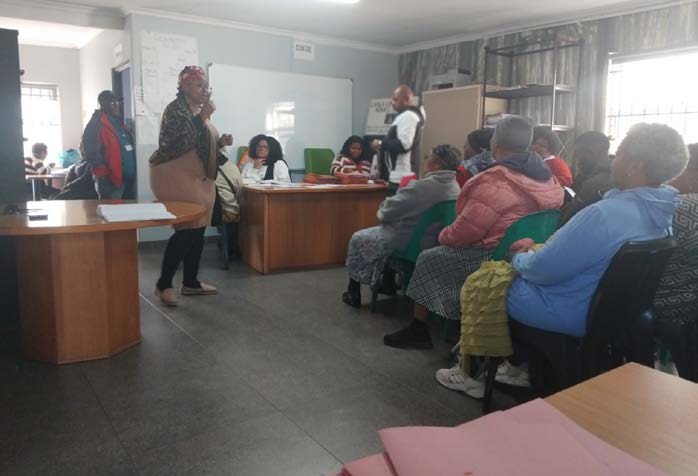
Sibambene Women’s Support Group. You cannot helicopter in a GBV programme and expect it to work. You must work with the people who already hold the community together. The NGO’s, the street committees, the mothers, the survivors; they are already doing the work. They need to be recognised, respected, and resourced.
AG: SAPS officers are not well-trained on the Domestic Violence Act. Each office, even the clerk within the SAPS precinct, needs to be trained and be aware of domestic violence. Someone is crying, you see that she’s hurt, you must know what to do. Sensitisation is very important in our police stations.
There’s a case we were doing of a young man who came to report that he was raped by a 40 year old man. Based on what has happened and the way SAPS handled the case, it has been pulled out of the court. So we said, can you open the docket to see what is happening? We find that the medical report form is not filled in. And the statements in the file do not correspond to what we were told by the boy.
So the system is failing us. The guy was first granted R1,000 bail. We wrote a review of that default decision. They didn’t acknowledge it. All the street committees submitted petitions. We said we don’t want him getting out because he is a second time rape offender. On his first offense, he raped plus minus six boys. So, the justice system is not working with us.
A!: A strong message I hear is that this whole process of fighting GBV has to be localised. It has to be community based.
AG: You cannot helicopter in a GBV programme and expect it to work. You must work with the people who already hold the community together. The NGOs, the street committees, the mothers, the survivors; they are already doing the work. They need to be recognised, respected, and resourced.