
Resistance to President Donald Trump is growing, taking the form of massive, peaceful protest marches, small local rebellions, Democratic Party election victories, and a gradually changing public opinion. One could even talk about a growing class consciousness. The growth of the Resistance comes in reaction to Trump’s attacks on public services, higher education, freedom of speech, and public employees and their unions, and the cruelty of the violent attacks on immigrants. The Resistance grows in response to the ferocity, depravity, and cruelty of Trump’s polices that are affecting millions. So, we have to describe those policies before turning to the Resistance. We have to know what we’re fighting to fight more effectively.
The authoritarian counter-revolution
We are in the midst of something like a counter-revolution—Trump is creating an authoritarian state that exists to further enrich the billionaire oligarchy by eliminating government regulation and taking away social programmes from working people and the poor. And at the same time, he is attempting to replace the global, neoliberal, capitalist order that began in the 1980s and went into crisis in the 2000s, with a nationalist, protectionist system.
Donald Trump is at the peak of his powers. He controls the presidency, both houses of Congress, and the servile Supreme Court. He is a billionaire himself and has the support of at least a dozen billionaire backers who donate hundreds of thousands of dollars each to his political campaigns, and other corporations and wealthy individuals who donate tens of thousands of dollars. This money powers both him and his MAGA movement. Many of the billionaires now also hold positions in the Trump administration.
Yet one cannot say that Trump and the Republicans represent the capitalist class, or at least not alone. Big tech corporations, Hollywood and the entertainment industry contribute most to the Democrats. Silicon Valley corporations give about 80% of their political money to the Democrats. The resistance to Trump, if it is to be truly successful, must also resist the powers of these corporations and the parties they finance.
The ideology of MAGA
Trump and his cabinet have increasingly become advocates of white, Christian nationalism. White people were the founders of the country, and they should remain the dominant group, so much so for Blacks, Latinos, Asians, and native Americans who make up 40% of the population.
Christianity demands patriarchy—a man heads every family, and each family is made up of a man, a woman and their children. So women must be subordinate to men, and LGBTQ folk are anathema.
And nationalism also means the idealisation of the United States, a country that was founded by conquest, and colonisers who exterminated and expropriated the indigenous people.
Trump and legal advisors have developed a series of legal doctrines on which they base their actions and which they are using to construct an authoritarian state:
- The doctrine of “originalism”: the Constitution should be interpreted as it was originally intended when it was published in 1786.
- The idea of “the unitary executive”: the President has absolute control over the entire executive branch—every department, agency, and office.
- The “impoundment theory”: the President can impound and withhold funds voted by Congress, which is supposed to control the nation’s budget.
- The “major questions doctrine”: government agencies may not engage in activities that are not explicitly spelt out in the laws that created them.
These legal theories, together with the Supreme Court ruling on presidential immunity for acts committed as president, give Trump enormous, dictatorial power. We now live in a dictatorial regime. That is what the Resistance is fighting.
Economic and social policy
In his two presidential terms, Trump has cut taxes on corporations and the rich by $4.5 trillion (projected from 2017 to 2030), which has led him to also cut social programmes. For example, he cut the budget for health, housing, education, science and the environment. Trump and the Republican Congress have proposed removing subsidies to the Affordable Care Act, the government health insurance policy that covers 44 million Americans. And he has fired 300,000 federal employees, torn up their collective bargaining agreements, and effectively destroyed their labour unions.
In an attack on academic freedom, Trump has attempted to take control of higher education, including at private universities such as Columbia and Harvard, by withholding billions of dollars in research funds and reducing the 1.1 million foreign students who study at U.S. universities (and who usually pay full tuition). The goal is to transform universities, whose faculty in the humanities are often liberal, progressive, or leftist, into more conservative institutions.
Trump has also attacked the media and the constitutional right to “freedom of speech and of the press”. He has banned several news organisations from events and briefings, filed lawsuits against major media, and cut federal funding for public radio and TV. Freedom of speech and freedom of the press in America still exist, but they are under fierce attack.
Since taking office, he has issued several Executive Orders ending all Diversity, Equity, and Inclusion (DEI) programmes, intended to protect racial minorities, women, and LGBTQ people, to create fairness in hiring, promotion, and treatment of federal workers.
Migration
The US under former President Joe Biden accepted 125,000 refugees per year. Under Trump, the limit is 7,500, with priority given to his infamous white Afrikaner programme.
Immigration and Customs Enforcement (ICE) raids have been among the most controversial and emotional issues of his administration. The ICE raids are conducted by armed, masked men and look like kidnappings. They are often violent and include arrests not only of undocumented immigrants, but sometimes of US citizens. They have removed over two million undocumented immigrants or approximately 8,000 per day (including self-deportations).
False claims have been used to justify federalising and mobilising the National Guard, and in some cases the Marines, dispatching troops to a number of cities.
War-mongering foreign policy
Trump has also transformed American foreign policy. While he claims to be “the president of peace,” many of his statements and actions portend war. Renaming the Department of Defence the Department of War is more than symbolic. Trump, like former US presidents, continues to provide billions of dollars in military assistance to Israel as it carries out its genocidal war against Gaza.
He and his Secretary of War, Pete Hegseth, have been ordering the destruction of small boats, mainly in the Caribbean, that they alleged, without evidence, are transporting drugs. So far, they have blown up 18 boats, taking 70 lives.
At the same time, in Europe, Trump has failed to provide the weapons needed for Ukrainians to defend their sovereignty, hoping instead to reach an economic deal with Russian dictator Vladimir Putin.
The protest marches against Trump
Millions of Americans have risen up in protest. There have been large peaceful marches, local militant actions that verge on rebellion, and voters turning to the left, voting for Democrats, and in some cases for progressive Democrats.
The Resistance might be said to have begun on January 21, 2017, with between 3 and 5 million people gathering in Washington DC, for the Women’s March, the day after the inauguration of Trump in his first term. Since then, the protests have been coming every couple of months, with protestors demonstrating in hundreds of cities, towns, and hamlets across the country, each protest larger than the last. In the latest “No Kings” protests, 7 million people participated in 2,600 cities in all 50 states. It was the largest protest in US history. Like the first No Kings, this was organised by a coalition of 200 groups, the most important being Democratic Party groups like Indivisible and MoveOn, and NGOs like Public Citizen and the American Civil Liberties Union, and activist network 50501.
The demonstrations have taken on the character of a social movement, and it is not clear that groups like Indivisible will be able to determine its course. It is a movement of people who, while they’re Democrats, are sick of the Democratic Party leadership.
In ten months, the demands have become clearer. They want to take their country back from Trump; they want no dictators, no billionaires. And they know that they are fighting fascism, which, if it isn’t here now, could be just around the corner.
Local protests verging on rebellion
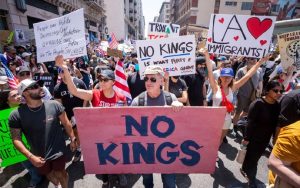
In the latest “No Kings” protests, 7 million people participated in 2,600 cities in all 50 states. It was the largest protest in US history.
In some areas, people have turned to more militant action that at times has verged on rebellion. In June in Los Angeles, and in September in Chicago, both cities with large Latino immigrant communities, protestors began to confront ICE officers engaged in raids on immigrant communities, and to take action to try to stop the raids. Protestors warned when ICE were coming, and at times blocked streets with their bodies or their cars.
In response, ICE has become more violent, with ICE officers using flash-bang grenades, tear gas and pepper spray, beating people in their custody, and firing guns.
The protests have been peaceful, if sometimes militant and disruptive. There is no sign at this point that armed attacks will become a trend.
There is also the resistance of university presidents who have refused to accede to Trump’s demands, and of progressive law firms and lawyers who have not only brought lawsuits against Trump’s administration but have also refused to be silenced by him.
On the electoral front
Most Americans who oppose Trump put their hope in ending his regime through elections. In the November 4 national elections, the Democrats won several important races, and also some minor ones. The results suggest a turning away from Trump that will be tested in the November 2026 mid-term elections, where there is the potential to flip the Congress to a Democratic majority.
The most notable victory was that of Zohran Mamdani in New York

In June in Los Angeles, and in September in Chicago, both cities with large Latino immigrant communities, protestors began to confront ICE officers engaged in raids on immigrant communities and to take action to try to stop the raids.
Mamdani ran on a platform calling for freezing rents, making public transportation free, and providing free childcare. And he also made clear that he supported Palestine, could not support Israel as a religious state, and promised to arrest Benjamin Netanyahu for war crimes if he came to New York. He won wide support from younger voters, renters, labour union members, and Black and Latino voters, and he won one-third of the Jewish vote.
Mamdani’s victory was a defeat for President Donald Trump, but it was also a victory for the progressive wing of the Democratic Party and for the Democratic Socialists of America (DSA), the country’s largest socialist organisation, with about 80,000 members. However, in Virginia and New Jersey, mainstream or moderate Democrats were elected; they are definitely not progressives.
When he becomes mayor on January 1, 2026, Mamdani will face enormous challenges. New York City is the centre of American capitalism, and Mamdani will face stiff opposition from the city’s financial and real estate elite. To pay for his multibillion-dollar programme of a rent freeze, free buses, and universal free childcare, Mamdani will have to persuade the state governor to support his goals, and convince the legislature to provide the budget—a serious challenge.
And Trump has suggested he will stop Mamdani and punish New Yorkers for electing a socialist. And he has the power to withhold funds from the city and to send ICE and the National Guard to the city.
Mamdani will have to move DSA’s members and many others to build a movement to fight for his programme. He can only be as good as the movement that supports him.
The future of the Democratic Party
Mamdani’s astonishing victory has created enormous excitement, and there will be attempts to change the Democratic Party’s direction. But it appears hopelessly out of touch with the American people, and it is not clear that it can change. Its main function is to represent the interests of certain sections of the capitalist class, not to speak for the people. Bernie Sanders’ 2016 campaign for president, which had a programme that spoke to the issues of the working class, was crushed by the Democratic Party leadership.
The Democratic Party is not a democratic organisation with an active membership. It has no members and virtually no organisation at the popular level. It is led and controlled by the elected professional politicians, and by donors who finance them, and is administered by political apparatchiks. It raises billions of dollars, which go to lawyers, political strategists, and principally to TV, radio, and social media advertising. Ordinary people play no role in setting the party agenda, hiring personnel, establishing goals, or anything else.
Election to national political office now costs several million dollars. The reform groups, progressives and leftists must either drop out or adopt the approaches of the Democrats.
The way forward
The Resistance must continue to do what it has been doing: mass demonstrations, small local rebellions, and fighting to win elections. In these mass marches, in small local rebellions, and in elections, the American people are standing up against Trump. We will need more militant, disruptive actions, civil disobedience, and strikes on a large scale to defeat him, and there is a chance we can do it. Still, we face the threat of Trump’s authoritarianism developing into actual fascism, and if that happens, the Resistance will have to change as well.
Dan La Botz was a founding member of Teamsters for a Democratic Union (TDU). He is the author of Rank-and-File Rebellion: Teamsters for a Democratic Union (1991). He is also a co-editor of New Politics and editor of Mexican Labour News and Analysis.