




Amandla!: It’s 60 years since the first debate you organised in the Oxford Union on the Vietnam War, and 50 years since the fall of Saigon. Can you remember how you felt as you saw the Americans being airlifted off the roof of the US Embassy?
Tariq Ali: On a very primitive emotional level, it was a feeling of total and complete joy to see that the United States had been defeated militarily as well as politically, and were fleeing a country that they wrecked for many years. It was a feeling of political joy that what was essentially a peasant country had inflicted a defeat on the world’s most powerful military power. And we celebrated. There were celebrations all over the world. There was a feeling, not just on the Left, but among all those who had opposed this genocidal war, that something had been achieved.
And that’s a memory which will never go away. Because not so long prior to that, I had been in North Vietnam myself, during the bombings. And I remember a briefing we got in Hanoi from very senior military officers. They were confident that they were going to win. This was in 1 January 1967, when we would come shell-shocked from having observed dead bodies and maimed children and just slump on our chairs. I remember Colonel Havanlau saying to me, “Comrade, it’s awful, but have no doubt we are going to win”. We thought at the time it could be bravado, it could be to keep the morale high, but no, they had a plan, and they implemented it, and the Tet Offensive took place a few months later, which showed that the Americans couldn’t stay on.
A!: How did activists like you in the West engage with the struggle of the Vietnamese people? What was the impact of the anti-war movement on the conduct and outcome of the war on the ground in Vietnam?
TA: I think it was very important. I remember years later, in the 80s, a deputy commissioning editor from Channel Four went to look at North Vietnamese documentaries made during that war period. He said they showed him documentaries that they used to show to their own soldiers and troops before they went from north to south to carry on the struggle. And there was a huge documentary on the international solidarity. And he said, “They showed you for two or three minutes, actually talking. We heard you.” This used to be shown in the caves from where they were shuffled across.
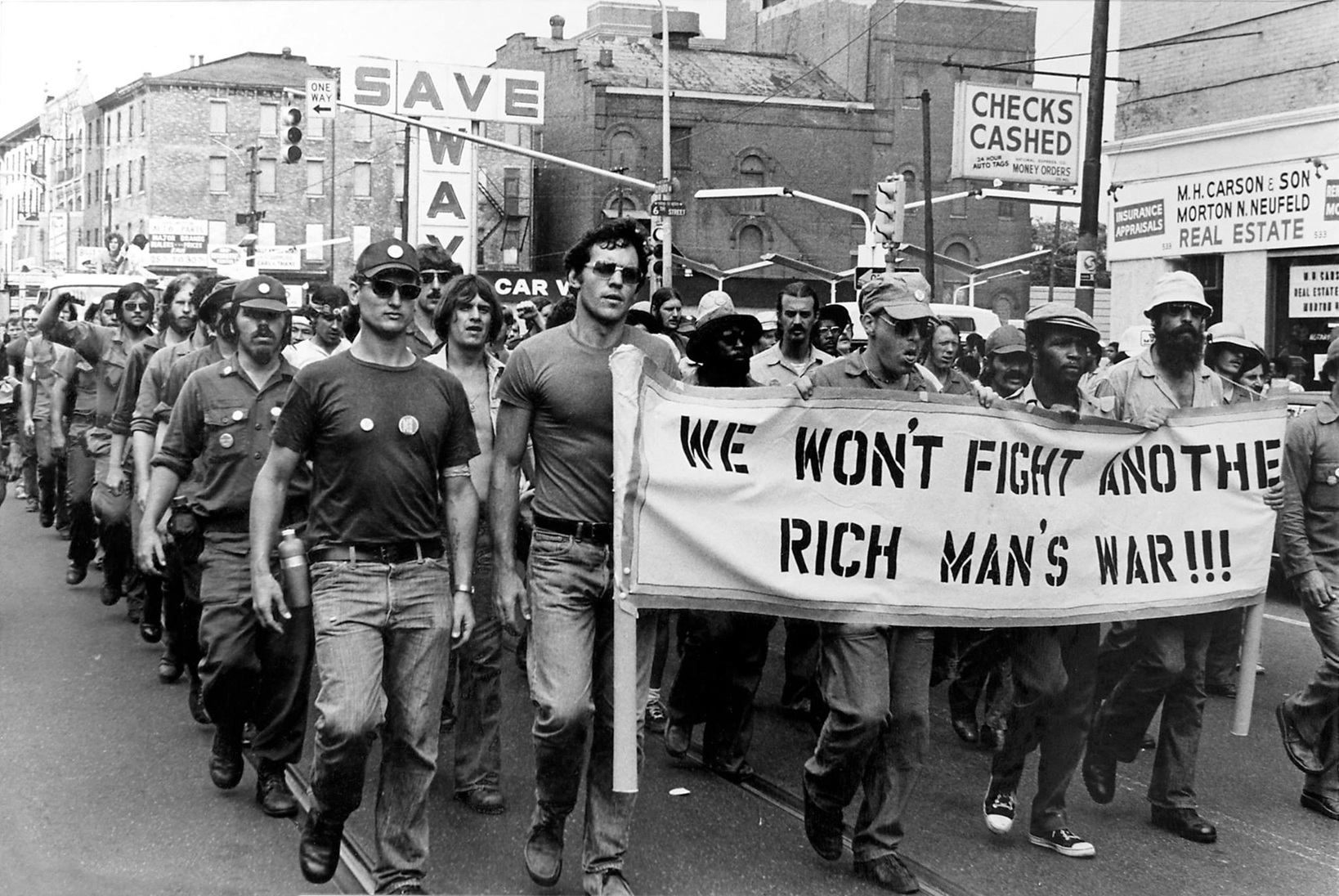
The people who got involved in the US were Marines — retired Marines, wounded Marines. They joined up with the anti-war movement — soldiers against the war.
But on a non-personal note, I think the role played by the anti-war movement in the United States was singular. It has had no equivalent since then, and there was nothing like it before then. It was absolutely staggering. And the reason for that is that the people who got involved in the US were marines — retired marines, wounded marines. They joined up with the anti-war movement — soldiers against the war. And there was this huge demonstration outside the Pentagon, in 1971 I think, where you had tens of thousands of people in uniforms, arms in a sling, all the top medals the United States had to offer its soldiers, marching outside the Pentagon and actually chanting the slogan, ‘Ho, Ho, Ho, Chi Minh, the NLF is gonna win’. Now you can imagine a general in the Pentagon looking at people who’ve just been fighting for the United States in Vietnam and hearing that. In later years, when I used to argue with terrorist supporters after 9/11, I would say, “You answer me yourself. Which was more effective? Which had a bigger impact? A broken, divided US army wanting its enemy to win and saying as much, or a bomb which temporarily cripples the Pentagon as a building?” And I still hold that view.
The Vietnamese themselves said it: they won the victories on the ground; the anti-war movement and the solidarity movement won the victories politically all over the world. I remember I was in Pakistan in 68/69. There was a student uprising against the military dictatorship, and a very great Pakistani poet, who spoke with me on platforms in many parts of the country, had written this song, ‘Vietnam is burning’, in Urdu, which he would recite. And he would taunt the ruling classes in other parts of South Asia and Southeast Asia: “Oh, lovers of human rights, where are you now? Why are you silent? Can’t you see? Don’t you see that Vietnam is burning? And watch it. Be careful. Because the cloud of bombs is coming your way soon”. And the crowds used to go absolutely crazy.
It was a period when people thought, if the Vietnamese can do it, if they can inflict this defeat, why can’t we do it in France or Italy or Portugal?
A!: Looking at the position of the Left, we are often marginalised from mass struggle, but it seemed that during this struggle, the Left was much more central in the mass movement. Was there something about how the Left behaved that enabled it to play such a prominent role?
TA: It was a political decision taken by a tiny, tiny minority, relatively speaking. This was not an initiative carried out by the mass communist parties of Italy, France, or elsewhere. They were supportive; I will not deny that. But their own attitude was a very careful, cautious, peaceful one. The far left, which had decided to launch this movement — to be precise, the Fourth International, which was led by Ernest Mandel — said, while this war carries on, the central political priority of our organisation is building support and solidarity for Vietnam. That’s why I joined them. This is our priority. And so that is what we did.
And our slogan was important: not just peace in Vietnam. We used to be very argumentative with those who just said peace. We said we don’t want the peace of the graveyard. We want a victory for the Vietnamese — victory for the NLF. And this had a huge impact on the Vietnamese. They told me. They said we had not met solidarity like this. And when retired American soldiers start chanting the same thing outside the Pentagon, you know that something’s happening,
A!: How did that movement challenge US imperialism, beyond just the Vietnam War? And do you feel like it had lasting effects?
TA: What had lasting effects from that period? Very few things. I think, for a while, the strength of the peace and anti-war movement, but more importantly, the impact of the Vietnamese victory, forced the United States to have a rest. There were ultra optimists in our ranks who said, this is it. The Americans will never intervene again. And I used to argue, no, this is a big defeat. They know it’s a big defeat, but they will recover, and sooner than you think, because as far as they’re concerned, okay, they’ve lost this very crucial battle, but hegemonising the world on an economic, social, and political level remains their priority. And of course, that was true. I think it had an impact in the sense that it’s part of the historical memory of the Left, what’s left of it. But more than that, no, it was of its time in that period. We couldn’t wage a solidarity movement with Gaza, which we are doing and especially in Britain, like that.
A!: As I was growing up politically, we had brief victories: Chile, Nicaragua, Grenada. We had these moments. Today it’s hard to find them. What do you think is the most important lesson from the war and from the solidarity movement for political movements today?
TA: You mentioned Chile, where we did have a victory, an electoral triumph, and then Henry Kissinger and the United States organised a coup d’état that toppled the elected government of Salvador Allende. This had two big results. One, the moderate soft left said, nothing is possible and retreated even further. And the far left said, well, what this shows is that Fidel’s last message to Salvador Allende, “prepare your rifles”, was correct. The Miristas, who were saying arm the workers, were not so wrong. So that old debate erupted again. Nicaragua was a very positive revolution, and then Reagan unleashed mercenaries against them, which weakened the revolution considerably and led to internal factional battles.
So even at that time, the victories that we had, outside Vietnam, had elements of defeat written inside them, though we built solidarity movements. But they were different times. There was a lot of hope. When Salvador Allende’s widow came to Britain, there was a huge meeting in Trafalgar Square, organised by trade unions. And she was invited to address the Labour Party, which was in office, and Callahan welcomed her, and the entire Labour conference gave her a standing ovation before she’d even said a word. So this solidarity extended from the Social Democrats through the Communist Party to the far left. That mood is very difficult to replicate, though we shouldn’t forget that the size of the demonstrations in solidarity with Gaza has been huge, much, much larger than the Vietnam demonstrations or any other solidarity demonstration in different times, in a different political framework, in a different political period. But it’s there, and this is now having an impact in Britain, at least on the ruling elite and its political parties.
A!: If we look at Vietnam itself, how do you see it having been shaped by the victory?
TA: For a while, of course, they were tending to their wounds, and there was no time for celebrations, though they knew the enormity of what they had achieved. Then, later in the 80s, China took the capitalist road, with Mao’s blessing, it should be said, and decided, to put it at its most optimistic, to have a new economic policy that transformed the country. We’ll see how it turns out, but it certainly has transformed China. And that then brought to an end that feeling of solidarity which existed, as the Vietnamese went down the same road. And some of the Vietnamese intellectuals from that period have asked, “Tariq, do you think it was worth it, us losing two and a half million people, if, in the end, what we’ve got is a form of capitalism?” And I said it was worth it, because it’s now part of your DNA, of the country’s DNA. You did this, and what you’ve done once can be done again, even though we’re going through bad times at the moment. I remember once being on a plane travelling to the US, and a Vietnamese student sat next to me, and I was reading some book, and she said, Oh, are you on the Left? I said, Yeah. And she said, and were you active in the anti-war movement of the anti war? So I told her not about myself, but about the movement and what it achieved. And I said, you obviously weren’t born at the time. So she said my grandfather and father fought in the war. And another person said, I still can’t go past Dien Bien Phu, because that’s where my grandfather and great uncles died to defeat the French. So that doesn’t go away on that level.
A!: A last question, or two related questions. How did your involvement in the anti-war movement shape your own political views and your own activism? And do you manage in these dark times to remain optimistic about the prospects for socialist revolution? And if so, how?
TA: I have remained on the Left from a very young age. The fact that we were right, the fact that we argued in the 80s, as so many people were turning rightwards, that capitalism couldn’t deliver the goods, has been demonstrated time and time again. The last big demonstration was 2008, where there was a big crash of the system. So sometimes when people ask me, don’t you get fed up with still being a socialist? I say, No. Socialism has been defeated once, and, in some shape or form, it will rise again, because no other system can satisfy the needs of ordinary people — ordinary people, not billionaires. And that is true all over the world, including your country.
And we see that to this day. Not the huge rise of the Left, although even that is beginning to happen, but the fact that the centre parties have wrecked the political ecology of the West, anywhere and everywhere you look. And there’s been a huge rise of the far right. And in some parts of Eastern Europe — Ukraine, Hungary, Croatia — there’s been a worship of those who fought with the Third Reich during the Second World War. Statues are going up. So that’s the world we live in.
I don’t think that we are now in an epoch that could be called revolutionary. I think the 21st Century marks the end of the revolutionary epoch that characterised the 20th century. We are now in an epoch of wars and counter-revolutions. That is effectively what is happening. My remaining a socialist, which I do, doesn’t change matters. So I think the old quote about optimism of the will and pessimism of the intellect is truer today than ever it was before.
Listen to the interview below, and don’t forget to subscribe here for our monthly political analysis!