
Some trade union investment companies own and manage, amongst their portfolio of investments, financial benefit schemes that are marketed to their membership and those of other trade unions. These financial benefits include funeral policies and medical aid schemes. This article reflects on one such example, as part of a series of articles on the difficulties and contradictions of these investment companies.
The Sizwe Hosmed Medical Scheme
Sizwe Hosmed, owned by Numsa Investment Company and a supplier of medical aid to many trade union members, was placed under statutory management. The company was in a bad financial position, and there were material irregularities and gaps in its administration.
The National Union of Metalworkers’ Numsa Investment Company (NIC) owns the 3Sixty Global Solutions Group. The 3Sixty Global Solutions Group owns 3Sixty Health. 3Sixty Health administers the Sizwe Hosmed Medical Scheme. 3Sixty Health (formerly Sechaba Medical Solutions) was founded in 1978 by mainly Black doctors who wanted to start up a medical aid for disenfranchised Black South Africans.
Sizwe Hosmed is an open medical scheme, unlike many others that are restricted, usually according to the employer. It was formed through the merger of Sizwe Medical Fund and Hosmed Medical Scheme in 2021.
The merger process itself was beset with many problems between the Sizwe Medical Scheme and the Council of Medical Schemes (CMS). After the merger, the joint scheme continued to struggle on many fronts.
By 2022, the scheme was recording the fourth-highest operating deficit according to the December 2022 Industry Report of the CMS. The scheme experienced higher claims than anticipated in its pricing for the 2022 benefits.
There were at least two forensic investigations into the payment systems of the scheme, and some of the CEOs were removed.
Problems with the merger process
The proposed merger process between Sizwe and Hosmed medical schemes was opposed by the CMS in 2020, who made an application to place Sizwe under curatorship instead. The CMS argued that a due diligence study demonstrated several problems:
- There were inadequate processes for members to vote for the merger
- Accreditation to the South African Local Government Association (SALGA) would lapse due to the merger, and the merged scheme would need to reapply for accreditation. This would result in municipal employees not being able to access their medical aid in this period – hence the objections by the trade unions operating in the local government sector.
- The due diligence was only undertaken when the merger process was already underway.
- A report by Sizwe’s auditors highlighted deficiencies in internal controls on the part of the scheme’s Principal Officer, trustees and administrator;
- The proposed merger was not reflected in the 2019 annual financial statements.
- Trustees’ remuneration for training, travel, accommodation, telephone and other costs were not reconciled;
- The scheme’s solvency levels in the annual financial statements were incorrectly calculated; and
- The annual financial statements for year end 31 December 2019 were rejected by the CMS.
The Sizwe Medical Scheme was previously placed under curatorship in 2012.
Statutory management
On 11th July 2024, CMS placed the scheme under statutory management. The statutory manager’s role was to ensure legal compliance, financial soundness and proper administration. He provided reports to the CMS on progress. Whilst there was a slight improvement in the June 2025 report, it was noted that the scheme was in a poor financial state, and that further action was required.
A joint statement by the Board of Trustees and the CMS stated that the decline in solvency levels was due to the underpricing of the benefits and historically unreliable budgetary and forecasting processes.
The statutory manager’s report of 15 August 2025 stated that the scheme was facing severe financial and operational problems, critical solvency issues, non-compliance with regulatory requirements, membership losses and unsustainable claims.
The CMS argued that the drop in solvency levels would not allow the scheme to be technically solvent. This resulted in the application by the CMS to place the scheme under provisional curatorship.
Provisional curatorship
As a result of this application, the Scheme was placed under provisional curatorship by the Gauteng High Court, effective 4 September 2025.
The Registrar used reports of KPMG and the statutory manager to demonstrate that Sizwe Hosmed was in a bad financial position and that there were material irregularities and gaps in its administration. The court appointed a provisional curator to address ongoing solvency concerns, non-regulatory and non-compliance issues. This process dissolves the board.
The CMS expects the provisional curator to investigate Sizwe Hosmed’s financial position and recommend solutions for the future of the scheme. These may include a merger with another scheme, liquidation, or the continuation of the scheme.
Loss of membership and marketing space
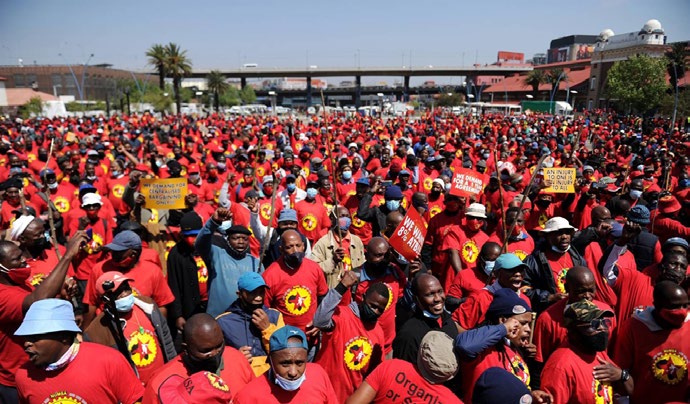
Members of Numsa and other trade unions are members of this scheme and have already been adversely affected by its financial problems. They have been faced with demands for upfront cash payments by health care providers and non-payment by the scheme to those providers.
Sizwe Hosmed announced that it would raise subscriptions by 19% in 2026. The South African Local Government Bargaining Council (SALGBC) said that, according to the conditions of accreditation, this required consultation with SALGBC. No such consultation took place. So the SALGBC has indicated that it will encourage municipal workers to move to other medical aids. Workers had also complained that they had difficulties accessing healthcare services.
The Independent Municipal and Allied Trade Union (IMATU), also in local government, says that its members found that healthcare practitioners required upfront cash payment, as it was alleged that Sizwe Hosmed had stopped honouring claims.
As a result, the scheme has not been granted accreditation to market the scheme and benefit options to local government employees for the 2026 year.
Solvency levels
The Medical Schemes Act (MSA) 131 of 1998 defines financial soundness to mean that a medical scheme has sufficient assets to generally conduct its business, provide for its liabilities at all times and meet the prescribed solvency requirements. The Regulations specify that it must, at all times, hold a minimum of 25% of its members’ gross annual contributions.
The solvency level of Sizwe Hosmed at the time of the merger in November 2021 was at 36.5%, but it dropped to 25.4% by November 2022, and fell below 25% in early 2023. This, in turn, required a detailed business plan under Regulation 29 of the MSA.
The first three business plans, submitted between February and October 2023, were rejected by the CMS due to inadequate information and inaccurate forecasts compared to actual performance. A fourth plan, submitted in September 2024 following a change in actuaries, was approved by the CMS in December.
Solvency levels stood at 5.6% in June 2025 and 6.2% in July. There is a view that the reserves fell so low due to underpricing of benefits, challenges in financial forecasting, and a R162 million claims shortfall.
Non-healthcare expenditure of the scheme
The CMS 2022 Industry Report stated that the non-healthcare expenditure of the scheme was higher than the average in the industry in a number of different areas. Some examples in the report include:
- The marketing and advertising expenditure of the scheme was four times the industry average;
- The 18 trustees were paid R11.8 million in 2022, an average fee of R658 000 per trustee. That is way above the industry average of R389 000, putting it at number 3 in fees paid. In other medical Schemes, like Discovery and GEMS, trustees are paid for attending meetings. Sizwe Hosmed trustees were also paid simply for being trustees.
- The Principal Officer at the scheme received a 20.23% pay rise in 2022; and
- Sizwe Hosmed was among the five medical schemes with the highest expenditure on their AGM.
Is this an appropriate model?
The problems at the scheme have spanned a decade, with repeated interventions by the CMS and internal forensic investigations to address them. However, none of these interventions has achieved the turnaround required to stabilise the scheme.
Members of Numsa and other trade unions are members of this scheme and have already been adversely affected by its financial problems. They have been faced with demands for upfront cash payments by health care providers and non-payment by the scheme to those providers.
The Board of Trustees of the scheme includes trade union leaders and officials who rely on the business leadership and judgement of the company directors and executives. Very often, the company leadership are rewarded through large financial packages and is not held accountable when the business fails. There are repeated patterns and examples of how little control and direction the trade union representatives have as trustees on these boards.
The original intention of the trade unions was to provide affordable financial services and associated products for their members. For a number of reasons, these services and products have been badly managed over a prolonged period of time. The unions will have to urgently confront and address whether this is the most appropriate model to provide services and benefits to their members.
Further articles will explore the appropriateness of trade unions attempting to address issues of redress through the capitalist market.
Suraya Jawoodeen is the former Deputy General Secretary of Nehawu, former Head of Secretariat at Numsa, and currently works at the Alternative Information Development Centre (AIDC) and Trade Unions for Energy Democracy (TUED).