
There is a rolling capitalist crisis that is causing chaos and misery in the world. It moves from place to place and from time to time. It is there during times of economic growth and of stagnation. It differs in form, intensity and content as it rolls. The crisis reached a devastating highpoint during the 2008 global economic meltdown, but since then rolls on with no end in sight.
The ruling class does not have a solution to the crisis of their system. They only debate how to manage it and how far they can go in making the working class pay for it. The failure of the capitalist class to solve its crisis is the reason we see the rise of neoliberal, right-wing populists such as US President Donald Trump, Hungarian Prime Minister Viktor Orbán and Indian Prime Minister Narendra Modi.
Divide the working class
Rightwing populists step into the breach, promising solutions. But they have no hope of success, because the crisis is a result of the nature of the capitalist system itself. It comes from the anarchy and unpredictability that are at the heart of the system. Capitalism’s inherent contradictions endlessly generate crises and chaos. The solutions of rightwing governments boil down to finding different and extreme ways of making the working class pay for the crisis.
The anti-immigrant policies advocated by the right-wing are essentially attacks on sections of the global working class, on workers who were born in another country and not theirs. Instead of laying the blame for unemployment and starvation wages at the door of the capitalist class, the right wing incites xenophobia against so-called foreign workers. But, as Marx and Engels wrote in the Communist Manifesto, “The working people have no country.”
The racism of the right wing is another attack on the working class. Instead of calling for policies to protect workers from the economic devastation caused by the capitalist crisis, right-wingers agitate to direct the anger of one section of workers against another. They invoke racist ideas in order to turn white workers against their class brothers and sisters. Racism and religion combine with Trump’s islamophobia and reliance on Christian fundamentalism and Modi’s anti-Muslim communal violence.
Ultranationalist ideologies that promote aggressive and jingoistic forms of patriotism and national self-aggrandisement underpin the racism. Make America Great Again! Make India Great Again! Make South Africa Great Again! Elevate your own ethnic-national identity to dizzying heights, while denigrating that of others. Legitimise imperialist looting and reject international solidarity in the name of economic protectionism. Justify your ruthless promotion of the national interest on the basis of a crude social Darwinism and brutal realpolitik. The world out there is a jungle, and only the fittest survive.
Ironically, it is right-wing populist movements that threaten to turn the world into a dangerous jungle. They typically promote xenophobic, misogynistic, homophobic and climate denialist agendas. They blame marginalised groups for the world’s socioeconomic challenges and have no problem bullying those weaker than themselves. They are ready to use violence if they can get away with it. They seek to turn the clock back to a time when people accepted hierarchy and inequality, and men sorted out their disagreements with fists.
Right-wing populism and fascism
There are similarities between the rightwing populism of the 21st century and its forerunner, the fascism of the 20th century’s interwar years, of Mussolini and Hitler. It is possible to see fascism as a particularly extreme and violent form of rightwing populism. We need to carefully analyse the dangers posed by right-wing populist movements for evidence of fascist features and how they may develop into full-blown fascism.
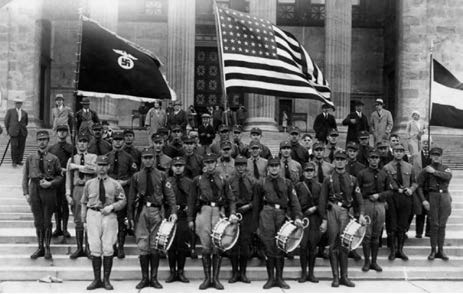
Fascists in Chicago, 1931. The road from rightwing populism to fascism is a slippery slope, and it is important to detect the early signs of this degeneration.
Both populism and fascism are born of the rolling capitalist crisis. As such, they both contest the liberal and socialist solutions to the crisis, where liberalism represents the interests of the capitalist class and socialism represents the interests of the working class. In the interwar period, the capitalist crisis was particularly acute—there was the 1929-1939 Great Depression—with the economic and political situation explosively unstable, especially in Europe. These chaotic conditions facilitated the growth of fascism and the institution of fascist states in Italy and Germany.
Lessons from this history suggest that fascism needs a supreme leader, a superior race or nation, totalitarian state control, and excessive use of violence. Fascist regimes defined anyone opposed to their policies as an enemy, and identified, persecuted and killed the opposition. In the same way, rightwing populists also do not tolerate dissent, as we have seen in Trump’s rabid attacks on journalists, politicians, judges and intellectuals who dare to oppose him, including liberals, socialists and Marxists.
A sure sign that populists in power have become fascist will be when they collapse democratic institutions and impose totalitarian rule. However, the road from right-wing populism to fascism is a slippery slope and it is important to detect the early signs of this degeneration. Specific conditions and responses to the incipient fascist project can accelerate or slow down this process.
The rhetoric and policies of populist leaders signal their contempt for, and willingness to destroy, the basic rules and norms of the democratic system. A democratically elected rightwing head of state may abuse their executive power and bulldoze and bully everyone for partisan ends, with little regard for the legitimacy of their political adversaries in the system. If the voters do not punish them for their transgressions, we can expect further downward movement on this slippery slope.
The problem with liberal democracy
Liberal democracy has become the standard for running governments. However, the capitalist crisis continually undermines and destabilises its economic and political foundations. Liberal democracy presupposes a certain degree of material prosperity for citizens, which the system of capitalism increasingly cannot provide. Furthermore, it is based on private property, which severely limits, distorts and undermines its democratic content.
A major rightwing critique is that centrist liberal parties serve the rich elite and not the masses. In people’s ears, this has a ring of truth because these parties, such as the Democratic Party in the US, have consistently played the role of defender of ruling-class interests. Social democratic parties in the world, including the African National Congress in South Africa, have capitulated to neoliberalism and connived in the weakening of the trade unions, the atomisation of society through the promotion of competitive individualism, and the hollowing out of substantive democracy, through the disempowerment of the citizen and empowerment of financial capital.
The exhaustion of bourgeois democracy and its replacement by elected dictators, life presidents, kleptomaniacs, megalomaniacs and neofascists is a consequence of the capitalist crisis. Antonio Gramsci wrote: “The crisis consists precisely in the fact that the old is dying and the new cannot be born; in this interregnum a great variety of morbid symptoms appear.”
The rise of rightwing populism is a morbid symptom on the right of the political spectrum. On the Left, we find the neoliberal capitulators, the class collaborators, and the sell-outs who abandoned their mandates, principles and values and succumbed to the power of capital. It is this so-called Left which blames workers for supporting rightwing populists, accusing them of ignorance, illiteracy and racism.
The response of the working class
Karl Marx argued that the working class is the revolutionary subject: “Of all the classes that stand face to face with the bourgeoisie today, the proletariat alone is a really revolutionary class.” Latent in every worker there is what Gramsci called “the organic capacities of the working class.” In his reflections on the Italian factory occupations of the 1920s, Gramsci noted the capacity of workers for self-government, for maintaining and exceeding the capitalist order’s level of production, and their limitless capacity for initiative and creation.
He marveled how he saw:
with one’s own eyes old workers, who seemed broken down by decades upon decades of oppression and exploitation, stand upright even in a physical sense during the period of the [factory] occupation—see them develop fantastic activities; suggesting, helping, always active day and night.
His general conclusion was that:
It was necessary to see these and other sights, in order to be convinced how limitless the latent powers of the masses are, and how they are revealed and develop swiftly as soon as the conviction takes root among the masses that they are arbiters and masters of their own destinies.
Our job as socialists is to focus on what workers can do rather than what we and our groups, organisations and resources can do. We have to approach workers looking for ways to release their organic capacities so that they can flourish. We have to identify and assist workers to remove the million obstacles that stand in the way of this. Only a militant working-class movement, driven and led by the workers themselves, can defeat and destroy rightwing populism.
Trevor Ngwane is a member of the Socialist Group and of the Greater Johannesburg United Front.