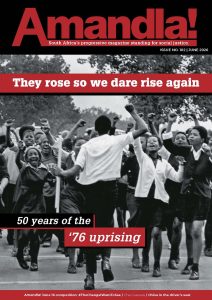

Amandla: How did the 1976 Soweto Uprising impact you? Where and how were you organising at the time?
Marcus Solomon: I was still serving a five-year banning order and was under house arrest. I had come off Robben Island in 1974 after serving 10 years for my role in initiating the armed struggle against the Apartheid state. Before the 1976 uprising, we were reviving the movement that had been smashed by the repression of the 1960s. The 1976 period was the time of the emergence of the black consciousness movement and the beginning of what was to be the renewal of the independent trade union movement. It was also the time when we were focusing on resisting the splitting up of the country through the state’s attempt at giving “independence” to the bantustans such as Transkei and Ciskei.
When we came off the Island, there was an expectation that we must give direction to the struggle. We quickly realised that we needed to listen to what people were saying. There was a new mood, obviously shaped by a new generation of angry and frustrated youth. They were militant and had different ideas on how we should conduct the struggle. We had to listen to what people were saying before thinking we could ”teach” people and tell them what to do.
This was a very important lesson, and it is one that is terribly important at this time. I suspect today, just as in 1976, we are dealing with a new generation of youth with new ideas. Once again, those more experienced activists would do well to listen to the youth before thinking they can just direct them. Before you can teach, you must first listen and be prepared to learn and share.
So by ‘76 I was part of a group supporting the students and parents of Hanover Park, a gang-ridden coloured township in Cape Town. As I was still banned and under house arrest, I could not do public political work. Nevertheless, I was able to participate in small clandestine meetings, coming into contact with this new generation of militant youth.
There was a lot of activity at the high schools and in the communities. Soweto was hugely significant. It became the symbol of the broader national resistance to Apartheid and once again reasserted the presence of a national liberation struggle and movement. It is crucially important to understand that while Soweto was a spark, the resistance, organising, and movement-building were emerging in all parts of the country, not least Cape Town and the Western Cape.
A!: What was the relationship between students and the broader working-class community?
MS: In Hanover Park, parents, especially mothers, were supporting students. There was also growing support from teachers. The apartheid state came down hard on them. It was a matter of life and death, so you needed broader community support.
To support the students, you actually had to build structures in communities. Later, these became the building blocks of what developed, first as Action Committees and later Civic Associations. What was also important was the alliances students formed with workers to undertake stay-aways against state repression.
Today, we see a similar process developing. Many students in #FeesMustFall are saying, “We come from communities. We need the support of our parents if we are going to win our struggle for free education.” And in an attempt to give support to these students, some of us were involved in forming parent solidarity committees to advance the demands of our children.
In the 1970s, students in high schools and even those at tertiary institutions realised that they were not just students. They were part of the youth in working-class communities that had specific demands beyond the education system. So alongside student formations, youth movements were proliferating all over the country, some of which evolved into the youth leagues that were important in campaigns to make the country ungovernable and challenge the entire system.
A!: As we commemorate 40 years of the ’76 Soweto uprising, what do you see as its significance and major lessons for today?
MS: As I said earlier, the major political current or frame of thinking was the black consciousness movement. There is a tendency to rewrite history and to present 1976 as an ANC-led struggle. That is not true. Many different components and perspectives shaped and were shaped by the Soweto uprising. It was the turning point for the liberation struggle.
It was the beginning of the end for the Apartheid regime. From then on, attempts at reforming the system were always too little too late. The legitimacy and power of the state had been broken. A new hegemony was emerging. In 1976, I saw in practice something that I learnt on Robben Island, from comrades like Walter Sisulu: we can belong to different movements, but we can work together in a united front and in a non-sectarian way for the common objective of national liberation.
When my comrades and I arrived on Robben Island, we were from the Marxist-oriented National Liberation Front. We were young, militant and quite arrogant. We were somewhat sectarian and of the view that the stalwarts of the Movement, the Mandelas, Sisulus and Mbekis, were too conciliatory. You can imagine my surprise when the first person I came into contact with was Walter Sisulu. He knew who I was and that I was not part of the ANC. What did he do? This seasoned comrade came and hugged me and showed me the ropes, completely disarming me and my sectarianism. We learned non-sectarianism not through theoretical debate but through praxis. I learnt what it meant to be a comrade and to respect people regardless of the movements they come from.
On Robben Island, you learnt to develop an affinity with each other. We had to depend on each other to withstand the hardships of jail, especially in the early years. And I can tell you, you learn how to differ in a way that doesn’t make the personal relationship difficult. So even though we argued very heatedly over strategy and tactics, when it came to the wardens and the police, this comrade watched your back, and you watched his.
Just as on Robben Island, the repression and hardship required us to work together. In our current struggle, we need to be able to distinguish between those who are our comrades, regardless of political differences, and those who are our adversaries. Without this capacity, we will never be able to unify our movements and find common cause – something that is vital under the current circumstances.
In ’76, the struggle started against the introduction of Afrikaans as a medium of instruction but developed into a broader struggle against Apartheid involving whole communities, trade unions, faith-based organisations, etc. What was amazing about this period was how quickly the question arose of what type of education system are we for. It was understood that we could not just be against. It was necessary to spell out an alternative. It is in this context that a powerful movement for alternative education emerged in South Africa. Much of the content of this alternative education came from the organised student movement itself, supported by intellectuals from across a wide sector of the population. It is unfortunate that much of this has either been forgotten or distorted in the post-Apartheid period. Nevertheless, for students fighting for the decolonisation of tertiary education, they would do well to research what the ‘76 generation of students were able to develop.
Under the influence of the black consciousness movement and people like Steve Biko, there began a deep process of uniting communities across colour and ethnic divides. The Apartheid terminology of African, Coloured and Indian was rejected. We were all black, and we are proud of our black identity. This was the great contribution of Biko and the BC movement.
“Black is Beautiful” became a powerful slogan within communities and was accompanied by a very influential cultural movement – reggae music, protest poetry, drama, etc. It tried to give meaning to this movement and many efforts to build a new world across the racial and other barriers associated with the apartheid system. And, of course, it gave rise to a new energy that made change possible. The call became: let us change our racially defined identities. In the process, the youth of ’76 laid the foundation for our vision of a new united South Africa.