

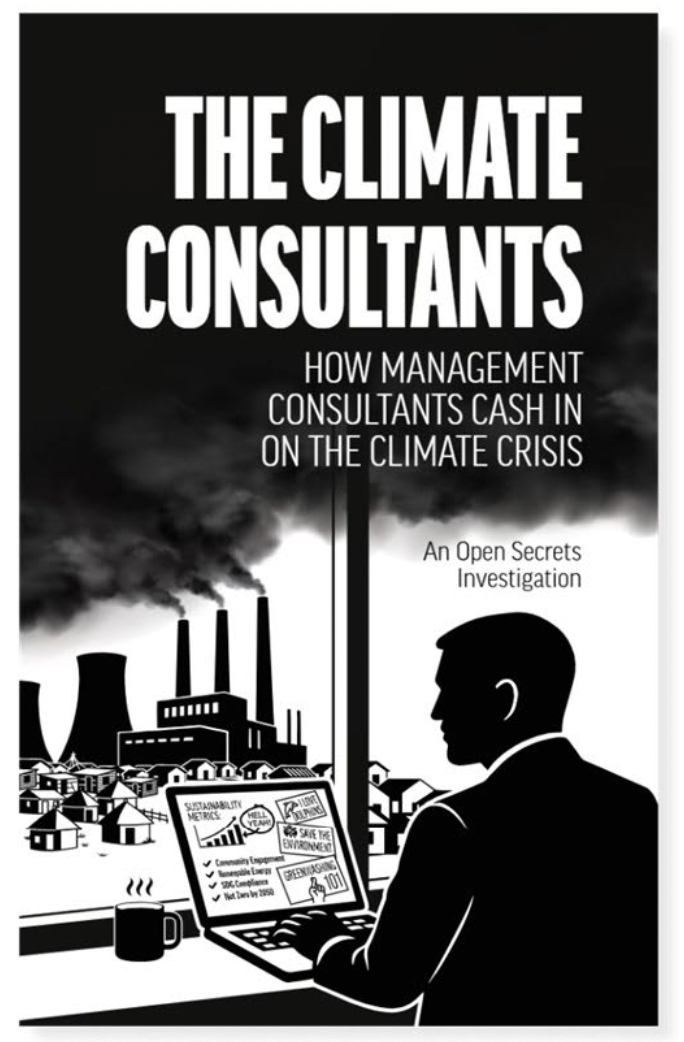
Open Secrets’ investigative report reveals how management consultants are cashing in on the climate crisis and South Africa’s Just Energy Transition (JET), potentially undermining the pursuit of a just transition.
South Africa’s Just Energy Transition (JET) is about much more than changing how the country produces energy. It is about doing so in a manner that contributes to decent work, social inclusion, and the eradication of poverty. This requires radical shifts to South Africa’s economy. These should be chiefly guided by public interest and the needs of those communities that are most vulnerable to the impacts of climate change and the nature of the transition.
In June 2025, Open Secrets released its latest report, “The Climate Consultants: How Management Consultants Cash in on the Climate Crisis.” The investigative report reveals how management consultants are cashing in on the climate crisis and South Africa’s Just Energy Transition (JET), potentially undermining the pursuit of a just transition.
Grant funds are committed to South Africa’s JET by the international donors of the International Partners Group (IPG), which is providing loans and grants to support South Africa’s transition from coal to cleaner energy sources. The report revealed that around 65% of these funds have been paid to private companies and organisations, including management consultants.
Globally, not nearly enough money is being provided by wealthy countries to poor and developing countries to support their energy transitions. Wealthy countries and companies based there have long benefited from the pollution and carbon emissions that have caused the climate crisis, and they owe people in the Global South a climate debt. Instead, most of the inadequate funds they provide come in the form of loans that must be repaid. When grants are paid, they are often pocketed by powerful private corporations linked to the donor countries.
South Africa is a good example of this problem. South Africa’s JET Implementation Plan (JET IP) estimates that we need at least $100 billion (just under R2 trillion) for a just transition. But the current IPG pledge is just $12.8 billion — a little over 10% of what the country needs. Of this, less than 25% had been committed by the end of 2024, and only 6% is envisioned as grant funding, with most of the money coming as loans.
It is outrageous that scarce grant funding, meant for South Africa’s energy transition, is lining the pockets of already very wealthy private consultants. Yet this is a global experience. Despite growing scrutiny of the damaging impact large consultancies have, they have continued to grow in size and influence. In fact, the poly-crisis facing the world today has proven a boon for consulting businesses, as the global market for management consulting surpassed $1 trillion in 2023. Consultancies are rushing to position themselves to benefit from new demand from corporations and governments seeking advice on a wide range of issues related to the climate crisis. South Africa is no exception.
The country has recent experience of the devastating complicity of major consulting firms like McKinsey and Bain in state capture, and their refusal to take genuine responsibility for the harm done. This is an ever-present reminder of why we must scrutinise the role of consultants, especially when they have an influence on issues of fundamental public interest and importance.
The circular flow of funds
Currently, much of South Africa’s just transition grant funds are caught in a circular loop: they are paid to private consultants based in, or with links to, the donor countries. For example, The Climate Consultants report revealed that global audit and consulting firms, PwC and Deloitte, have been major recipients of United Kingdom (UK) and United States (US) grant funds, respectively.
PwC was an implementing agent on JET projects worth around R130 million, all funded by the UK government. This included two large projects working with another UK-based consultancy, Adam Smith International. These projects — on issues related to water, energy, and the local economy in Mpumalanga — go to the very heart of South Africa’s just transition. Yet, PwC South Africa told Daily Maverick that it had no knowledge of this work; it was likely conducted by its UK office. This means that scarce grant funding, meant to benefit people in Mpumalanga, is paying for the swanky London offices of consulting firms instead.
In much the same way, Deloitte was the implementing entity for around R145 million in JET projects funded by the US, prior to the US withdrawing from the IPG following the election of Donald Trump. Deloitte South Africa similarly confirmed that it had no knowledge of the projects, suggesting that US grant funds meant for South Africa were paid directly to consultants based elsewhere.
Often, the grant funding for South Africa’s JET does not even touch our shores.
Conflicts of interest
And most of these consulting firms are fundamentally conflicted. They have made their fortunes by advising fossil fuel firms. Most still do lucrative work for these firms and other corporations that contribute to the climate crisis, and have acted to deliberately slow down any transition. This is a global phenomenon; infamously, McKinsey & Company has aggressively pursued and promoted new oil and gas deals on the fringes of global climate negotiations, where it plays an advisory role.

US consulting firm, the Boston Consulting Group (BCG), has worked closely with corporations and big business lobby groups, all while receiving grant funding to work on JET projects in Mpumalanga, and to assist some of South Africa’s biggest emitters in planning their energy futures.
In South Africa, a powerful example of this is another US consulting firm, the Boston Consulting Group (BCG). The Climate Consultants report showed that BCG’s South African office was the most prominent private consultant in South Africa’s JET space. It has worked closely with corporations and big business lobby groups, all while receiving grant funding to work on JET projects in Mpumalanga, and to assist some of South Africa’s biggest emitters in planning their energy futures.
BCG faces significant conflicts of interest from its global and local work for fossil fuel companies and petrostates. It has done lucrative work for Saudi Arabia, and, in 2023, it named major fossil fuel firms — Saudi Aramco, Shell and ExxonMobil — amongst the top 50 innovative companies in the world. This, despite them being amongst the largest carbon emitters and contributors to the climate crisis. In South Africa, BCG holds a lucrative contract with Sasol, whose Secunda facility is the single largest greenhouse gas emitter in the world, as well as Standard Bank, a prominent funder of new oil and gas projects in Africa.
Remarkably, BCG has received JET grant funds for work that will benefit these corporations. It received funds to develop an ‘Energy Transition Roadmap’ (ETR) for the Energy Council of South Africa in 2024. The Energy Council says its mission is to “address energy security and the just energy transition”, but it is made up of some of the world’s largest polluters, including Sasol, TotalEnergies and Exxaro. It is chaired by Sasol’s CEO, Simon Baloyi.
Lack of transparency and oversight
These consultants’ contracts with donor countries are usually not publicly available. Further, the models and information they use to inform crucial climate policies are kept secret due to their financial interests. So there is no opportunity for the public to exercise any proper oversight over the work that they are doing. This opacity is built into the models of private consulting firms.
A related risk is that this kind of work is usually done in terms of contracts between donor countries and the consultants. So, the grant funding does not flow into South Africa’s fiscus, and the appointment of consultants and other contractors takes place outside South Africa’s public procurement laws and constitutional provisions. This not only introduces corruption risks, but crucially casts doubt on the ability of the South African state to determine the nature and scope of work being undertaken on a just transition, purportedly in terms of South Africa’s state policy. The risks to South Africa’s sovereignty are obvious.
The struggle for a just transition
It is now obvious that private consulting firms see energy and climate consulting as the new frontier for profit-making. Their growing role in advising on South Africa’s JET raises serious concerns due to their conflicts of interest, secrecy, and influential role outside of the oversight of public bodies. Like all consultants, there is also a risk that they will contribute to the long-term decline of the state’s capacity to undertake this vital work itself, inducing dependency on these profit-driven, private actors.
But there is still time to change this. The state must ensure greater transparency for how JET monies are spent. It must maintain a publicly accessible database of the full expenditure of JETP monies — both loans and grants — and the funding partnership agreements, in all their forms, should be publicly accessible. There must also be a concerted effort to ensure that JET funds are routed through the South African state, wherever possible.
It is also urgent that the state introduce proper regulations for consulting firms, which currently operate with no regulatory body and little effective oversight. Strengthening legal, policy, and regulatory frameworks in the consulting sector will be crucial in ensuring that the current problems do not persist within South Africa’s JET space.
Michael Marchant and Zen Mathe are investigators for Open Secrets.