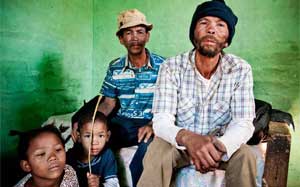
Throughout the controversial four-year life of the Traditional Courts Bill (TCB), the African National Congress government has firmly allied itself with tribal chiefs (with their new polished image and title of "traditional leaders"), even allowing them a strong hand...
Magazine
Harvesting discontent
"I earn R800,00 per month and with this money I have to feed, clothe and fend for my family of eight. We barely survive; I cannot even afford to buy school shoes for the children. I cannot take it any longer"- Gertie Beukes, Ashton farmworker. "We produce the food...
What the frack: will shale gas develop or retard the Karoo? | by David Fig
The South African government lifted the moratorium on fracking on 7 September, opening the way for exploration of what's been sold as a massive shale gas resource beneath the beautiful, sparsely populated Great Karoo. Fracking (short for hydraulic fracturing) is a...
Whose strike to whose gain? | by Christian Selz
Alongside the prominent demand for R150 a day, striking farm workers in the Western Cape are demanding an end to labour brokering – an uphill battle that they are likely to lose given that some of their perceived leaders appear to trade in that very business. It is...
We don’t want your development
The people of Mpondoland are determine theird to save their land from mining by an Australian company which wants to tear apart their pristine coastal dunes to mine titanium. Four years ago, they succeeded in reversing a decision to allow the destruction of the Wild...
Neoliberal land & agricultural policies at heart of farm strikes | by Mazibuko K. Jara
The heroic and historic strike by thousands of farm workers in the Western Cape has struck at the heart of the ANC government's neoliberal policies on land reform and agricultural policy. The strike marks the beginnings of much-needed mass struggles to challenge white...
Rebuilding the Zimbabwean state: an idea whose time has come? | by Thomas Deve
Beginning in 2000, Zimbabwe experienced a decade of unprecedented political and economic crisis that was only temporarily alleviated by the inception of a government of national unity in 2010. Despite the occasional populist and radical pronouncements of the head of...
‘We cannot walk freely’| by Jeanne Hefez
Voices from Marikana: Lonmin workers speak It's nearly four months after the Marikana massacre, and the atmosphere in and around Lonmin is still one of fear in the face of a de facto state of emergency. As Amandla! goes to press, police continue to use excessive force...
Mali: folly of war in the Sahel | by Professor Issa Ndiaye
The current crisis in Mali is not the result of the March 22 coup d'état, which marked only the collapse of a misguided and corrupt democracy which has been so noisily eulogized. The current disaster has been produced by the monopolization of the State and other...