
REFLECTIONS ON THE SACP’S DECISION TO CONTEST ELECTIONS INDEPENDENTLY
The decision of the South African Communist Party (SACP) to stand independently in the coming local government elections must be welcomed. For decades, independent socialists and other militants have argued that the SACP’s subordination within the Alliance weakened the political independence of the working class and tied the fate of socialist politics to the ANC. This decision—even if belated—represents a potential step forward in re-establishing the independence of the working class and advancing class politics based on socialist renewal.
It would be a mistake to underestimate the significance of this shift. The ANC’s political hegemony is broken, its moral authority eroded, its electoral base fractured. Yet the space that has opened has not been occupied by a confident, militant Left. On the contrary, right-wing forces like the Democratic Alliance, the Patriotic Alliance, and various ethnic and populist outfits have increasingly filled the political vacuum with their demagogic politics. The Left, meanwhile, has become weaker and more fragmented, precisely when the deepening crises cry out for a clear, anti-capitalist alternative.
So, why are we so weak today, given the scale of this crisis? And what can be done to reverse the situation? There are no easy answers. Numsa’s 2013 break from the Alliance never resulted in sustained mass struggle or a viable political alternative. If the SACP’s electoral turn is to mean more than another false start, then it must be accompanied by deep soul-searching, rigorous debate, and a willingness to rethink political theory and strategy. This is a task for the entire Left, but the SACP bears the heaviest responsibility, given its central role in providing left cover for the ANC in government.
Lessons from the SACP’s record in the Alliance
Any renewal of socialist politics must begin with an honest reckoning of the past. Why did the SACP remain in the Alliance, in government, and in state institutions, even as the ANC was captured by a predatory elite, and the state itself became a site of accumulation for that elite?
Why did the party remain loyal as the ANC imposed Gear, which entrenched neoliberalism? Why did the party, in the mid-2000s, champion Jacob Zuma as a “Left alternative” to Mbeki, only to find itself shackled to a misogynist, corrupt and authoritarian project? Why did it defend the National Union of Mineworkers (NUM) bureaucracy against a self-organised mass strike of mineworkers at Marikana? And ultimately, why did it defend the state’s legitimacy in the aftermath of the Marikana massacre, rather than standing unreservedly with those striking mineworkers?
The answers lie not only in tactical misjudgements but in the very political framework that has guided the SACP since the 1920s. This was shaped above all by Stalinism, and only partially challenged by party leaders of the calibre of Ruth First, Harold Wolpe and Chris Hani. As the SACP rethinks its perspectives and strategy, it would do well to return to their inputs.
The problem of Stalinism and the vanguardist conception of the party
The continued hold of Stalinist conceptions of socialism is one of the roots of the problem. By Stalinism, we refer to the politics of a current that led the communist movement for most of the period after the death of Lenin until the fall of the Berlin Wall. After this, Joe Slovo attempted to initiate a process of correction and renewal. He warned against bureaucratism and affirmed democracy as central to socialism in his seminal paper Has Socialism Failed? Yet, there was never a thorough reckoning with the core of the party’s theory and strategy.
The SACP retained the dogmatic conception of itself as the ‘vanguard of the working class’, even though, for much of its history, the most class-conscious activists of the workers’ movement were not in the party. In fact, in the 1980s, they were subject to SACP vitriol for their role in building an independent, militant and worker-controlled labour movement. This fostered a bureaucratic notion of socialism, where an enlightened party élite substitutes itself for the conscious self-activity of the masses.
This runs directly against the revolutionary principles of Marx and the First International. They insisted that “the emancipation of the working class must be the act of the working class itself.” Socialism cannot be handed down; it must be created from below, through mass organisation and popular self-activity.
By confusing its own institutional survival with the interests of the working class, the SACP weakened resistance to neoliberal restructuring and undermined the principle that socialism means freedom—the democratic transformation of all aspects of society.
This vanguard self-conception also shaped how the party related to other Left forces. It consistently refused to build unity with other radical Left organisations, independent trade unions or emerging social movements. Instead, it often condemned or even violently repressed rivals it deemed “ultraleft.” Movements such as the Anti-Privatisation Forum, Abahlali baseMjondolo, AMCU and others felt the brunt of this hostility. This sectarianism contributed to the Left’s fragmentation and stifled the possibility of a united, anti-capitalist bloc, or what the SACP refers to today as a Left Popular Front.
The National Democratic Revolution and stageism
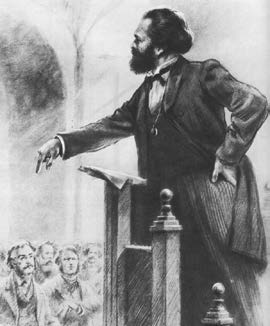
This fostered a bureaucratic notion of socialism, where an enlightened party élite substitutes itself for the conscious self-activity of the masses. This runs directly against the revolutionary principles of Marx and the First International. They insisted that “the emancipation of the working class must be the act of the working class itself.”
A major theoretical and strategic weakness is the party’s conception of the “national democratic revolution” (NDR). Developed in the Stalinist phase of the Comintern, the NDR entrenched a rigid two-stage theory of revolution: first, the “national democratic” stage, led by the national bourgeoisie; later, a “socialist” stage. In South Africa, this was combined with the thesis that apartheid represented a “colony of a special type”.
Thinkers such as Harold Wolpe, Martin Legassick and Neville Alexander pointed out that racial capitalism cannot be reduced to “two economies” coexisting side by side. It must be understood through the lens of combined and uneven development: the wealth of the “first-world” enclaves depended on the underdevelopment and exploitation of the townships, homelands, and rural areas.
The stageist conception encouraged the party to view deracialised capitalism as a stepping-stone to socialism, rather than as a barrier to real transformation. The failure of the transition since 1994 is the strongest proof that this approach was flawed: taking over the apartheid state and attempting to deracialise capitalism did not open the road to socialism—it blocked it.
Several historical examples are instructive in illustrating the self-defeating and tragic outcomes of this stageism. In China (1927), the alliance of the Chinese Communist Party (CCP) with the nationalist Kuomintang ended in massacres, destroying the Shanghai workers’ movement. In Indonesia (1965), the PKI’s subordination to Sukarno’s nationalist project led to annihilation. In Spain and Chile, similar compromises ended in tragedy.
South Africa’s experience differs in form but is comparable in principle: the SACP’s loyal alignment with the ANC subordinated working-class independence to a “national democratic” project that stabilised capitalism rather than challenging it.
Instead of viewing 1994 as the start of a deeper phase in the struggle, the SACP and its Alliance partners hailed the “democratic breakthrough” as its culmination. They took up positions in government and the state and implemented market-based reforms, such as in housing under Joe Slovo. They even repressed the wage struggle of public sector workers under Minister Geraldene Fraser-Moleketi. By subordinating the working class to the ANC and accepting neoliberal restructuring, the party effectively disarmed the working class and hollowed out the emancipatory potential of the democratic breakthrough.
Furthermore, the SACP underestimated the corrosive role of the post-apartheid petty bourgeoisie. Frantz Fanon’s critique of the “national bourgeoisie” as a class destined to betray the revolution proved tragically accurate. The party did not sufficiently analyse how its own leaders—parliamentarians, state officials, senior union bureaucrats—were themselves incorporated into the new elite through salaries, perks, and patronage.
This produced a deep conflict of interest. Instead of leading a struggle against neoliberal capitalism, many party leaders defended the status quo. The bureaucratisation of the trade unions, with officials drawing salaries comparable to corporate managers, further disconnected them from their base.
Some in the SACP claim that their critics misunderstand their theory of NDR: in historically colonised countries, struggles for socialism have always incorporated national democratic tasks; the NDR is in origin a socialist strategy; critics of the NDR are “ultraleft,” imagining an abstract, pure class struggle, divorced from national realities.
This critique has merit in recognising the historical importance of combining democratic and socialist tasks, especially in colonial or semi-colonial situations. In Russia, China, and Vietnam, socialist revolutions did indeed combine anti-imperialist, democratic, and socialist struggles. Class struggle in isolation, without addressing national oppression, land questions, and democratic rights, would not have mobilised the masses.
But critics like ourselves have not called for an “abstract pure class struggle.” We have argued for continuity: the working class should lead democratic reforms. When the bourgeoisie is on the back foot, push further to seize power and begin the socialist transition. So national democratic tasks are necessary but insufficient; they must be linked organically to the exercise of working-class political power. Land reform, the vote, freedom of association and movement, and other democratic gains are integral to the socialist project. These “non-reformist reforms” progressively dispossess the bourgeoisie of its control over the economy and its influence over the state. But these tasks have to be led by the working class, and integrated into a strategy of systemic transformation advancing an anti-capitalist programme. The problem with the SACP’s conception of the NDR lies in the subordination of the struggle to bourgeois nationalist forces.
Internationalism, campism, and the global Left
The SACP’s approach to internationalism has long been shaped by a Stalinist ‘campist’ logic. This often prioritised geopolitical alignment over solidarity with the struggles of workers and oppressed peoples. It substitutes principled internationalism with a crude formula: the enemy of my enemy is my friend. This has led the party to defend regimes simply because they oppose US or Western power, regardless of how those regimes treat their own populations or suppress genuine emancipatory movements.
The war in Ukraine is a case in point. Many on the Left, influenced by campist thinking, framed the conflict solely as a proxy war between NATO and Russia. This downplayed or ignored the imperialist ambitions and aggressive foreign policy of Putin’s Russia. And it effectively denied the agency and suffering of the Ukrainian working class and population, portraying them as pawns rather than as active subjects in a struggle over their own sovereignty. Similarly with Syria, much of the global Left interpreted the uprising against Assad as a Western plot, leading to uncritical support for Assad’s regime.
Across these cases, there is a consistent refusal to recognise that socialism can only emerge from the struggles of the oppressed and exploited, rather than being imposed from above by authoritarian leaders. True internationalism requires principled solidarity. It demands standing with workers, peasants, women, and oppressed peoples everywhere, and critically assessing all regimes and forces.
A renewal of socialist politics must reject campism and false anti-imperialism, and refuse to substitute ideological shortcuts or geopolitical games for the concrete reality of struggle.
Towards a renewal of socialist politics
The SACP’s independent electoral turn could be the spark for a new chapter. But it will only succeed if it is part of a broader renewal of socialist politics, rooted in democracy, mass self-organisation, and unity in struggle.
Several principles should guide this renewal:
- Re-affirm democracy as the essence of socialism. Socialism means freedom, not authoritarian commandism. It requires the expansion of democracy into every sphere of society—economic, social, cultural, and political.
- Recognise the plurality of the Left. No single party can claim to be the sole “vanguard.” The Left is diverse, ranging from unions, community organisations, feminist groups, and socialist collectives to radical NGOs. A new socialist politics must be pluralistic and open to dialogue and united fronts.
- Rebuild mass organisation and self-activity. Electoral politics must be subordinated to mass mobilisation. Without strong grassroots organisations in workplaces, communities, and schools, electoral breakthroughs will become another exercise in élite substitution.
- Unite struggles around immediate class demands. The Left must campaign for jobs and decent work, a basic income grant, genuine land and agrarian reform, national health, free basic services, and housing for all. These struggles must also be explicitly feminist, anti-racist, anti-xenophobic, and environmentally just.
- Reclaim internationalism. Solidarity with Palestinians resisting apartheid, with workers rising up in Sudan, with women in Iran, with climate justice movements worldwide must become central. No alignment with authoritarian regimes can substitute for real solidarity from below.
A moment of possibility
The decision of the SACP to contest elections independently is long overdue. For the Left, if it triggers a deep reckoning with the party’s Stalinist legacy, its subordination to the ANC, and its bureaucratic habits, then it could open a path towards genuine renewal.
Welding the different sections of the working class into a united force remains the only means of leading society out of the profound crisis in the country. But it can do so only if it is united, organised, and conscious of its own power.
The SACP now faces a choice. It can cling to old dogmas and repeat past errors. Or it can embrace socialist renewal, break with authoritarian habits, and help forge a new, united Left for the twenty-first century. For the sake of the millions abandoned by neoliberalism, for the sake of socialism itself, we urge the road of socialist renewal.
Brian Ashley is a member of the National Committee of Zabalaza for Socialism and of the Amandla! Editorial Collective.