
The ‘America First’ logic, adopted by the US neofascist movement known as MAGA, may seem rational to those who are not familiar with the economic history of international relations. According to Trump and his acolytes, America has spent huge sums of money protecting its allies, especially the rich countries among them, i.e. the geopolitical West (Europe and Japan in particular) and the Gulf Arab oil states. It is time for them to pay off the debt: all these countries must foot the bill by escalating their investments in the United States and their purchases from it.
This is especially important for their purchases of weapons (which is what Trump means by his constant pressure on the Europeans to increase their military spending). All of this naturally falls within the mercantile logic consistent with the nationalist fanaticism that characterises neofascist ideology. US military expenditure has truly not only exceeded that of America’s allies. It almost equalled, at one point, the military spending of all other countries in the world combined. From the ‘America First’ perspective, this has been a major sacrifice for the benefit of others.
According to the same logic, the large deficit in the US trade balance is but the outcome of other countries exploiting US goodwill. That is why Trump wants to reduce it by imposing tariffs on all countries that export to the United States more than they import from it. In doing so, he also seeks to increase the federal state’s income in order to offset his reduction of the same income by means of tax cuts benefitting the rich and big business. The historical truth, however, is very different from this simplistic portrayal of things.
How the US has exploited allies
First, US military spending after World War II was, and remains, a major factor in the specific dynamics of the US capitalist economy, which has since been based on a “permanent war economy” (this is explained in detail in my book The New Cold War: The United States, Russia, and China, from Kosovo to Ukraine).
Military spending has played, and continues to play, a major role in regulating the course of the US economy. It has also played a major role in financing technological research and development. This role was prominent in the ICT revolution, a field that restored the United States to a technological pole position after the relative decline of its traditional industries. Second, the military protection that the United States provided to its allies in Europe, Japan, and the Arab Gulf states was part of a feudal-like relationship. These countries provided great economic privileges to the US overlord, in addition to their participation in its military network under its exclusive command.
The truth completely contradicts Trump’s and his acolytes’ portrayal of the United States’ relations with its allies as being based on their exploitation of it. The reality is the exact opposite. Washington has imposed on its allies, especially the rich countries among them, a pattern of economic relations through which it has exploited them. It has especially done this by imposing its dollar as an international currency so that these countries directly and indirectly financed the twin deficits of the US trade balance and federal budget. The dollars of the US trade deficit, along with sundry dollar resources of various countries, have continually returned to the US economy, some of them directly financing the US Treasury.
Thus, the United States lived, and continues to live, far beyond its own means. This is evident in the size of its trade deficit, which approached a trillion dollars last year, and the size of its enormous debt, which exceeds 36 trillion dollars, equivalent to 125 percent of its GDP. The United States is the ultimate epitome of a large and powerful debtor who lives at the expense of wealthy creditors, in a relationship of domination of the former over the latter, instead of the other way around.
Even with Ukraine, the $125 billion the United States has given to that country so far (far from Trump’s fanciful figures, where he claims that his country has spent $500 billion in this regard) is equivalent to what the European Union alone has provided. This is the case even though the EU’s GDP is about 30% less than that of the US. And this doesn’t count what Britain, Canada and other traditional US allies have contributed.
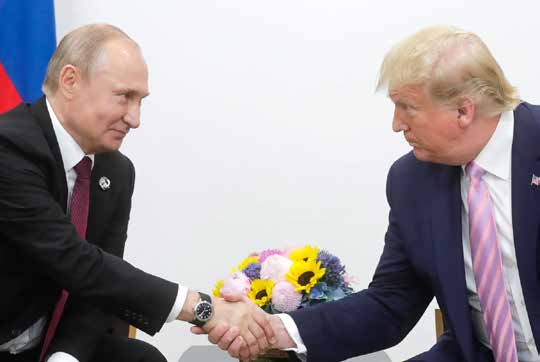
For years, Washington treated Russia as a rival imperialist state, particularly since the 1990s when the Soviet Union collapsed and Russia rejoined the global capitalist system. However, Trump and his allies now see Putin as a potential partner in advancing neofascism.
New alliances
In addition, what the United States has spent in funding the Ukrainian war drive served its policy of weakening Russia as an imperial rival. Washington is primarily responsible for creating the conditions that facilitated the neofascist transformation in Russia and led to its invasion of its neighbour. It deliberately stoked hostility towards Russia and China after the Cold War to consolidate the subordination of Europe and Japan to its hegemony.
When Trump and his supporters acknowledge that previous US administrations played a role in creating the conditions that led to Russia’s invasion of Ukraine, it is not because they genuinely care about peace, despite their claims. Their stance on Palestine reveals the hypocrisy of this supposed concern.
Instead, their position reflects a shift in their view of Russia. For years, Washington treated Russia as a rival imperialist state, particularly since the 1990s when the Soviet Union collapsed and Russia rejoined the global capitalist system. However, Trump and his allies now see Putin as a potential partner in advancing neofascism.
They anticipate working with him to strengthen the far right in Europe and beyond while also gaining economic benefits from Russia’s vast market and abundant natural resources. While they view Europe’s liberal governments as both ideological opponents and economic competitors, they see Russia as an ideological ally that poses no real economic threat.
On the other hand, China, in the eyes of Trump and his acolytes, is the greatest political opponent and economic and technological competitor. Joe Biden followed this same policy, establishing a continuity between Trump’s first and second terms with regard to hostility to China. The Trump team may hope to separate Moscow from Beijing, just as China separated from the Soviet Union in the 1970s and allied with the United States. But Putin will not risk taking this path as long as he is not sure of the permanence of the US neofascists at the helm of their country.
What will Europe do?
The big question now is whether the European liberal axis is ready to take the path of emancipation from US tutelage. This would require stopping its alignment with Washington in hostility towards China and consolidating cooperative relations with it. This would also require European countries to be prepared to work within the framework of international law and contribute to strengthening the role of the United Nations and other international institutions. These are two things that Beijing has been constantly calling for.
Europe’s economic interest is clear in this regard, of course, especially the interest of the largest European economy, the German economy, which has extensive relations with China. The irony is that China is now joining forces with the Europeans in defending global freedom of trade against the mercantile approach adopted by Trump and his acolytes. They are also defending environmental policies against their rejection, accompanied by climate change denial that characterises various brands of neofascists. The incoming German Chancellor, Friedrich Merz, has expressed sharp positions in criticising Washington and calling for Europe’s independence from the United States. If these lead to an actual attempt to follow this path, they may be reflected in the European Union’s attitude towards China, especially since the French position is leaning in the same direction.
All these matters confirm the death of the Atlantic liberal system and the world’s entry into a stormy phase of reshuffling the cards, of which we are still at the beginning. The US Congressional elections next year will play a major role in pushing this process forward or curbing it, depending on whether they lead to strengthening or weakening neofascist dominance over US institutions. Meanwhile, the US neofascist movement has begun to imitate its counterparts in various countries in gradually undermining electoral democracy and laying its hands on US state institutions in an effort to perpetuate its control over them.
Gilbert Achcar is Professor of Development Studies and International Relations at SOAS, University of London.