
The long budget debate this year underlined a clash between two arguments on the public service sector. We will disregard all the opportunistic noise in the middle, with politicians jumping into the VAT debate without opposing budget cuts and austerity. In essence, we have two positions:
- Communities and progressive forces demand a larger public sector to deal with the understaffing at schools, clinics and hospitals; to build repair and maintain water and sanitation infrastructure; to build local roads; and to replace the R370 SRD grant with a much higher Universal Basic Income Grant, or at least to increase the current grant which has been hollowed out by inflation.
- The Treasury and the GNU say that the public service is already too big. They are pushing for privatisation and ‘Public Private Partnerships’. They say that there is no money. You cannot increase taxes on the middle class and the rich—they are allegedly already under such “tax pressure”. Meanwhile, interest costs are rising on the government’s growing debt.
- But maybe the problem is that there is not one public sector, but two:
- Public Sector One is underfunded. Frontline staff struggle to cope. Classrooms are overcrowded. Seven or eight people every night arrive at the hospital with gunshot and stab wounds. In Gauteng, for example, in just 17 of the province’s 37 hospitals, there is a surgery backlog of 34,000 operations.
- Public Sector Two is overfunded. It is overpopulated with people who are earning extremely high salaries. It is difficult to know what all of them are doing, but they are making a very good living.
And in the middle of these extremes, there is the necessity of keeping essential staff.
How much is too much?
But what is an excessive salary in South Africa? There is no ‘scientific’ or ‘objective’ answer. We have the most unequal society in the world. Half the population live on or under the poverty line. The national minimum wage is about R5,000 per month (R28.79 per hour). So we decided to put this class, gender, racial, moral and political question to five people with low income, or no income at all from work: what is a “very, very, high salary”?
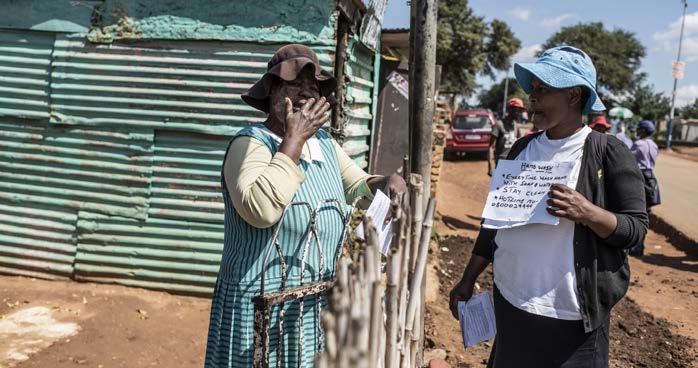
Public Sector One is underfunded. Frontline staff struggle to cope. Community Health Workers, for example, are not even recognised as permanent employees.
We accept that this is a very unscientific study. It could be done better in Amandla! reading groups or trade union workshops. We posed this question:
What should be paid to someone each month, who is not corrupt, who has spent years to get a high education, who is competent in his or her job and where the job is very important to society? There can be phone calls even at night about difficult problems. You don’t want the person to leave the post, despite the challenges. Maybe you’re managing a big city riddled with problems, or the Koeberg nuclear Power station, or a large hospital with a thousand employees?
Opinions varied between R60,000 and R80,000 per month after tax. That would mean remuneration before tax of between R90,000 and R120,000 per month (R1.08 million and R1.44 million per year). Increase that to between R1.21 million and R1.61 million, to include pension and medical aid contributions. For the sake of simplicity, we used “R900,000 or higher” as our benchmark.
A first point of reference, earning far beyond our panel’s benchmark of R900,000, was the Speaker of the National Parliament. We see her now and then on TV, handling ‘points of order’. The speaker earns R3.16 million per year, the same as the Deputy President of the country. Ordinary members of parliament earn R1.27 million this year.
This question was prompted by a thorough study of the 185 personnel tables in a 1,000-page publication called Estimates of National Expenditure. It is published every year and voted on in Parliament as part of the national budget.
We don’t find provincial employees, such as teachers, headmasters, nurses, or doctors, here. 278 municipalities are excluded. We find the staff in the police, courts or prisons (“Correctional Services”). We find the average labour cost in 34 government departments. And then we find the staff at 151 outfits, agencies, institutes and organisations sitting under those departments.
Let’s look at some examples:
- Development Bank SA employs 37 people at an average labour cost of R3.4 million per person, 459 at an average cost of R2.1 million and 110 at a cost of R1 million per year.
- The Industrial Development Corporation employs 37 people at R3.4 million, 459 at R2.1 million and 100 at an average per person of R1 million.
- The National Energy Regulator (that rules over the electricity price hikes) employs 10 people at R3.1 million, 110 people at R1.8 million and 43 people at R1.2 million on average per person and year.
- The National Lotteries Commission employs 3 people at R3.7 million, 56 at R1.8 million and 43 at R1.2 million, on average per person and year.
- The Compensation Fund under the Department of Labour and Employment has 562 employees in payment grade 7-10, at an average labour cost per person of R2.6 million.
It is hard to believe.
Consultants half visible, half in the shadows
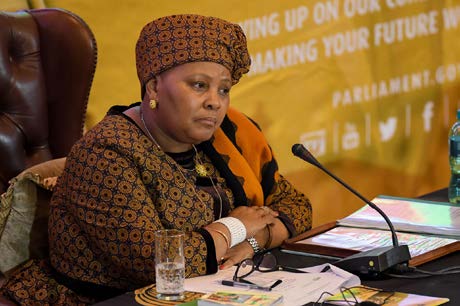
Public Sector Two is overfunded. It is overpopulated with people who are earning extremely high salaries. The Speaker of the National Parliament earns R3.16 million per year.
But in many cases, paying consultants gets mixed up in the government tables with personnel. The result is apparently crazy averages per employee. AIDC reported that last year, it had an email discussion with the Treasury about the R14 billion excess in Eskom’s personnel table. The Treasury only responded indirectly: they omitted the personnel table in the 2025 ENE.
In the same way, we must either accept that the eight highest-paid employees in the Police Department cost R1.4 billion each in 2025, or that the Police are paying R11 billion to an unknown number of consultants, whose remuneration has entered the personnel table. Likewise, either the Defence Department spends over R4 billion on an unknown number of consultants, or two people at the top of the department cost over R2 billion per year…to keep them in a good mood?
Remuneration at the PIC
Many readers of Amandla! are aware from previous articles that the Government Employee Pension Fund is a main creditor to the government. It charges market rates on 13 percent of the domestic government debt. It is a main reason why the GEPF has a surplus every year of R60 million after pensions and benefits to members are paid. Most of the surplus is lent back to the government again, in a circle of money. PIC staff indeed handle the important GEPF funds of R2.3 trillion (that’s R2,300 billion). But is it necessary to pay 51 people at the top of the PIC an average of R4.1 million in compensation for what they are doing, and 171 other staffers R1.7 million each on average?
The PIC also manages the funds of the Unemployment Insurance Fund (UIF). But there is also other work to be done at the UIF. To administer the UIF, 154 people are paid an average remuneration of R2.3 million per year, and 1,154 people are paid R1 million per year on average.
Should income millionaires have CPI increases?
Every year, the salaries of these employees, earning R1.5 million, R2.5 million, R3.8 million, or R4.7 million per year, are upgraded by 4 to 5 percent (the rate of inflation). For the one on R4.7 million, that’s an extra R235,000. The increase on its own is more than the entire salary of a low-paid public sector worker.
The Consumer Price Index (CPI) is the measurement used for inflation. It measures average price increases on a basket of goods and services. But should an employee receive the full CPI increase on the whole salary when a significant part is not used for the consumption of goods and services at all? It may be used to pay off credit cards or other debts (which is basically an investment: the interest earned on the investment in the interest not paid on the debt). It may be invested on the stock market. Such investments or savings will likely lead to an increase in income and wealth, without any salary increase at all.
A new 3-year ‘wage freeze’, but only for the 78,500 public sector employees earning more than R900,000 per year, would save the fiscus R4 billion in 2025, or R13 billion over three years. That money would buy the services of a lot more nurses or teachers.
The apartheid legacy of privilege and inequality in South Africa remains a benchmark. There is a divided social fabric, a lack of information for the mass of people and pressure from the private sector. Altogether, they dictate that an upper-middle-class salary in government ‘must’ be between R1.5 and R2.5 million.
Tens of thousands in public employment earn more than what our small panel regarded as a reasonable remuneration of a very important person, who must be kept in a good mood so that they don’t become an “economic refugee”. The panellists shot well below the mark.
Dr Dick Forslund is an economist at AIDC and a member of Zabalaza for Socialism.