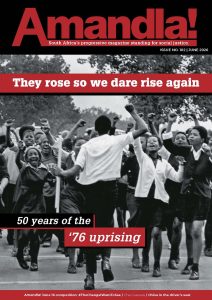

Fifty years after the youth of 1976 took to the streets, resisting the Bantu education regime, South Africa remains confronted with appalling learning conditions and uncomfortable questions about the value and purpose of education.
The students of the Soweto uprising were not just rejecting Afrikaans as a medium of instruction, but an entire political system designed to deny Black children dignity, equal opportunity, and a chance at a better life. Today, although apartheid laws have fallen, the education system continues to reflect the deep inequalities already displayed across South African society.
Race, class, home language and geography continue to be key determinants of the type of education that South African learners receive. Schools in marginalised communities continue to have poor infrastructure, a shortage of teachers and textbooks, and disruptions to the scholar transport and school nutrition programmes.
Despite this, the Government of National Unity keeps deprioritising education by implementing budget cuts. And it fails to enforce timeous consequence management in instances where there is evident misuse of public funds earmarked for education, and continuous poor performance by officials.
All this is a deep betrayal of the youth of 1976 and generations of young people to follow, whose dream of quality and equal education in South Africa remains unfinished.
Through various social policies and legislation, the democratic government made important gains for education after 1994. In 2025, the Department of Basic Education reported a 97% school attendance rate for all learners between the ages of 7 and 17. This is a major improvement in access to education.
Yet access alone has not translated into a dignified schooling journey that guarantees quality education. Only 59% of learners who started Grade 2 ten years ago made it to matric in 2025. Recent studies have shown that in South Africa, rural areas experience significantly higher learner dropout rates than urban areas. There is also an admissions crisis in urban provinces that continues to keep learners out of school for prolonged periods of time, resulting in missed teaching and learning. This crisis particularly affects learners with disabilities—poor Black learners, and these are already people who desperately need education to transform their lives.
“My school has no fencing; animals roam around the yard during schooling hours. The roof is leaking, and the floors are dangerous for both teachers and learners. This situation is not motivating for us to come to school, especially because we cannot learn when it’s too cold or raining.”
– Saxola Rholo, Grade 10 learner, Lukhozi High School
A crisis of infrastructure
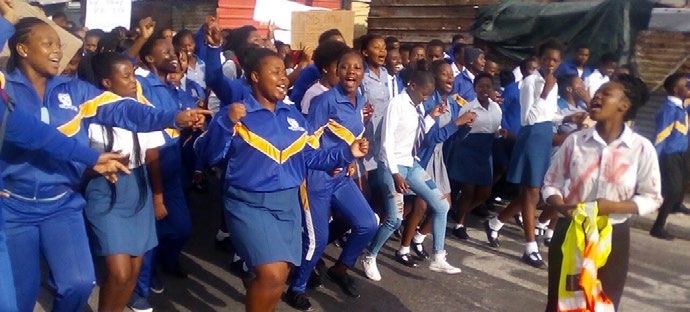
March 2018. More than 150 students from Phillipi High School marched to parliament. “We are 52 students in one container [classroom]. The situation is making it difficult for us to learn.” (Photo: Thembela Ntongana/GroundUp)
Eastern Cape is still reported to have 846 schools using pit latrines. Their MEC is claiming that it will take more than 10 years to fix the infrastructure backlogs in the province. Despite the Regulations, implementation has been painfully slow and marked by regression. The Norms and Standards were hard won through activism led by Equal Education; we secured binding deadlines for the provision of safe infrastructure, such as proper sanitation, electricity, perimeter security, and libraries.
However, subsequent amendments weakened these gains by removing the binding deadlines. For a lot of schools like Lukhozi, this regression represents not just a legal change. They continue to bear the human cost of delayed implementation, poor planning, and chronic underfunding. These are learners who are expected to compete equally in national examinations.
A crisis of learners’ health and safety
Poor schooling conditions also threaten both the physical and mental health of learners. Under apartheid, learners faced direct violence from the state. Today, many learners face violence from the state in different forms, including the absence of security that makes schools vulnerable to gangsterism, bullying, gender-based violence, drugs, and severe mental health pressures. The shortage of educational psychologists results in more than 10 schools being allocated to one social worker. This creates backlogs for learners to access psychosocial support.
Equal Education has consistently argued that school safety is not simply about fences and security guards, but about creating environments where learners feel supported, valued, and protected.
The 2020 court judgement recognised access to food as a key determinant of the right to education. However, it is rather concerning that we have witnessed major disruptions in the NSNP programme in recent years.
The number of social grant recipient candidates who passed the 2025 NSC examinations decreased from 86.06% to 77.70%. Learners often carry the burden of poverty and instability into the classroom, yet the education system does not always provide the support needed to address these realities. Schools are not only centres of learning but, for millions of children, also spaces of care, nutrition, and safety.
“As a parent and an SGB member in Luzuko Primary School, I have been hearing for years that the Department of Education doesn’t have enough money to build a school for our children. They are in temporary structures that have been there since 1999; learners and teachers have been injuring themselves in these structures. These prefabs are unsafe, overcrowded and disease in our school spread fast. We have tirelessly engaged the Department of Education, and we are concerned to learn about the SIU report that there are monies being spent on bogus schools.”
– Thembani Booi, SGB member, Luzuko Primary School
A crisis of austerity
Another major concern is the declining prioritisation of education funding. Equal Education has repeatedly highlighted how budget cuts undermine the constitutional promise of basic education. It is predicted that the school infrastructure budget will decrease by nearly R1.2 billion over the next three years, meaning an 8% decrease by 2028. This will result in the halting of ongoing projects to improve learning conditions. The amount allocated per learner has not been sufficient to cover the needs of learners; as a result, we see the poorest schools requiring parents to make contributions.
Year after year, poor and working-class communities are expected to accept underfunded schools, while inequality continues to widen.
A crisis of political will
The apartheid government was morally illegitimate and fundamentally oppressive, yet it often implemented its discriminatory policies with ruthless consistency and administrative discipline. Bantu Education, forced removals, racial segregation, and pass laws were systematically enforced through coordinated state machinery.
By contrast, democratic South Africa has one of the most progressive constitutions and policy frameworks in the world. However, the current government frequently fails to implement or respect its own laws and policies, including the recent Basic Education Law Amendment (BELA) Act. Court orders on scholar transport, sanitation, infrastructure norms and standards, and school nutrition programmes are often ignored, delayed, or unevenly implemented.
Today’s crisis is not caused by a lack of progressive laws, but by weak political will, poor accountability, corruption, and administrative failure
And there is a lack of urgency to remedy these issues. The Minister of Basic Education had promised to eradicate plain pit latrines by March 2025. But until today, there has been no public accountability for missing this deadline. The Eastern Cape MEC openly claims it will take another ten years to eradicate school infrastructure backlogs, while generations of learners continue to study in unsafe and undignified conditions. The appointment of figures like Zukisa Faku into the portfolio committee, despite serious public concern, reflects a political culture where accountability is treated as optional. At the same time, dysfunctional interdepartmental relations mean that education, public works, treasury and municipalities operate in silos, constantly shifting blame. Meanwhile, schools collapse.
A crisis of democratic governance
This is poor governance at the political level. But we are also seeing the steady weakening of democratic structures that are meant to guard education at the community level. School Governing Bodies (SGBs), which were meant to give parents and communities real power in schools, are increasingly undermined and sidelined. Equal Education’s campaign on anti-corruption in schools attempts to revive community power in the governing of schools, in the spirit of the 1976 youth, whose resistance showed that education struggles are won through collective action.
It is unfortunate that our education system remains marked by inequality, unsafe infrastructure, budget cuts, and weak accountability. While progressive laws exist, poor governance, lack of political will, and weakened democratic structures continue to deny many learners a dignified and quality education. Through campaigns on school infrastructure, anti-corruption, school safety, scholar transport, and the National School Nutrition Programme, Equal Education continues to show the power of organised youth and communities in holding the state accountable.
The legacy of 1976 reminds us that meaningful change in education will require both stronger governance and sustained grassroots organising to ensure that every learner can access safe, equal, and dignified schooling.
Itumeleng Mothlabane is the General Secretary of Equal Education.
*Featured Image by Nombulelo Damba-Hendrik/GroundUp
At Good Hope Primary in Cofimvaba, parents began building toilets in November 2025 for the school’s 200 learners, who were using broken pit toilets or the bush. Poor schooling conditions also threaten both the physical and mental health of learners. Under apartheid, learners faced direct violence from the state. Today, many learners face violence from the state in different forms.