
Nick: There is a real sense that we are in a moment of transition. How do you assess the geopolitics of global power today?
Walden: I don’t think the Trump project is best conceived as a reassertion of US power globally. That was Biden—basically, the reinvigoration of liberal internationalism, which sought to make the world safe for US capital through the projection of US military and political power and free trade.
Trump is unpredictability personified. But his instincts are basically isolationist and inward-looking, and a significant part of his base is also isolationist. This project might be labelled defensive imperialism as opposed to the expansive imperialism of the liberal internationalist project. It is rebuilding what he and his MAGA outfit consider a damaged core of the empire by putting up a wall against imports and against non-white migrants and bringing prodigal US capital back through reshoring via raising tariffs.
The focus is on fortifying the US core of the empire, though he considers Latin America falling within the US sphere of influence. His comments on Canada, Greenland, the Panama Canal, and the Gulf of Mexico reflect this refocusing of priorities on the Americas.
Nick: What do you see as the underlying causes of this moment—not just the rise of the multipolarity but also the phenomenon of Trump?
Walden: I would identify three major contributors: first, the flight of US transnational capital to China in search of dirt-cheap labour that was less than 5% of the cost of US labour. This enjoyed the blessings of Washington, from Bush Senior to the Obama administration. Some estimate that this cost the US some 2.4 million manufacturing jobs and destroyed that synergy between technological innovation and a dynamic manufacturing sector.
The second major contributor was financialisation, which made the financial sector the favourite for investment, owing to the massive profits that could be made from speculation. Both de-industrialisation and financialisation were key factors in the stagnation of the income and living standards of at least half of the US population and the sharp rise in inequality.
The third major factor was the overextension of US military power in the Middle East under the Bush Junior administration, which became a trap from which Washington found it very difficult to extricate itself and led to its loss of credibility even with allies.
Now, the obverse of US de-industrialisation was the super-industrialisation of China, which made the fastest run in history, from being a complete outsider to the global capitalist system to being at its very centre in about 30 years. This involved not just rapid industrialisation but swift technology acquisition so that the country’s scientific and technological base is now largely self-sustaining.
Nick: How do you think the US–China relationship and geopolitical rivalry is shaping capitalism?
Adam: The extraordinary development that we’ve seen from the insertion of China into Western value and supply chains involved the huge urbanisation of hundreds of millions of Chinese rural dwellers. It has led in the last 10 years to a situation in which China entirely dominates global manufacturing in practically every key area or is at least a significant rival or major player.
As was the case with the US at its manufacturing heights, China’s capacity is now dominated by Chinese domestic demand, based on its huge market of four billion increasingly affluent people. And so those markets are not just dynamic but trend-setting. We see this most dramatically in electric vehicles, where the Chinese ecosystem, the market, the demand, the pace-setting consumer style, technology and manufacturing capacity are all located in China.
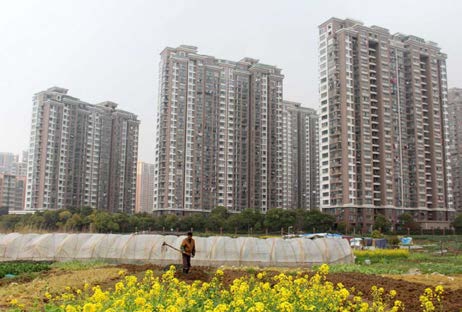
The extraordinary development that we’ve seen from the insertion of China into Western value and supply chains involved huge urbanisation of hundreds of millions of Chinese rural dwellers.
Major East Asian and European competitors like Toyota and VW face a strategic choice as to whether they hang on in the Chinese market or increasingly rely on various types of protectionism to shield their local markets against Chinese competition.
The auto industry was once the hub of global capitalism. The age of Fordism drifted out of sight in the 1970s and 1980s, but it’s unambiguously one of the key drivers of at least regional development of supply chains.
This is a major shift in one of the key areas of the global division of labour.
If I may just expand on one other area, finance. What we’ve seen since 2008 is an increasing bipolarity. We have a US-dominated system centred around the dollar. And that dollar system is massively dominated by the key US players—the BlackRocks, the JP Morgans. And then, separate from that, within Chinese exchange-rate and currency controls, a Chinese system, which again, given the scale of the Chinese market, has scale and compares with and is even larger than the JP Morgans, yet it’s not part of the same system.
So I think there is this break in America’s political economy. But does that fundamentally change capitalism? No, because clearly, America’s capitalism developed in the 19th century under a massively protectionist system. There are many different ways in which this can manifest and develop.
It changes the direction, it changes the bargaining power of different actors, it changes the points at which bargaining power and leverage can be applied. And, in the form of the Chinese system, we are seeing something which doesn’t neatly fit a cookie-cutter definition of what capitalism is because of the role of the party and state institutions.
In any case, we’re seeing a diverse, complex polycentric model in which big shifts are happening, while in others, there’s a consolidation of American power within the dollar system.
Walden: In terms of the departure from neoliberal ideology, it has been uneven. China has, of course, in the last few years, touted its model of capitalism as the reason for the success of the country’s development.
When Trump tore up the TPP (Trans-Pacific Partnership) and rejected free trade, he basically accelerated the process of abandoning the neoliberal models of market-driven corporate expansion. Similarly, the Biden administration took a giant step towards industrial policy with the passage of the Inflation Reduction Act, the Chips and Science Act and the Infrastructure Investment and Jobs Act.
However, neoliberalism continues to be the ideology of the IMF and the World Bank. In many countries that have their programmes, like my own country, the Philippines, they continue to implement neoliberal policies because the Bretton Woods Institutions have pushed them to legislate these policies and even institutionalise them in their constitutions.
Nevertheless, the massive failure of neoliberal policies will inevitably create tremendous pressures to abandon these policies and force the adoption of initiatives that will prioritise social welfare, re-regulation, and a leading role of the state. We saw this with the revolt against neoliberalism in 2019 in Chile, which was probably the most neoliberalised country in the Global South. This is a trend that we will see more and more.
In the post-neoliberal state, I believe that national economic goal-setting will be the trend, planning will again become legitimate, and technocratic decision-making on such fundamental issues as consumption and investment will be more salient.
The greater role of the state in countries where authoritarian or fascist regimes come to power means that a whole host of economic privileges and incentives will be provided to the majority population while stripping minorities of access to them. India here is a pacesetter.
In terms of relationships among governments, the era of globalisation, which saw the free flow of capital and goods across national borders, guaranteed by a multilateral system, will give way to more bilateral relationships in trade, capital flows, aid, and migration.
The character of these relationships will be determined by whether countries are geopolitical rivals or whether they are seen as racially or culturally compatible. What Trump calls ‘shithole countries’, meaning most of us in the Global South, will be marginalised from this web of bilateral relationships.
Now, one must also factor in that the institutional landscape of capitalism is changing. The Fordist corporation under managerial control is now only one of several incarnations of capital, as Melinda Cooper has shown. There has been a revival of dynastic capitalism, or family-owned wealth transmitted intergenerationally, through changes in inheritance laws and favourable tax treatment, with Trump being an example of this phenomenon, along with the Koch brothers.
And we have also witnessed the emergence of billionaires with a Napoleonic complex, eager to use their access to the state as well as the media and civil society for their personal goals—like Trump, Elon Musk, and Jeff Bezos.
So, I would just like to sum up that we have as key elements of the current global institutional landscape: the return of the activist state, the re-regulation of the market, the return of dynastic capital, and the emergence of Napoleonic capitalists.
Adam Tooze is an economic historian, chair of History at Columbia University and Director of the European Institute.
Walden Bello is co-chair and co-founder of Focus on the Global South, a research, analysis, and advocacy institute.