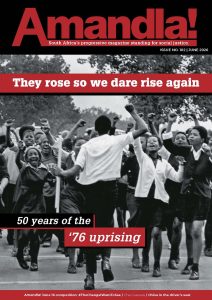

In a society dominated by materialism and where publicfigures are motivated by huge salary packages, Rita Edwards stood out as an exception. Rita was born in Ottery,Cape Town on 25 March 1950, the third child of nine. Her political convictions were honed byher parents, who embraced ideals of social justice and raised their children to stand up for their convictions. For Rita, the personal was, and is, political. For her, the beliefs you espoused needed to be matched byyour deeds. Hers was a commitment to a simple and modest life. She spurned several offers to enter higher once in government or the private sector, preferring to spend her time with ordinary women in the New Women’s Movement and with farmworkers. She was a product of the anti-apartheid movement, a fighter and activist who dedicated her life to the struggle of the working class and rural poor. She was extremely open to ideas and fought fiercely against sectarian approaches, even amongst her own comrades. She was also a committed feminist and socialist, which brought her into the centre of the debates that led to the split in the anti-apartheid movement. She had an amazing capacity to be unwaveringin her convictions yet able to relate to and work with comrades from opposing political tendencies.. Throughout her life, Rita combined service to the poor with activism critical of the status quo,whilst continuingto contribute to a body of work based on creating feminist alternatives. Much of her writings focused on the intersection between race, class and genderand her theories on the triple oppression of black women guided her activism. She was a strong-willed, determined fighter with a gentle and caring approach. These characteristics were her trademarks throughout her life. The Rita Edwards Collective aspires to honour her life and others like her, and press forward against any and all forms of visible and invisible oppression and exploitation of women. We are proud to claim her name. For more information on Rita Edwards: https://www.amandla.org.za/home-page/90-rita-edwards-an-ordinary•person-an-extraordinary-activist The cover of this issue was inspired by an original poster produced by the See Red Women’s Workshop (seeredwomensworkshop. wordpress.com) for the 1975 International Women’s Day march. Concerning My Funeral
Number One Absolutely no priests (except if they remain silent). Absolutely no prayers No sign of the cross No crucifixes No hymns No mention of God, Christ, Mary, angels, devils or all the other paraphernalia of religion, any religion
Number Two Flowers are ok, but comrades Don’t spend money on ridiculous bouquets or tombstones or fancy coins Cardboard or plywood is fine Or just carry my body on a plank of wood Dressed in my jeans and a wosa T-shirt Why not? With my hair brushed and shiny It will look a lot better than the hacked images Twisted and crumpled Splattered over the dusty streets and our newspapers every day.
Number Three Don’t carry pictures or posters saying silly things What I thought would be nice Is to carry some of my pics I took Perhaps I’ll make some of the best ones into posters My pics from London And the farmers in Zimbabwe And the women working and struggling And the marches and struggles in South Africa These are the real images we should carry at funerals Of those who produce life Of those who resist so that all may live.
Number Four And I hope you will sing, really sing And toyi-toyi, really toyi-toyi No dirges, no mournful wailing But really singing
All the best songs The Youth Commission songs And .’Sithulele mama’And international song – The diggers Song, Joe Hill, Songs of the Deportees, Harriet Tubman, And Seni singing her songs, And the women songs – The Women’s Army. We Don’t Wear the Same Size Shoes (for Carl), Standing Behind a Man (for me) And the Irish songs – Broad Black Brimmer, Four Green Fields. As well as the Italian ones (you’ll need Sigrid) And the Chilean ones (Victor Jara – you’ll need Seni) And any others you feel like.
Number Five If I could you say just one thing (After all it’s the last time you’ll have to listen to me) It is to suggest that we reserve our anger, our tension, Our bitterness, our hatred… for the real enemy: the bosses, the racists, the sell-outs, the murderers, the Third force, the hit squads Comrades, let us build a new culture Lest us rid ourselves of all the twisted Bitterness We carry in our hearts That bubbles through our mouths, because we refuse the meaning of Comradeship Let us remember Che, who said, “At the risk of sounding ridiculous, revolutionaries are guided by great feelings of love” Let us build ourselves as new women and new men Let us risk the ridicule And love, really love each other Because it is liberating Because it will make us stronger Because it is enjoyable and creative Because it will help us to make the revolution.
Kate Truscott, November 1991