
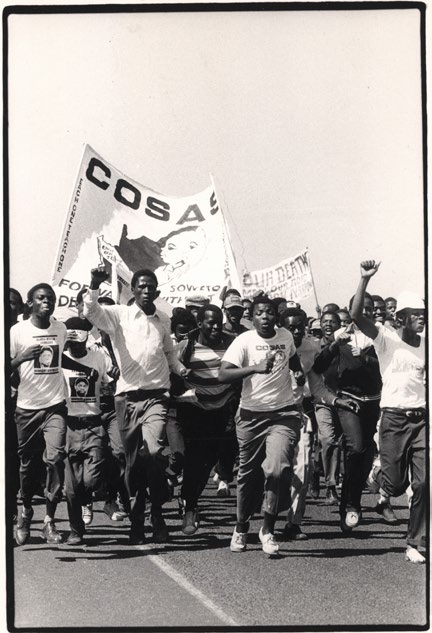
Funeral of Congress of South African Students (COSAS) organiser Bongani Khumalo. By 1984, Black students were leading internal resistance to apartheid, with the mighty COSAS spearheading class boycotts across the country. (Photo: Paul Weinberg)
Fifty years ago, the student uprisings of June 1976 radically altered the terrain of the anti-apartheid struggle in South Africa. They laid the foundations for the mass resistance of the mid-1980s, as they opened up new possibilities for solidarity between students, workers, parents, and teachers, and galvanised nationwide resistance beyond Soweto. Until today, the events of June 1976 remain a global symbol of resistance to apartheid and genocide beyond South Africa.
Ten years after June 1976, Sowetans were again at the forefront of education resistance. In December 1985, local organisations saw 1986—the tenth anniversary of the Soweto uprisings—as a watershed year in Black education, given the sustained interruptions to schooling since 1976. Activists in Soweto and other townships drew power from the emerging civic movement that was seizing control over local governance, as well as from the trade union movement with the launch of Cosatu in 1985. They called for a “people’s education” that spoke to the histories, hardships and hopes of all South Africans.
Trade unions and civics
The June 16 uprisings erupted from students’ frustration with the implementation of Afrikaans as the language of instruction in Black urban schools from 1976 onwards. However, the protests that followed transcended the language issue. The militancy of students was grounded largely in the ideology of Black Consciousness (BC), which pushed them beyond their school grounds and into the struggle against the racial capitalist system of apartheid, during which they forged strategic ties with workers and trade unions. In August and September of 1976, students and workers waged two successful stayaways that bridged intergenerational divisions evident during the uprisings.
In Soweto, another source of intergenerational solidarity came from progressive parents. Shortly after 16 June 1976, Soweto parents formed the Black Parents’ Association (BPA) to assist families of detained, missing and injured students. It included important activists such as Winnie Mandela, Dr Nthato Motlana, Sally Motlana and Rev. Manas Buthelezi. The BPA was banned in October 1977 but soon reconstituted as the Committee of Ten, chaired by Dr Motlana, a local physician and ANC member. Many of these activists were detained for their solidarity actions.
When the Soweto Civic Association (SCA) was launched in 1979, the Committee formed its first executive. By then, the state had dealt a lasting blow to the BC movement. This coincided with (or left space for) the re-emergence of Charterist politics through organisations such as the Congress of South African Students (COSAS), which was also launched in 1979.
Rather than crush resistance, state repression instead birthed a deeper commitment among the masses to dismantling apartheid. The regime tried to reform some of the more stringent apartheid laws, but the formation of the UDF in 1983 signalled mass rejection of any reform that did not grant full political power to the Black majority.
Liberation now, education later
By 1984, Black students were leading internal resistance to apartheid, with the mighty COSAS spearheading class boycotts across the country. By 1985, these had rendered township schools ungovernable. In August 1985, COSAS was banned, just one month after State President Hendrick Verwoerd—himself a key architect of Bantu Education policy—declared a state of emergency. The situation in schools was so violent that military and police presence had become an almost permanent feature of township school life. In response, many parents sent their children to the relative safety of the Bantustans. The boycotts in Soweto threatened to disrupt year-end exams scheduled for October 1985. Learning was virtually impossible, and the political climate was compounded by dilapidated school buildings, underqualified teachers, and lack of access to essential textbooks and stationery.
As boycotts continued, parents’ committees sprang up nationally. In Soweto, an SCA meeting on 13 October 1985 deliberated a collective response to the exam issue, and the Soweto Parents Crisis Committee (SPCC) was formed. It was mandated to meet with the Deputy Minister of Defence and Law and Order, Adriaan Vlok, about removing the military from Soweto schools so that exams could proceed in (relative) peace. A week later, the SPCC reported to a second meeting that Vlok was unavailable or unwilling to grant them an audience. Instead, representatives met with Sam de Beer, Deputy Minister of Education and Development Aid, who agreed that exams would be postponed to 7 January 1986. However, 1985 year-end exams were only written in March 1986, after a complicated battle with authorities.
Unlike the BPA, who had limited engagement with formal education authorities, the SPCC met with various ministers at least ten times, from its inception in late 1985 to its demobilisation in 1987. It was made up of key Soweto activists who were deeply impacted by 1976. Curtis Nkondo, of the non-racial National Education Union of South Africa (NEUSA), was the principal of Lamula High School in Meadowlands. He was also a leading figure in the Soweto Teachers Action Committee that mobilised teachers in a mass exodus of the profession in 1977, in defiance of Bantu Education. Dr Motlana, a leading ANC activist from Dube, was instrumental in the formation of the BPA and Soweto Committee of Ten. Like many young people after 1976, one of Motlana’s own sons skipped the border to join the liberation movement in exile, which shows the deep entanglement of personal and political life.
On Christmas Day 1985, the SPCC sent a three-member delegation to meet with exiled ANC leaders in Lusaka, Zambia, and thus consolidated its position in the constellation of Congress alliances.
People’s education for people’s power
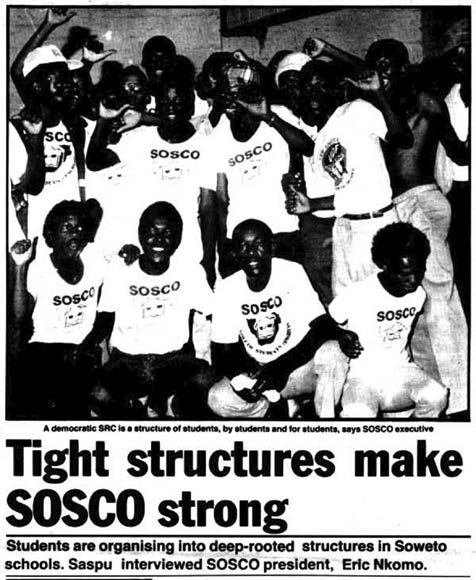
The banning of COSAS forced angry students to re-organise, and organisations like the Soweto Students’ Congress (SOSCO) and the Transvaal Students’ Congress (TRASCO) emerged to fill this void.
Another pressing issue for the SPCC was the schools boycott. The banning of COSAS forced angry students to re-organise, and organisations like the Soweto Students’ Congress (SOSCO) and the Transvaal Students’ Congress (TRASCO) emerged to fill this void. They worked closely with the SPCC to organise what is perhaps the most historically significant convention in Black education, the National Education Conference at Wits University on 28–29 December 1985.
About 700 representatives from 200 organisations, including the South African Council of Churches, South African Committee on Higher Education, UDF, NEUSA, Azanian People’s Organisation (AZAPO), and many other student, youth and civic structures, attended. They resolved that students would return to school in January 1986, but on condition that the government meet six critical demands by March 1986:
- Reschedule examination dates to a time agreed on by students, parents and teachers;
- Lift the emergency in all areas;
- Withdraw the military from all townships;
- Unban COSAS;
- Reinstate all dismissed teachers and release all detained students; and
- Allow schools to elect democratic student representative councils (SRCs).
The Wits conference marked a massive shift in education resistance, and the earlier slogan “liberation now, education later” was replaced by “people’s education for people’s power”. This emphasised occupying and taking control of schools, rather than boycotting. Schools were thus repositioned as sites of renewed struggle. This shift coincided with a broader move towards adult literacy and worker education in the trade unions. The conference also mandated the formation of the National Education Crisis Committee (NECC) to coordinate national campaigns against apartheid.
As March 1986 drew closer, the SPCC realised that its demands would go unmet. Under the auspices of the NECC, the SPCC organised a second national conference in Durban on 27–28 March 1986.
The Durban conference defied the government by declaring COSAS unbanned. It called on students to elect SRCs in schools, and on parents to withdraw from school management committees and elect parent-teacher-student associations (PTSAs) instead. Both BC- and ANC-aligned groups participated in both conferences, and their differences produced tangible tensions over People’s Education. AZAPO representatives walked out on the first day of the Wits conference, and because the Durban conference took place on the same weekend as the national conference of the BC-aligned National Forum, ANC-aligned organisations dominated the trajectory of the process. But BC groups, especially students, participated robustly in the NECC up until the early 1990s.
Soweto activists lead
Ten years after 1976, Soweto activists were again leading education resistance. These activists drew on local political networks established in the 1970s and evoked the memory of 1976 to channel student frustration away from the frontlines and back into classrooms, towards “people’s education”. But on 12 June 1986, just days before the tenth anniversary, the government detained hundreds of anti-apartheid activists, including some of the SPCC. By 1987, the NECC itself was banned, and the SPCC activists that had been absorbed into its leadership faced serious police intimidation. By 1989, People’s Education was effectively demobilised. It was only in 1990 that a new layer of activists emerged, under the banner of the Soweto Education Coordinating Committee, to take up education liberation for Sowetans.
While the road from 1976 to 1986 was not linear, without the disruptive actions of students on that fateful day in 1976 and the politics that came from it (student-worker solidarity, parents’ organisations, and the proliferation of local education crisis committees nationally), people’s education would arguably not have manifested in the mid-1980s.
Terri Maggott is a doctoral candidate in the Department of Sociology at the University of Johannesburg.