
In May 2022, I was at the Museum of Black Civilisations in Dakar. What struck me immediately was not only the scale of the building but also the political message conveyed by its exhibition on African languages. One panel proudly declared: “Africa, after inventing writing, never lost the use of it”. The exhibition showed examples of writing systems in Coptic, Ge’ez, Tifinagh, and Hausa written in Arabic script. It reminds visitors that different groups and societies on the African continent had long produced knowledge, literature, and intellectual traditions in their own languages before and despite colonial domination.
Yet in many countries, including Algeria and Senegal, colonial languages such as French came to dominate public institutions, education, administration, and social prestige. Colonialism was not simply about occupying land or extracting wealth. It also had an aim to reorganise cultural hierarchies by marginalising indigenous languages and presenting them as inferior or incapable of modernity. This violence against language remains one of the deepest wounds inherited from colonialism. It is today a key tool for the Zionists and their allies to try to smash the Palestinian resistance and its existence.
Settler colonialism weaponises language
I grew up in Algeria in a multilingual home. My father spoke Kabyle, the main language of Kabylia. My mother spoke a local Arabic dialect known as “bougiotte”. In the streets of Béjaïa, my city, people moved naturally between languages. We also spoke French. South Africans can recognise themselves in that linguistic normality. Even if French was the language inherited from colonialism, it remained deeply present after independence.
Yet despite this linguistic richness, some languages were almost absent from public life. Kabyle was largely confined to the private sphere and today is not properly taught in schools. Our local dialect (spoken Arabic) had no place in the media or in education. As a child, I did not yet understand why some languages were valued while others were marginalised. Later, I began to understand that colonialism was one of the key elements.
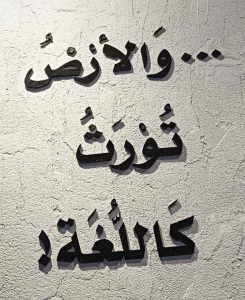
“And the earth transmitted like language”, Mahmoud Darwish, Palestinian poet. Different groups and societies on the African continent had long produced knowledge, literature and intellectual traditions in their own languages before and despite colonial domination. (Photo: Sadia Agous-Bienstein)
This became even more obvious to me when thinking about Palestine and South Africa. These two places, like Algeria, share the experience of settler colonialism, even if their histories are different. Settler colonialism, with its occupation plan, is a system that seeks to replace the indigenous population politically, culturally, and symbolically. It reorganises space, rewrites history, renames places, and imposes new hierarchies. Language is one of its most powerful tools.
South Africa under apartheid offers one of the clearest examples of this process, and the uprising of Soweto in 1976 was clearly triggered by language. English and Afrikaans dominated public institutions, while indigenous languages such as Zulu, Xhosa, and Ndebele were marginalised. The Bantu Education Act of 1953 created a segregated educational system, designed to keep Black South Africans in subordinate positions.
June 16 and language
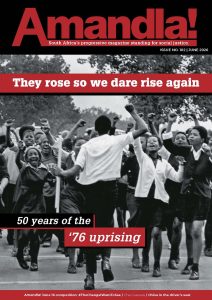
In 1974, the apartheid government decided to impose Afrikaans, the language of the oppressors, as a language of instruction in Black schools. Half of all subjects had to be taught in Afrikaans, even though many teachers themselves had not mastered it. Students understood that language was being used to maintain domination and to force them into failure, exclusion and segregation. On 16 June 1976, thousands marched peacefully through Soweto to protest this linguistic policy and the apartheid system more broadly. The police opened fire on them. Hundreds of young people were killed or wounded.
The Soweto uprising became one of the defining moments of the struggle against apartheid. It revealed how deeply language and political oppression were connected. The students were not only fighting against a school reform; they were fighting against a system that denied their humanity. This was a key historical moment that captured my attention back in Algeria. Steve Biko highlighted this connection very clearly. For him, liberation was not only political but psychological and cultural. Colonial systems attempt to convince the oppressed that their languages, cultures, and histories are inferior.
Frantz Ibrahim Fanon understood this process. In Black Skin, White Masks, he wrote: “To speak a language is to assume a world, a culture”. Fanon showed that colonialism attacks the colonised not only through physical violence, but also through language and culture. The colonial language becomes associated with intelligence, civilisation, and power, while indigenous languages are treated as backward or inferior. This creates what Fanon described as an internalised inferiority complex.
Although Fanon was writing primarily about the French colonial experience, his work continues to resonate internationally, from Algeria to South Africa to Palestine. Today, he is once again being read in the context of Gaza and the ongoing destruction of Palestinian life.
Hebrew as tool of domination in Palestine
The Palestinian experience needs also to be seen through a colonial cultural lens. Hebrew played a central role in the occupation of the territory and in the broader project of Hebraising and de-Arabising Palestine. If settler colonialism is fundamentally about territorial control, as the historian Patrick Wolfe argued, language becomes another essential instrument of domination.
The Zionist project emerged in Europe in the late 19th century and drew on European colonial models before being implemented in Palestine. This political project went hand in hand with a cultural and linguistic project in which modern Hebrew occupied a key place. Modern Hebrew came to represent the figure of the “new Jew”, the sabra, rooted in the land and disconnected from exile. In reality, this linguistic project was a process of Hebraisation and Judaisation of the land. Its aim was to erase the native character of the Palestinians. This process was later consolidated under British rule, the same British Empire that colonised South Africa and Australia and systematically marginalised, suppressed, or erased many indigenous languages in those territories.
Through language, place names, education, and public institutions, the colonial project sought not only to conquer the land but also to reshape its cultural identity and erase its Palestinian-Arab character. The Palestinian writer, Ghassan Kanafani, once wrote that “Zionism fights on the language front”. This sentence remains profoundly relevant today. This struggle in Palestine can be seen in the renaming of villages, streets, and landscapes; in the marginalisation of Arabic in public institutions; and in the segregationist educational system imposed on Palestinian citizens inside Israel.
Palestinian Arab children study in separate schools that are often underfunded and overcrowded compared to Jewish schools. They receive fewer educational resources and face discrimination throughout the educational system. They often face major barriers to higher education if they do not fully master Hebrew. Also, Arabic- Palestinian education programmes are banned in the Palestinian schools of occupied Jerusalem. This linguistic hierarchy was further reinforced by the 2018 Israeli Nation-State law.
It officially defined Israel as the nation-state of the Jewish people, downgraded Arabic from an official language to a language with a “special status” and promoted Jewish settlement as a national value. Through this law, Israel officially linked Jewish identity, the Hebrew language, and the expansion of Jewish settlements within the legal structure of the
state itself. All that with the silence of the powers of the world.
Language part of the ongoing Nakba
Language in Palestine is therefore not a secondary issue. It is part of what Elias Khoury called the “ongoing Nakba”—al-Nakba al-Mustamira. The Nakba did not end in 1948. It continues through displacement, occupation, and segregation, and through attempts to erase Palestinian presence culturally and linguistically Colonialism-Zionism attempts not only to occupy the land but also to reshape how the land is spoken about and remembered.
The destruction of Gaza since October 2023 has revealed the brutality of our contemporary world. Entire neighbourhoods, schools, universities, libraries, and archives have been destroyed. Journalists, teachers, writers, and students have been killed. What is being attacked is not only a population but also a cultural and intellectual world.
Gaza shows us that colonial violence is never only physical. It also targets memory, knowledge, and language. This is one reason why Palestine has generated such enormous solidarity across the world, especially among young people. South Africans have recognised echoes of their own history in the Palestinian struggle. The mobilisation of South Africa for Gaza is rooted not only in political solidarity but in a shared memory of settler colonialism, racial segregation, and cultural domination.
Language as resistance
Yet colonialism never fully succeeds in erasing indigenous languages and memories. Across African countries and Palestine, people continue to resist through language itself, by writing, speaking, translating, singing, and remembering in their own languages. Indigenous languages carry histories, ways of seeing the world, and forms of collective memory that colonial systems attempted to destroy but never fully succeeded. To defend a native language facing colonial domination is not simply a cultural act. It is also a political one. From Soweto to Gaza, the struggle over language remains inseparable from the struggle for liberation.
Sadia Agsous-Bienstein is an associate professor at Sorbonne nouvelle and works in Palestine and Israel studies. She is also an activist for a decolonial Palestine.
*Featured Image by Peter Magubane