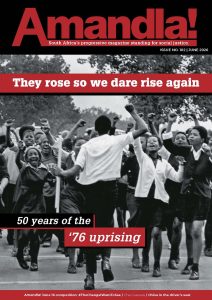

In June 1976, thousands of Black students marched against Afrikaans as a medium of instruction and against the entire machinery of Bantu Education. The Soweto uprising and the waves of student resistance that spread across the country thereafter created a new demand for alternatives to apartheid knowledge itself. One response to these demands came in the platform and programme of a magazine.
Produced between 1981 and 1996 by the South African Committee for Higher Education (SACHED), Upbeat magazine became one of the most widely read anti-apartheid publications for youth in South Africa. Despite repression, by 1982 it had a readership of around 60,000, and by 1990 this had grown to more than 105,000. It became the go-to magazine for activist youth, progressive teachers, and trade union organisers across the country throughout the 1980s. It was purposefully part of a broader experiment in liberation pedagogy, political education, and movement building.
Creating a magazine for youth was part of SACHED’s response to the demands of “the 76 generation.” According to Enver Motala, coordinator of SACHED’s Resource Centre in Durban from 1981-1991, commitments to the Black Consciousness and the radical workers’ movement, and the student uprisings led to the development of radical educational programmes with anti-racist and socialist orientations, throughout the 1980s. Upbeat was one such programme. It was initiated by John Samuel, national director from 1979 to 1990, who returned from exile in Zambia after the 1976 uprising:
School children in the townships, in particular, were searching for different information and trying to understand what was going on in the world and in South Africa, and particularly in Africa.
Upbeat entered this new terrain strategically. SACHED was careful not to be kicked out of schools or to have the magazine banned (as some of their recent newspaper projects had been). It did not work with the apartheid schooling system itself but rather with teachers and students in schools, and youth who had left school for political and practical reasons. This strategic positioning, an “in but not of” the schools’ “undercommons” approach, became central to its politics and pedagogy.
Neville Alexander, director of SACHED’s Cape Town office, described organisations like SACHED as part of outlining “a revolutionary alternative to the apartheid state.” Upbeat formed one strand of this wider project of new experiments in radical education work. They ran parallel to the political and economic fronts of the anti-apartheid struggle.
Opening up imagination
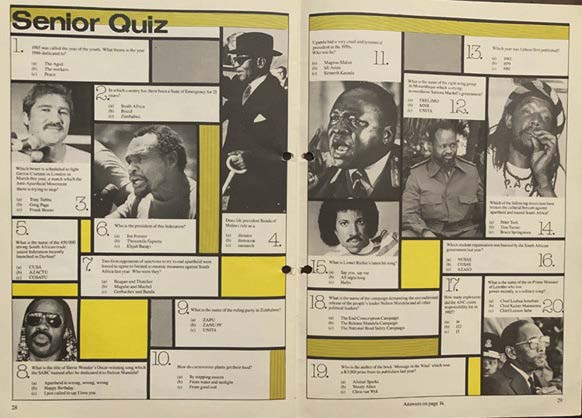
Inside its pages, Upbeat attempted to open up children’s imaginations beyond apartheid logics of separateness and subordination. Each edition carried short stories written by readers, excerpts from African literature, interviews, science columns, ecology features, debates, theatre reviews, penfriends, quizzes, puzzles, comics, and music features. And “Talkshop” discussions where youth from around the country debated current issues, ranging from school governance to sexism and relationships.
A quick scroll through the archive reveals article titles such as: “Beauty contests are sexist?”, “Big business has its claws in soccer,” “How to debate”, “Building SRCs”, “African jazz”, “Nationalisation a way to spread wealth?”, “How weather works” and “Can you say no?” Alongside articles on puff adders, reggae, recipes, and chess sat discussions on forced removals, school boycotts, corruption in homeland education departments, and violence from Natal to Grenada.
Marcus Solomon was back in the classroom after a decade on Robben Island and five years of banning. He was relieved to leave teaching in the apartheid school system to become a distributor for Upbeat in 1981. Upbeat, he explains, “was seen as something that covers everything; like the capitalist world… an alternative in every dimension of education”. Harriet Perlman, editor of Upbeat in the late 1980s, noted how they went to great lengths to ensure that Upbeat also strategically dovetailed with the official curriculum so that teachers would use it. And, at great risk, they did.
Sean Jacobs, the founding publisher of Africa is a Country, was at primary school in Ottery, Cape Town, in the 1980s. He recalls:
What else did I get to read? My dad worked as a gardener for a supreme court judge in Bishopscourt and would give my dad newspapers — that was the only news, other than SABC state propaganda…There is the official curriculum, and then there is Upbeat.
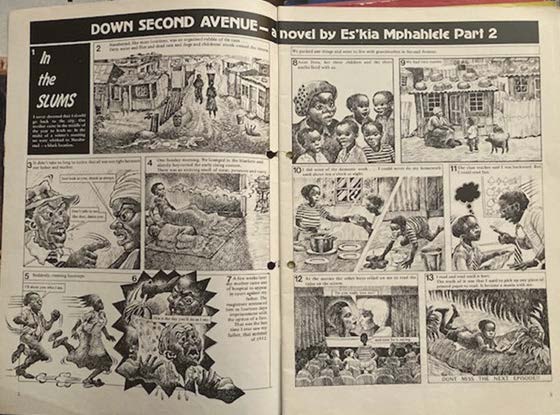
Mphahlele’s Down Second Avenue was published with an accompanying handwritten letter by Mphahlele to Upbeat readers.
The refusal to divide political culture from education, or art from organising, shaped the entire publication. Upbeat introduced banned African history and literature in accessible forms. Muziwakhe Nhlabatsi illustrated serialised comic versions of novels by Ngũgĩ wa Thiong’o, Bessie Head and Ama Ata Aidoo. Es’kia Mphahlele’s Down Second Avenue was published with an accompanying handwritten letter by Mphahlele to Upbeat readers. Political cartoonist Andy Mason created science fiction series like Stella Starfinder’s Encyclopaedia of the Universe. The visuality of the magazine was striking, especially in a context of an extreme dearth of access to media and history.
Reading as critical engagement
But the radicalism of Upbeat was not only in its content. It was also in its pedagogical form.
SACHED concurred with Paulo Freire’s understanding that reading is not merely decoding words. It is a process of critical engagement between text and context. In a 1990 SACHED Journal article, “A Book is N ot a Book Until it is Read,” they argued: “If we aim to challenge a passive mode of reading, then we must produce books that our readers can hold conversations with; books that shout out at the readers and prompt them to action.” Upbeat attempted precisely this.
It encouraged readers not simply to consume information but to argue, write back, participate, and produce cross-border conversations themselves. Fikile Mazibuko distributed up to 11,000 copies of Upbeat each month in KZN in the 1980s:
The children were active, and a full area of creativity opened up because of Upbeat. And liking to read, because of Upbeat…Even adults wanted to read it to the end. It was umrhabulo; it conscientised and broadened one’s understanding of one’s environment.
By 1989, the magazine was receiving more than 150 letters each week. Readers debated sex education, politics, and music. One student wrote in 1983: “Should we be taught sex education in schools? Definitely yes!” Another complained that Upbeat was becoming too political and “boring,” only for the SRC at Harold Cressy High School to respond in the next issue, defending the magazine’s focus on struggle. The pages became a forum.
Readers also became writers. In 1990, a feature story titled “Stop Wishing and Start Fighting” carried a note explaining that Reuben Moshonia, a student from Daveyton, had visited the Upbeat office wanting the editors to write about local student struggles. “Why don’t you write the story?” they replied. Two weeks later, he returned with the article “proudly tucked under his arm”. This process of creating readerships, of collectives, was as important as the printed content itself.
Distribution as an educational follow-up
The same was true of the labour behind the magazine. Upbeat’s history highlights the political life of movement publications beyond their pages: the organising work of production, circulation, and distribution. During the States of Emergency, progressive materials had to be snuck into schools by distributors building relationships with trusted teachers.
John Samuel emphasised that distribution “was not simply a mechanical issue, it was an educational follow-up.” SACHED built networks of students, teachers, organisers, artists, and distributors around the magazine. Teachers used Upbeat articles to develop alternative curriculum materials that challenged apartheid textbooks. Mercia Andrews, an art teacher at Steenberg Primary in Cape Town in the early 1980s, agreed to become a distributor at the school:
You can have unnuanced educational material that … doesn’t speak to young people. It doesn’t allow critical thinking. It wants you to swallow…This publication was very different.
A magazine as an organiser
“If we aim to challenge a passive mode of reading, then we must produce books that our readers can hold conversations with; books that shout out at the readers and prompt them to action.” Upbeat attempted precisely this.
Reading groups set up around the magazine formed the basis of the first Black teachers and domestic workers unions. Teachers gathered around Upbeat to discuss getting African writers into the curriculum, eventually asking broader questions: how do we organise ourselves? How do we build democratic education?
The magazine demonstrates that anti-colonial periodicals were not simply containers of ideas. They were vehicles for organising and for building counter-institutional and counter-cultural spaces. In this way, they blurred the post-1994 normalisation and (neo)liberalisation of lines between teacher and organiser, editor and distributor, artist and activist.
The significance of Upbeat magazine lies not only in what was written in its pages, but in what those pages enabled: critical creativity, youth speaking across segregation, alternative reading cultures, democratic debate, relationships between teachers and students beyond authoritarianism, and spaces to create wider pre-emptive cultures of liberation to counter Bantu education (ie white supremacy), in response to the calls made by the 1976 generation of youth.
Koni Benson is an historian, organiser, and educator in the Department of Historical Studies at UWC. This article is part of a forthcoming book, Upbeat Magazine: Liberation Pedagogy in Practice (Jacana Media, 2027).