
The residents of parts of Soweto, Tembisa, Umlazi and other townships ask a simple question: when you say load shedding has ended, do you mean that our lived experience of long periods without electricity is not load shedding? The Minister of Electricity announced in September 2025 that the government plans to end load reduction within the next 12 months. It was only then that we began to appreciate that load shedding has been repackaged for the poor in townships, rural areas and marginalised communities, whose voices do not cause a stir.
Load reduction is worse
You ask, ” What is load reduction, and why do we say it is worse than load shedding?” President of the Economic Freedom Fighters, Julius Malema, has correctly pointed out that load reduction is worse because it is targeted. It is worse because it reflects a political and economic choice about who must bear the burden of the energy crisis. It is worse because it normalises inequality in access to a basic necessity. The country’s generation capacity increased from 43% in 2023 to 70% in 2025. Yet municipalities and Eskom are still cutting the electricity to some communities.
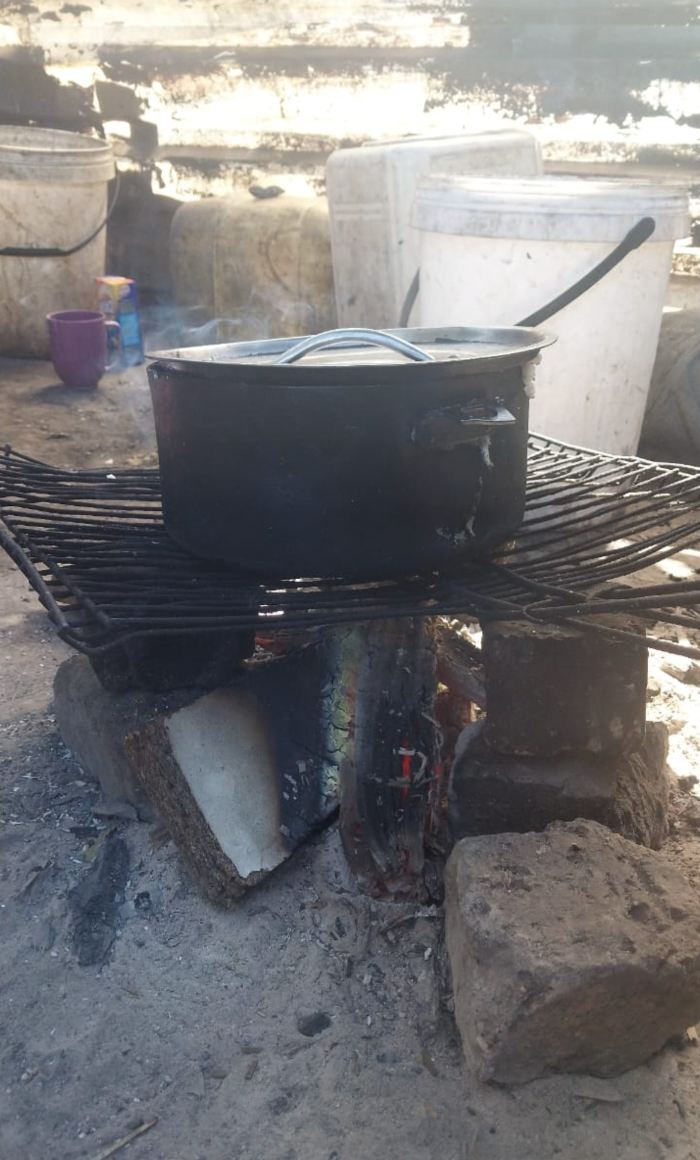
Households must rely on coal, firewood, paraffin and candles. That means an increased risk of fires, injury and death. PIC: Matthews Hlabane
When so-called load reduction is implemented for the poor, it is the children of the poor who cannot study consistently at night. Households must rely on coal, firewood, paraffin and candles. That means an increased risk of fires, injury and death. It is a deliberate decision to perpetuate and entrench energy poverty for one group of society.
When residents of Soshanguve said in 2024 that there is no difference between Eskom load shedding and City of Tshwane load reduction, no one listened. The best explanation the City Council could provide was weather conditions and increased demand. Therefore, the council decided to reduce energy consumption from 6 pm to 10 pm daily.
But this explanation collapses under scrutiny. The people affected were not chosen randomly. They were selected along class lines. Not the residents of Centurion, Faerie Glen, Montana or Waterkloof, but those of Soshanguve, Mamelodi and parts of Atteridgeville. This is not about the weather. It is not about demand. It is about who matters and who does not.
The same pattern can be seen in the protests that flared across Soweto, where more than six communities took to the streets to express their frustration over the City of Johannesburg’s implementation of load reduction. Communities such as Chiawelo Extension 2, Old Dobsonville and Meadowlands were subjected to these outages, not Sandton, Parkmore, Bryanston and Midrand, the very areas where residents have alternative options, from solar installations to backup batteries and generators. For them, any interruption is temporary and manageable.
If you go to eThekwini, Nelson Mandela Bay or Ekurhuleni, you will find similar patterns. The geography of load reduction follows the geography of poverty. It is a map of inequality reproduced through the electricity supply.
End privatisation of electricity
The President, in his State of the Nation Address, expressed concern about rising electricity costs and made a commitment to act. Yet the Minister of Finance remained silent on this matter in his budget speech. Instead, the continuation of Operation Vulindlela threatens to deepen the crisis by transforming municipalities into commercial trading entities for electricity, water and sanitation. This turns citizens into consumers. It is the highest expression of neoliberal policy, where access is determined by the ability to pay, in a failing economy.
Until we end the creeping privatisation of Eskom and consolidate generation, transmission and distribution under full state control for the purposes of energy security, sovereignty and development, load reduction will continue. It will only end in ministerial speeches, not in lived reality.
The continued decommissioning of Eskom power plants, without aggressive and balanced alternatives, further worsens the situation. South Africa requires a diversified energy mix that takes into account baseload requirements, while also investing in off-grid and embedded solutions that are accessible to the poor, not just the wealthy.
Without such a shift, South Africa will not resolve the energy security crisis. It will not overcome energy poverty. It will not re-industrialise. The outcome will be the deepening and entrenchment of inequality.
Load reduction is not a technical adjustment. It is a political statement about whose lives matter. And as long as it continues, it confirms a simple and painful truth: electricity for those with resources, and darkness for those without.
Sinawo Thambo is an EFF Member of Parliament and National Spokesperson