

Thirty years into democracy, fishers continue to struggle with the same issues they were grappling with under apartheid. They are fighting for their rights to livelihoods, culture, and equality. The recent Fisher People Tribunal in Cape Town heard testimony of shrinking fishing grounds, as industry, tourism, accelerated green extractivism, and misplaced environmentalism threaten traditional fishing communities.
The Fisher People Tribunal, convened by the Masifundise Development Trust and Coastal Links, brought together coastal and inland fishers, civil society organisations, and academic institutions. What emerged as an essential objective was to create a vision and strategies to build greater alliances and solidarity to advocate for social, economic, and environmental justice for local, small-scale fishers.
The Fisher People Tribunal also aimed to share and document the lived experiences of South African fishers. It shed further light on the complex way in which current ocean governance policies impact fishing communities. The Tribunal also provided a pivotal space to discuss the struggles that have emerged around these critical issues. It showed the fishers’ invaluable contributions to addressing systemic problems threatening their way of life, as well as their contributions to the local economy.
The tribunal process involved legal experts presenting charge sheets for six cases of human rights violations against fishers to a jury of six experts. Case reports detailing key challenges faced by the fishers and their testimonies and stories were then shared. The jury members were tasked with drafting a preliminary statement summarising their verdict and recommendations for moving forward.
Broken promises
The Tribunal began with a case about the “Broken Promises of the Small-scale Fishers Policy (SSFP)”. This policy was developed in 2012 in response to a 2007 Equality Court Order that ordered the government to address the injustices faced by traditional fishers. The promise of the SSFP was that it would provide legal recognition to small-scale fishers by allocating fishing rights and ensuring equitable access to marine living resources.
Fishers from the Northern Cape, Western Cape, Eastern Cape, and KwaZulu-Natal testified that, in fact, their traditional fishing practices and livelihoods remain threatened. They are exposed to the same conditions as under apartheid. Although the SSFP policy seemed like a positive step forward for fishers’ rights, they continue to struggle to gain access to food, pursue livelihoods of their choice, and engage in their cultural practices in their oceans and rivers. The SSFP policy was designed to address fishers’ struggles. Its implementation does not live up to this objective.
For instance, in the Western Cape, Andre Cloete from Papendorp, the Chairperson of Coastal Links Western Cape, drew attention to the many different challenges:
- The fishing basket, in the SSFP policy, grants access to a set variety and quantity of marine species. This can include the single-species approach, which restricts access to other important species.
- Weather conditions can result in lost income and food.
- Obtaining a permit from the department is a tedious process, delaying fishers’ opportunity to work and go out to sea.
- Similarly to the Northern Cape, oil and gas applications are getting approved. This is despite communities advocating against these developments that pose a threat to the ocean, which they depend on for their livelihoods.
- There is lack of aid from the government, which only supplies permits. There is no other funding support to assist the fishing cooperatives in business administration and support the value chain and local markets in communities.
- He further highlighted that access to fishing grounds is often difficult because they are often far away, and the high cost of transport is unaffordable to fishers.
This case demonstrated how fishers are no longer able to access marine resources and areas where they have traditionally fished. These areas have become restricted and inaccessible due to being located in a protected area of iSimangaliso Wetland Park. Permits issued under the SSFP policy limit the type of fishing gear that can be used and where these fishing grounds are. For example, in Kosi Bay, located within this park, fishers receive permits that prohibit them from using small boats and gillnets. This limits their ability to fish effectively.
In the Dwesa-Cwebe region in the Eastern Cape, legal restrictions prevent fishers from accessing the Mbhashe River. Located in this region is a Marine Protected Area (MPA). While Dwesa-Cwebe communities have for decades used the entire area as fishing grounds, the MPA now bars them from accessing their land and the marine resources in the MPA. This has forced them to travel long distances to find alternative fishing grounds.
Women, in particular, face additional challenges and discrimination, as their rights are often overlooked in the implementation of the SSFP policy. The case underscored the need for a more inclusive approach in the current policies. Fishers, including women, must be involved in decision-making processes, and their needs must be met, to ensure fishers’ rights to sustainable fishing environments that are accessible, and create viable livelihoods.
Conservation prejudices fishers’ livelihoods
The case of the Gariep Dam in the Free State drew attention to the difficulties inland fishers face due to private land ownership and nature reserves. There has been an increase in private farms and resorts along the Orange River, restricting public access to historical fishing grounds, and prioritising recreational fishers over the local fishers who depend on these waters for their livelihoods.
Testimonies from Venterstad and Norvalspont in the Northern Cape highlighted how historical fishing grounds have been converted into public conservation areas, restricting access and imposing fees. Fishers have been restricted to specific fishing times (between 6 AM and 6 PM). Before this arbitrary time regulation, fishing occurred at dawn and dusk. Due to these regulations in this area, fishers cannot catch enough, threatening the livelihoods and increasing dependent fishing communities’ vulnerabilities to hunger.
Another challenge is the environmental pollution within Venterstad, where a malfunctioning wastewater plant has culminated in untreated sewage contaminating fishing a\reas, posing serious health risks to fishers, the environment, and fishing populations.
This case illustrated fishers’ many challenges, with the impact of privatisation, exclusionary conservation and environmental degradation.
Fortress conservation
The Tribunal examined the case of ‘Violence of the conservation fortress’ in iSimangaliso Wetland Park, a protected area along the KwaZulu-Natal coast. ‘Fortress Conservation’ is a model that believes in protecting biodiversity and protected areas, regardless of the exclusionary affect this has on local communities, and regards those communities as representing the greatest danger. While the park is deemed to be ecologically significant, prioritising the protection of biodiversity cannot come at the expense of local fishers’ rights to a livelihood and their right to food. Conservation efforts must operate with the aim to balance these rights.
Inside protected areas, local fishers are often criminalised if found engaging in traditional fishing practices. For instance, if found fishing without a permit, they face arrest and harassment from park rangers, who sometimes resort to violent tactics. This infringes on their rights to safety, dignity, and livelihoods. In addition, access to other natural resources, such as wood and medicinal plants, has also become restricted. People gathering these resources now risk arrest if they are caught by the park rangers.
The case demonstrated the violence and harm that fishers experience due to harmful and inappropriate conservation efforts. It also displayed the absolute urgency of integrating customary rights that ensure fisher rights are protected, respected and included in conservation policies.
The threat of mining
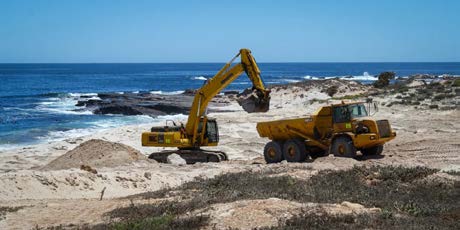
The ‘West Coast of extraction’ case exposed the extensive allocation of the West Coast to mostly private interests for sand and diamond mining, oil and gas, prospecting, exploration and drilling, and the development of green hydrogen production.
The ‘West Coast of extraction’ case exposed the extensive allocation of the West Coast to mostly private interests for sand and diamond mining, oil and gas, prospecting, exploration and drilling, and the development of green hydrogen production. In recent years, the South African government has embraced the concept of the ‘Blue Economy’ through Operation Phakisa. This emphasises the extraction of land and ocean resources to maximise their productive potential, in a bid to boost government revenues.
Testimonies from fishing communities in the Western and Northern Cape detailed how these industrial activities have restricted access to traditional fishing grounds.
In Port Nolloth in the Northern Cape, Alexkor, a state-owned diamond mining company, introduced cofferdam mining on the coast. Large temporary barriers, called cofferdams, are built to enclose and drain water from an area. This allows miners to work in the dry space that was previously underwater, to extract valuable minerals from the ground.
Cofferdam mining threatens marine habitats, particularly that of the West Coast Rock Lobster, as well as pushing small-scale fishers further out to sea. This case showed that small-scale fishing communities are not included in decision-making processes about what happens to communal ocean resources, despite there being a legal obligation to meaningfully engage affected communities under the National Environmental Management Act (NEMA).
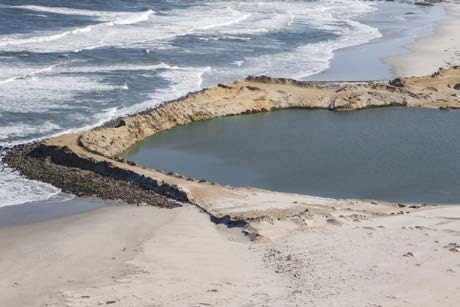
Cofferdam diamond mining on the Wesst Coast. Cofferdam mining threatens marine habitats, particularly that of the West Coast Rock Lobster, as well as pushing small-scale fishers further out to sea.
Walter Steenkamp, Chairperson of Coastal Links for the Northern Cape, described the destructive impacts of cofferdam mining and oil and gas exploration. He described the exclusion of fisher communities in the Northern Cape from the Ocean Economy Master Plan, designed to develop economic growth in South Africa’s ocean economy. Steenkamp pointed out that, while the Department of Mineral Resources and Energy (DMRE) has granted access through the Environmental Impact Assessment (EIA) process, fisher communities remain sidelined in critical decision-making. Fishers, he emphasised, have been denied access to mining areas along both the Western and Northern Cape coasts, due to the mining sector’s dominance. “We can’t afford oil and gas to come and kill our coastline; we must hold them accountable”, Steenkamp urges. He reminds us that all fishers are custodians of the ocean and play a role in protecting the ocean. It is so important that they are included in shaping policies that impact their livelihoods and the environment.
The case allowed a deeper insight into the impacts of extractivism on fishers and the ocean. It showed how the state prioritises profit-making, the plundering of communal natural resources, and corporate interests. Small-scale fishing communities must be included when strategies and policies are developed that will directly affect their access to food, livelihoods and way of life.
Women in small-scale fisheries
The Tribunal concluded with a discussion on ‘Women in small-scale fisheries in times of climate emergency.’ It profiled women’s vital contributions in KwaZulu-Natal coastal communities. Women are crucial to sustaining their families’ health, well-being and livelihoods, and play a significant role in the local economy and maintaining food security. However, the small-scale fishing sector in KZN is facing unprecedented challenges due to climate change, which has resulted in unpredictable weather patterns and increased flooding events. The floods in the coastal areas of KZN have had a devastating impact on coastal communities, particularly women.
The community in Umgababa has relied on mussel harvesting for generations. As a result of the floods, the ocean became polluted, leading to a noticeable decline in mussel populations. This disrupted harvesting practices, making it more difficult for women to collect mussels and sustain their livelihoods. This jeopardised the food security of their families and the broader community.
Zakhele Nkamisa, Coastal Links Eastern Cape Deputy Chairperson from Madakeni, Port St Johns, highlighted their difficulties with the Department of Forestry, Fisheries and the Environment (DFFE) and their actions toward fishers:
A concerning issue is the recent reduction in the harvesting of mussels; it was 50 mussels a day per person, and in 2020, this was cut to 30 mussels a day. Additionally, the conditions of the own-use permit, which limit fishing for crayfish only between 8 am and 4 pm, are restrictive and hinder our ability to make a living. Even more troubling is the department’s failure to implement customary rights and its disregard for both the SSF policy and the Gongqose judgment about customary rights. These failures are profoundly troubling and continue to impact our livelihoods negatively.
The testimonies highlighted the multiple challenges fisher women have experienced and, at the same time, showed that what is envisioned in policy is disconnected from reality. The case emphasised the urgent need for targeted policies and strategies that respond to the impacts of climate change, especially on the most vulnerable and least responsible. These must also address gender inequality and support communities in adapting and responding to climate disasters.
The Tribunal underscored the need to address these pressing challenges and advocate for more inclusive and equitable policies, practices and strategies that celebrate local knowledge and respect customary rights to fishing livelihoods. Moreover, the testimonies emphasised the importance of building alliances and strengthening the movement to advance the rights of fishers. This is essential to secure a more just and sustainable future for local fishing communities and the environment in South Africa.
Tyla Cloete is an ex-intern at the Alternative Information and Development Centre (AIDC).