On 6 June, in the face of the growing rhetoric of March and March, 123 people from 51 organisations met in Cape Town to discuss how to respond. This was the birth of what became the Western Cape Coalition Against Xenophobia (WCC-AX). Its origins lay in Chronicles of Refugees and Immigrants, an organisation set up to do advocacy, educational and support work around refugees and migrants.
Already in May, Chronicles had collaborated with the Johannesburg-based Kopanang Africa Against Xenophobia (KAAX) to produce a collective statement:
We refuse the lie that migrants are responsible for the failures of our system. Their [March and March] rhetoric and propaganda is meant to mislead South Africans from the real problems affecting us. The crises we face were created by capitalism, corruption, borders, exploitation, and political elites who profit from division and desperation. … We stand with migrants, refugees, undocumented people, and all those targeted by xenophobic politics. We stand for solidarity across borders and against every attempt to turn vulnerable people into enemies.
The days leading up to 30 June and the day itself presented us with shocking scenes and stories. We were part of a humanitarian response along with other groupings: Global South Against Xenophobia (GSAX), Inspire Network, Siyafana Sonke and the South African Council of Churches, Interfaith structures and the Muslim Judicial Council. Together we called for donations, and collected and distributed food, blankets, nappies and supplies at the Zimbabwe Consulate and at Home Affairs in Epping, as well as many places around the province.
What has the coalition done?
Media: WCC-AX regularly conducts media interviews and issues press statements, trying to interrupt the increasingly dominant narrative of support for xenophobic sentiments and actions. We have created and compiled popular education content shared on social media platforms. A member of the coalition, Africa Unite’s Mars Empowerment, ran the ‘Where must I go’ campaign on social media, inviting young people to submit poems or video clips. This targeted young South Africans born in South Africa with parents who were born in another African country.
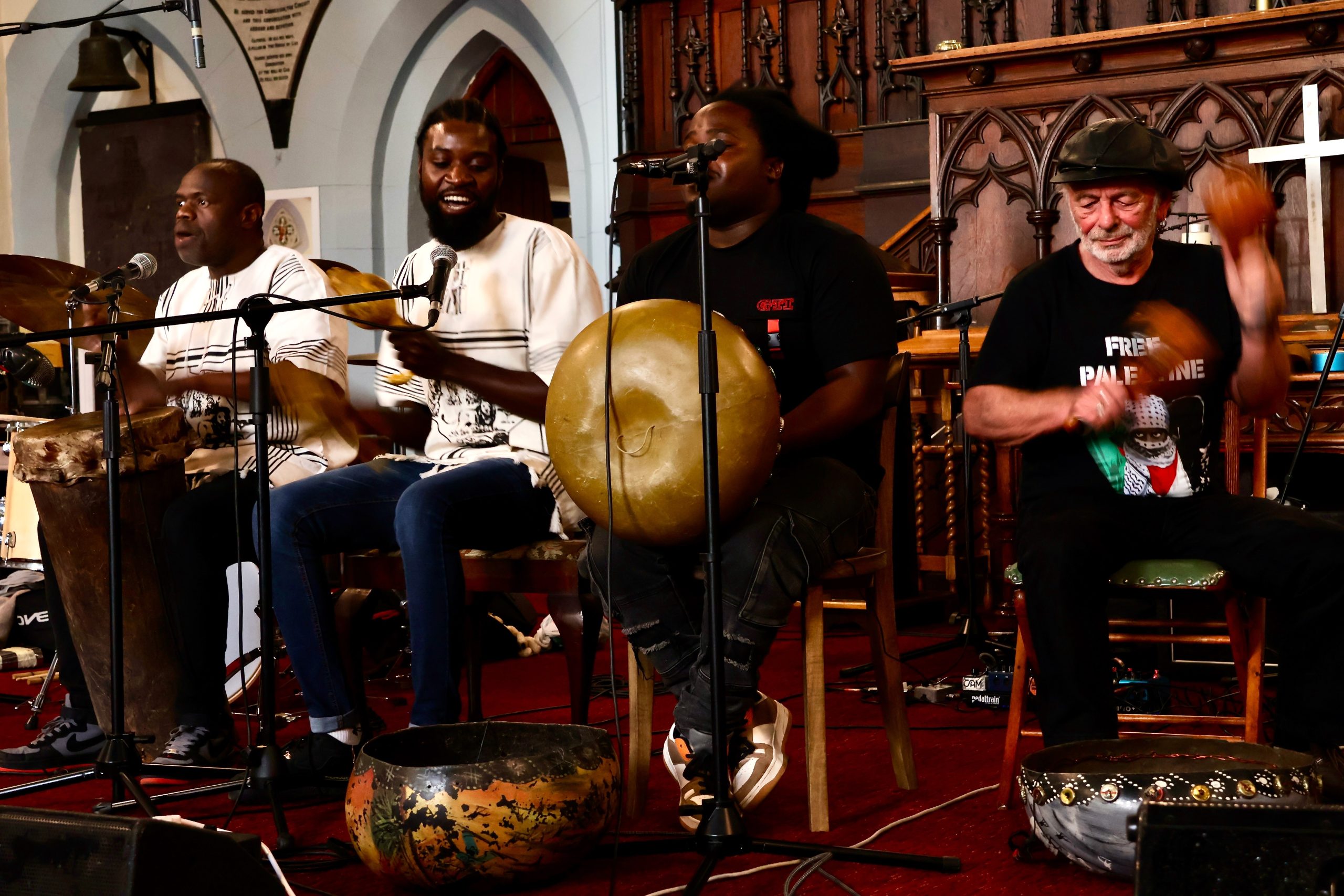
We felt the need for a positive pan-African event and organised an Africa Unite – Pan-African Cultural Festival. After the festival, we formed a human chain in Greenmarket Square. (Photos: Matthew Hirsch/GroundUp)
Community Engagement and Activations: We produced a flyer and worked on the ground in Bellville and Parow before the March and March march in that area, and we started monitoring their marches and engaging SAPS. We felt the need for a positive pan-African event and organised an Africa Unite – Pan African Cultural Festival. After the festival, we formed a human chain in Greenmarket Square, and member organisations organised other human chains in communities, and an African Solidarity Walk and Refugees Day Silent Walk.
Member organisations have conducted training on migration. They have also provided support for migrant and refugee communities, for example, creating a food garden at Wingfield Refugee Camp together with the residents there.
In one or two areas, it was possible to convene community-wide meetings with migrants, refugees, locals, SAPS and community organisations in preparation for 30 June, where it was agreed that everyone would work toward maintaining peace in the community and refuse to tolerate March and March attacks. If any attacks occurred, SAPS would offer shelter and step in.
Legal support response: SAPS started to arrest people through raids on shops, or when people went to the police station for an affidavit or to report a car accident. We set up a legal support group for people in the Western Cape who are arrested/detained due to documentation. Various public interest law NGOs are participating. The group has also called for SAHRC to conduct a monitoring visit to Pollsmoor Prison due to reports of many migrants being held there and worrying reports of how they were being treated. And when a Zimbabwean man’s death was reported in Pollsmoor Prison, we called on the Judicial Inspectorate for Correctional Services to investigate his death.
Psychosocial support: We do our best to create a safe space in our WhatsApp community by screening participants carefully. Refugee leaders provide ongoing support to their communities via regular meetings and online WhatsApp support groups.
Access to services: We have taken proactive measures to prevent abusive treatment that asylum seekers, refugees and migrants receive in health care facilities. We met with both the provincial Department of Health and Nehawu. We expressed our solidarity with South Africans who also experience serious problems in accessing quality healthcare in an environment of public sector budget cuts and rampant corruption. Then we raised the particular issues experienced by asylum seekers, refugees and migrants:
- People being denied treatment
- People being wrongly charged as private patients
- People being bullied and humiliated because they are not South Africans
- People avoiding healthcare facilities from fear, risking their own health and the health of
others.
The Department of Health agreed to work with us on a public information campaign on the rights of migrants to access health care. And Nehawu agreed to discuss circulating our publicity material on migrant’s rights to healthcare and other government services.

Nkqubela Township in Robertson. Up to 200 migrants were locked up for more than two months unlawfully and without due process, before many of them were shipped off to Lindela. (Photo: David Harrison/GroundUp)
The police: we are also working on building a dossier on problems that migrants have experienced with the police. Firstly, we have records of instances in which the police have acted aggressively against migrants. At times they have simply refused to believe the authenticity of valid documents. At other times, they have gone door to door, arresting migrants, irrespective of their documentation, and incarcerating them for extended periods. The worst case has been in Robertson, where up to 200 migrants were locked up for more than two months unlawfully and without due process, before many of them were shipped off to Lindela. Secondly, the police have blatantly stood by and watched as documented migrants have been abused and attacked by March and March people and prevented from carrying out their business. The worst example that we have experienced has been in Bellville, where stallholders have been shut down completely illegally, while the police have stood and watched.
Some thoughts on a way forward
Xenophobia is not impossible to overcome, but it is a long and hard road. Through education, community engagement, stronger laws, and promoting respect for diversity, we believe that we can build societies where people are treated with dignity, regardless of where they come from.
Community engagement and activations must be ongoing to educate everyone, so that we start to reduce fears, create a welcoming presence in communities and foster social cohesion. These messages should challenge the idea that refugees and migrants are responsible for unemployment, crime, pressure on public services, or other social problems. They should emphasise that migrants are not the enemy and that many of the challenges communities face have deeper economic and social causes and are shared by all who live in South Africa, no matter where they come from. We need to find effective ways to challenge stereotypes.
It is also necessary to engage with state departments to inform them of institutional xenophobia and demand that actions are taken to address the problems that arise. Another important intervention is training government officials on immigration documents and identification. Officials in the South African Police Service (SAPS), hospitals and clinics, Home Affairs, schools and other government offices need to understand the different forms of identification and documentation held by South African citizens, refugees, asylum seekers and other migrants. An official who does not understand someone’s documentation may wrongly assume that the person is undocumented or has no rights.
This can reduce institutional xenophobia, where people experience discrimination not only from individuals but also when trying to access government services. This flows into the issue of matric examinations, where a lack of documentation may prevent migrant children from accessing or completing education. A child should not lose an educational opportunity simply because their parents struggle to obtain documents.
The state must also be held to account. As civil society organisations, we need to demand that Chapter 9 institutions engage and support our calls for action on the part of the state departments.
The state and civil society should work together
Civil society organisations have been at the forefront of the fight against xenophobia by raising awareness, challenging harmful stereotypes, mobilising communities, protecting rights, and supporting those affected. Through media campaigns, community dialogues, legal assistance, and psychosocial support, civil society has shown that solidarity can be a powerful response to fear and discrimination.
But the responsibility cannot rest on civil society alone. Government and various state departments, law enforcement, communities and civil society must work together to address the root causes of xenophobia and ensure that everyone is treated with dignity and can live without fear, regardless of nationality or where they come from. We have to put pressure on the state to stop blaming migrants for its own failures. Ultimately, we as WCC-AX will continue to fight against xenophobia. We invite you to join us in building a society where no one is excluded, targeted, or denied their rights simply because they are different.
Lorna Houston and Lasconie Matembe are members of WCC-AX
*Featured Image by David Harrison/GroundUp